Boston, MA — 2026-05-25
PitchBud.io Replaces Wire Distribution With AI-Personalized Journalist Outreach
Startup launches after founder spent $1,600 on 25 wire releases and received zero serious press inquiries.
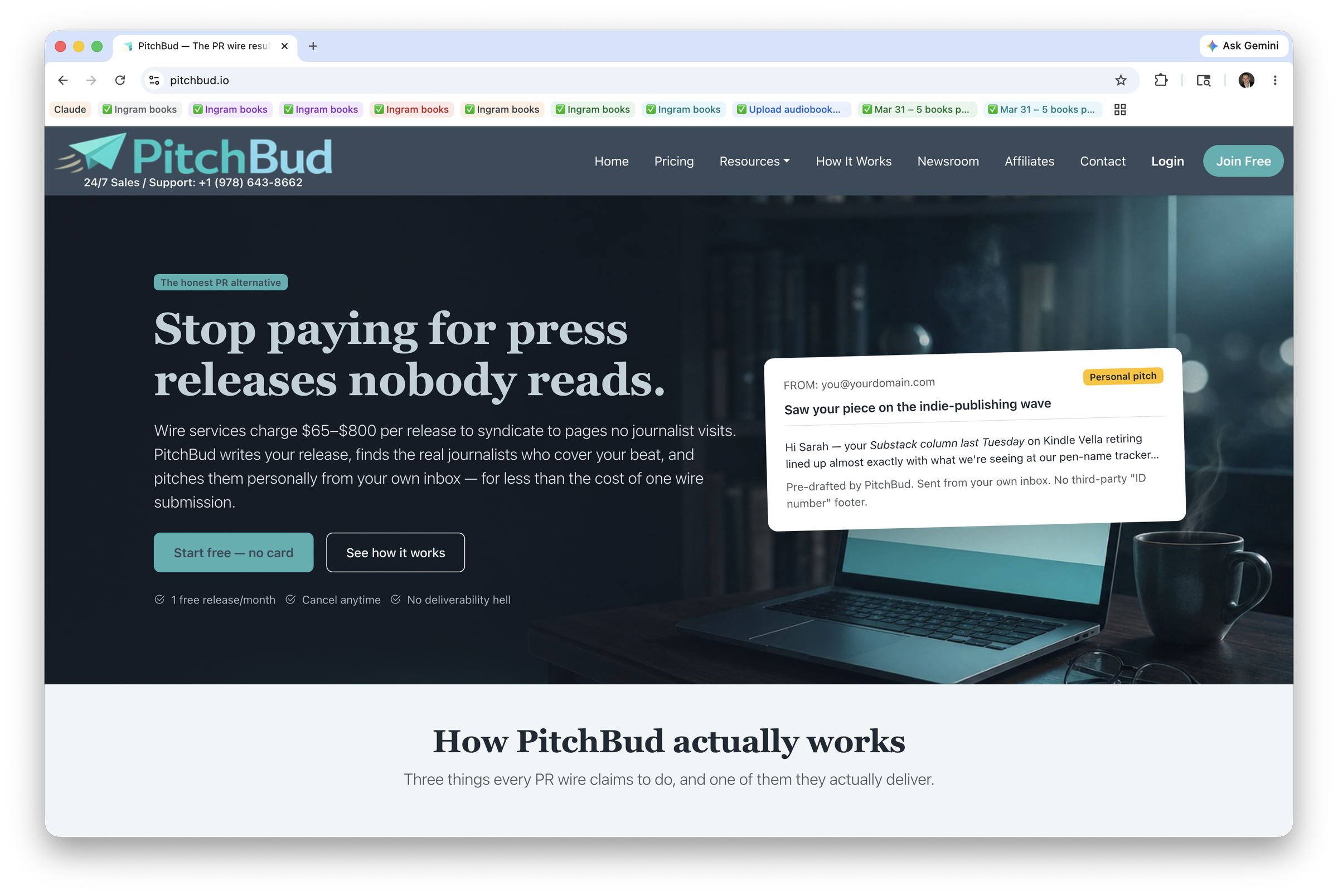
PitchBud.io, a new AI-powered press relations platform at https://www.pitchbud.io, launched in 2026 with a direct challenge to the wire distribution model that has dominated press release publishing for decades. The service writes a press release from a single-line angle, identifies between 25 and 500 journalists whose recent bylines match the story, drafts a personalized pitch referencing each journalist's actual published work, and sends it from the user's own email inbox — bypassing the shared-IP deliverability problems that undermine most bulk PR tools. Free syndication to search indexing endpoints is included on every plan, including the no-cost tier.
The platform was built out of a specific, documented frustration. Founder Bo spent approximately $1,600 on "traditional" releases over two months in early 2026. The result: zero serious press inquiries and an inbox full of sales spam. That experience became the product thesis. Wire services distribute releases to aggregator pages that working journalists rarely visit. PitchBud routes the story directly to reporters who have already demonstrated they cover the relevant beat — and it shows its work by referencing their actual bylines in each pitch.
The core workflow begins when a user submits a one-line news angle. PitchBud's AI drafting layer, built on Claude Sonnet 4.6 via OpenRouter, generates a structured press release. The journalist scanner then identifies relevant reporters and reads their recent published work. Each outgoing pitch is written to reference that work specifically — not a generic salutation with a name field dropped in. Pitches are dispatched via MAILTO, meaning they leave from the user's own inbox and carry that inbox's sender reputation rather than a shared platform IP. This distinction matters: shared-IP deliverability degradation is a known failure mode for bulk PR email tools, and PitchBud's architecture sidesteps it by design.
Syndication runs automatically on every plan through a suite of indexing endpoints: IndexNow (covering Bing, Yandex, and DuckDuckGo), the Google Indexing API, the Internet Archive Wayback Machine, a WebSub hub, and Google News Publisher Center. The company estimates this free syndication layer captures roughly 60 percent of the SEO benefit that wire services charge for, at no cost to users on any tier. Paid plans add journalist outreach volume, HARO and source-request digest matching via a private auto-ingest forwarding address, and cross-release contact history so agencies can track which journalists have been approached across multiple campaigns.
What separates PitchBud from both wire services and generic AI writing tools is the combination of journalist-specific research and inbox-native delivery. Wire syndication places content on aggregator pages; it does not put a story in front of a reporter who covers that beat. Generic AI tools draft copy but leave distribution entirely to the user. PitchBud closes both gaps in a single workflow. The HARO/Qwoted/Featured/SourceBottle digest matching, available on Starter and above, adds a reactive layer: when a journalist posts a source request that matches a user's beat, PitchBud flags it and can assist with a response — turning the platform into a two-direction media relations tool rather than a one-way broadcast system.
"The wire model sells the illusion of reach — potential audience numbers that no journalist ever validates. We built PitchBud to put a real story in front of a real reporter who has already written about that topic," said Bo, Owner and Founder of PitchBud.io.
The platform serves several distinct user types. Startups and early-stage founders who cannot justify $500-plus wire fees for each announcement gain access to personalized journalist outreach starting at $29 per month. Independent creators and newsletter operators who need media coverage to grow an audience but lack a PR agency relationship can use the free tier to index their announcements and upgrade when they need direct journalist contact. Small business owners who have previously relied on wire releases without measurable return have a lower-cost alternative with tracking built in. PR agencies managing multiple clients are the target for the Studio tier, which supports unlimited releases and up to 500 journalist pitches per scan, with maximum journalist-cache depth for sustained campaign management.
PitchBud is available now at https://www.pitchbud.io. The Free plan includes one release per month and full automatic syndication with no journalist outreach. Starter is $29 per month and covers four releases with 25 personalized journalist pitches each, plus HARO digest matching. Pro is $79 per month for ten releases with 100 pitches per release, all six source-request venue types, and cross-release contact history. Studio is $199 per month for unlimited releases with 500-journalist scans and maximum cache depth, designed for agencies running concurrent client campaigns. Annual billing is available at ten times the monthly rate, equivalent to two months free across all paid tiers.
Pickup tracking — the ability to confirm whether a release generated actual coverage rather than reporting vanity reach metrics — is on the product roadmap as a near-term addition. The planned implementation uses Google News headline search combined with IMAP reply detection to identify when a journalist responds or when a story appears in Google News. This would give users a factual measure of campaign performance: named outlets, confirmed replies, indexed coverage. Additional phases in development include an expanded journalist scanner and automated HARO ingestion via a dedicated mailbox parser. The roadmap reflects a consistent design principle: replace PR industry metrics that sound impressive but measure nothing with signals that indicate actual editorial interest.
PitchBud.io (https://www.pitchbud.io) is an AI-powered press relations platform that replaces wire distribution with direct, personalized journalist outreach. The service drafts press releases from a single-line angle, identifies journalists by beat, reads their recent bylines, and sends individually tailored pitches from the user's own inbox. Automatic syndication to Bing, Google, the Internet Archive, and Google News is included on every plan. PitchBud was founded in 2026 after its founder documented a complete absence of return on $1,600 in wire distribution spending, and is built as the explicit alternative to the aggregator-page syndication model that has defined press release distribution for the past two decades.
Related: Archieboy Launches Review Copy Club to Fix Compliance Gaps in ARC Campaigns
