Boston, MA — 2026-06-05
TrafficBud.io Launches AI SEO Toolkit That Hands Off Fixes to Agents
Eleven-tool platform emails monthly action plans formatted for AI agents, built across a 40-plus-site portfolio.
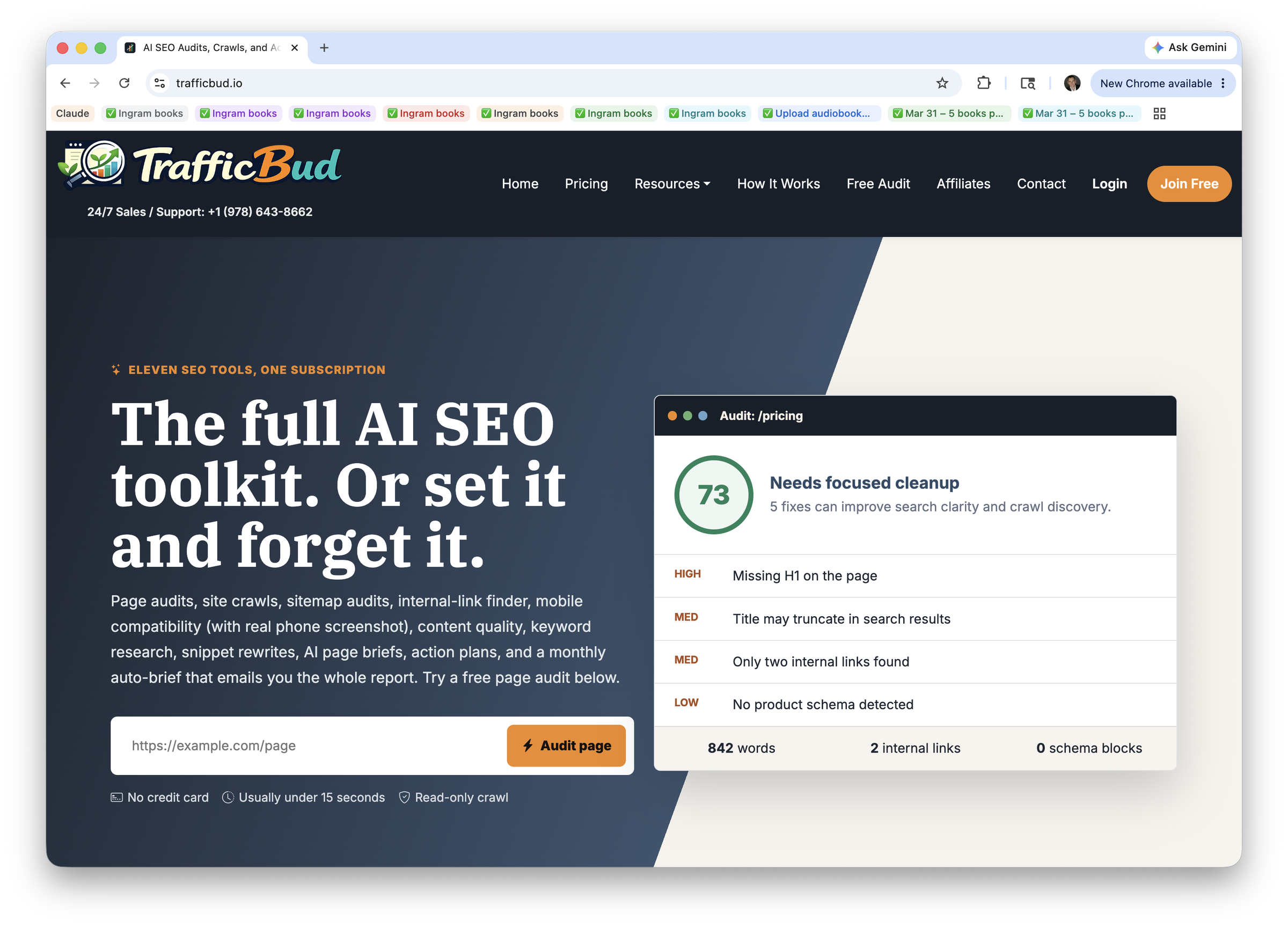
TrafficBud.io, available at https://www.trafficbud.io, has released a full AI-assisted SEO platform that moves beyond audit reporting to deliver ranked, actionable fix lists formatted specifically for AI agents and webmasters. The platform bundles eleven discrete SEO tools — covering page audits, site crawls, sitemap validation, internal link discovery, keyword research, snippet rewrites, mobile compatibility checks, content quality analysis, AI page briefs, action plans, and a monthly auto-brief — into a single subscription workspace. The core differentiator is an automated monthly cycle that runs the entire playbook without requiring a user login, then emails a finished action plan with both a PDF attachment for human webmasters and a plain-text file structured for direct input into an AI agent.
The platform was built by Bo Bennett, PhD, owner of Archieboy Holdings, after he confronted recurring organic traffic problems across a personal portfolio of more than 40 websites. Bennett's stated practice is to prove tools on his own properties before opening them to the public, a process that shaped TrafficBud's design around the realities of ongoing, multi-site SEO maintenance rather than one-time technical audits. The tool draws on Google's public SEO documentation as the foundation for its recommendations, while acknowledging that search ranking algorithms remain opaque. That grounding in documented best practices gives the action plans a defensible, repeatable basis rather than relying on proprietary scoring black boxes.
TrafficBud operates in two modes. In Driver mode, users click through a step-by-step wizard and apply each tool individually, maintaining direct control over which recommendations to act on. In Autopilot mode, users connect Google Search Console via one-click OAuth, enable the monthly auto-brief, and receive a complete SEO action plan by email each month without logging back in. The emailed report includes a PDF formatted for a human webmaster and a separate text file structured so an AI agent can parse it and execute changes without manual interpretation. Bennett has described the AI-agent handoff as the most important use case for 2026 and beyond, noting that the text file tells the agent exactly what to do rather than requiring the owner to translate diagnostic output into instructions.
The eleven tools each address a distinct step in the SEO workflow. The page audit checks titles, meta descriptions, headings, schema markup, and indexability, with batch processing available on paid plans. The site crawler identifies sitewide patterns and supports scheduled weekly recrawls so regressions surface automatically. The sitemap audit validates sitemap.xml against robots.txt and HTTP-checks every listed URL, catching 404s, redirects, and noindex conflicts. The internal link finder scans body text for pages that mention another page's topic without linking to it — a gap Bennett describes as the single highest-leverage SEO move available. Keyword research pulls live data from Google Keyword Planner seeded by actual Search Console queries. AI page briefs generate a complete content brief — H1, outline, internal links, schema recommendations, and target keywords — for a chosen keyword cluster. Snippet rewrites produce three AI-written title and meta-description options informed by real Google Search Console impression and ranking data.
The platform's approach to mobile compatibility illustrates the depth of its tooling. Rather than relying solely on HTML parsing for known viewport issues, TrafficBud renders a real phone screenshot at 375 pixels wide, giving site owners a visual confirmation of what mobile users actually see. The content quality tool runs a three-pass check: a deterministic spell-check for typos, a grammar pass, and a style pass, with the latter two handled by a local AI model. Each suggestion is displayed side-by-side with the original text. The combined action plan aggregates every check into a single ranked to-do list downloadable as a PDF or as an AI-agent prompt file, giving site owners a single artifact they can hand directly to whoever — or whatever — is responsible for implementation.
Competing SEO platforms typically separate technical auditing, content tools, and reporting into distinct products or require significant manual work to translate findings into implementable tasks. TrafficBud's architecture consolidates those layers and adds the AI-agent output format, a capability not standard in general-purpose SEO suites. The monthly auto-brief model also shifts the product from a reactive diagnostic tool to a scheduled maintenance system, reflecting Bennett's view that SEO is a recurring process with no permanent fixed state. The platform's own pricing page scored a 73 in a live demo — flagging a missing H1, a potentially truncating title tag, and only two internal links — a result Bennett left visible rather than suppressing.
"It just doesn't tell you, yeah, you have a problem. It tells you how to fix it — and that's the most important thing," said Bo Bennett, PhD, Founder, TrafficBud.io.
TrafficBud serves three distinct user profiles. Solo site owners with limited technical resources can use Autopilot mode to receive a monthly brief and hand the PDF to a freelance webmaster or paste the prompt file into an AI assistant. In-house webmasters at companies managing multiple web properties can use the Growth tier to track up to ten sites, schedule weekly crawls, and receive weekly auto-briefs rather than monthly ones. Autonomous AI agents represent the third profile — one Bennett identifies as increasingly central — where the structured text output allows an agent to receive, interpret, and execute SEO changes without a human intermediary. Authors and content publishers running their own websites outside a managed hosting environment are also a named use case, as the tool operates on any publicly accessible domain.
TrafficBud is available now at https://www.trafficbud.io under three pricing tiers. The Free plan costs nothing, requires no credit card, and includes three page audits per month, one tracked site, a site crawler limited to 25 pages, a sitemap audit, internal link finder, HTML-based mobile compatibility check, spell-check, three AI page briefs, and action plan downloads. The Starter plan is $29 per month or $290 per year — equivalent to roughly $24.17 per month — and adds 100 page audits, the monthly auto-brief email, real phone screenshot rendering, AI grammar and style suggestions, Search Console OAuth, keyword research, snippet rewrites, and 30 AI page briefs. The Growth plan is $79 per month or $790 per year, approximately $65.83 per month, and extends coverage to 500 page audits, up to ten tracked sites, a weekly auto-brief option, and 80 AI page briefs. Annual billing provides two months free across paid tiers.
TrafficBud's release fits into a broader strategy at Archieboy Holdings of building business-side infrastructure tools validated on Bennett's own web portfolio before public release. The platform joins other tools in the Archieboy stack, including Scroops.com and BookBud, each targeting a specific operational problem for website owners and publishers. The roadmap implied by the current feature set points toward deeper AI-agent integration as autonomous site management becomes more common, with the structured prompt file serving as the connective layer between SEO diagnostics and automated execution. Bennett has indicated that the agent-ready output format will remain a primary development focus as the market for AI-assisted site operations matures through 2026.
TrafficBud.io (https://www.trafficbud.io) is an AI-assisted SEO platform developed by Bo Bennett, PhD, under Archieboy Holdings. The platform provides eleven integrated SEO tools — from page audits and site crawls to AI page briefs and snippet rewrites — in a single subscription workspace. Its monthly auto-brief delivers a complete, ranked SEO action plan by email each month, with attachments formatted for both human webmasters and AI agents. Bennett built the tool after managing chronic traffic challenges across a personal portfolio of more than 40 websites, applying a policy of internal validation before public release. Archieboy Holdings operates a range of web-based products spanning publishing, content, and business infrastructure tools.
