Marlborough, MA — 2026-09-28
Talking Manual Puts a QR Code on Every Rental Machine So Renters Can Ask the Operator's Manual Directly
Setup runs $499 per branch location with unlimited machines; a public demo answers from Genie's operator's manual for the GS-1930.
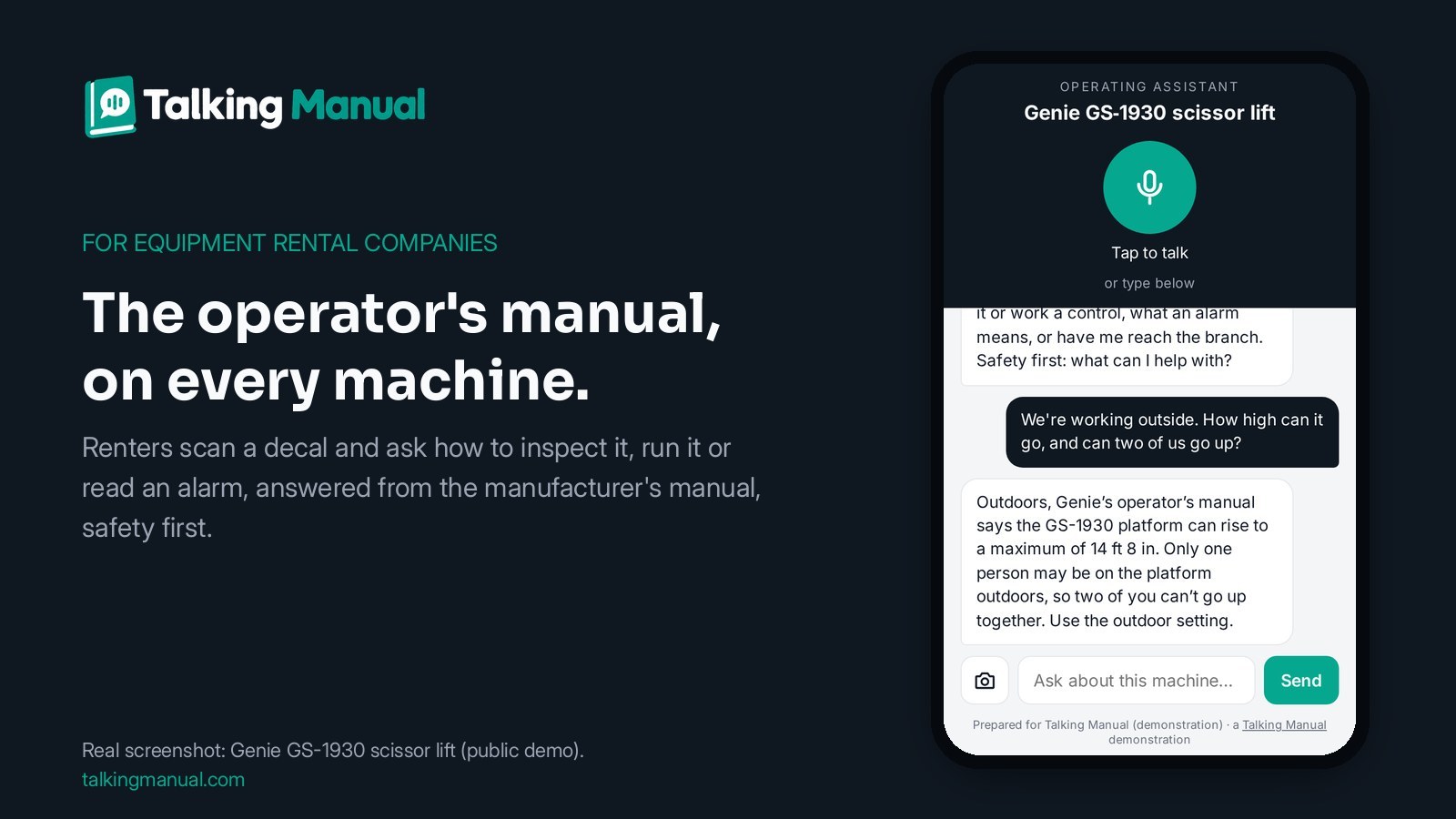
Talking Manual, at https://www.talkingmanual.com/equipment-rental, has launched a version of its scan-and-ask assistant built for equipment rental companies, putting a QR decal on every machine in a fleet. Whoever rents the machine scans the decal and asks, by voice, text or photo, how to inspect it, start it, work a control or read an alarm. The assistant answers from the manufacturer's own operator's manual for that exact model and the rental company's own terms, with the manual's safety limits always taking precedence. Breakdowns, extension requests and swap requests reach the branch inbox already carrying the asset number, the fault, and the machine's location. The product is aimed at branch counters and jobsites where renters change every few days and the printed manual in the machine's box goes unread.
Rental fleets routinely include machines that a given renter has never operated before, and the person explaining the equipment at pickup is rarely available once the renter is on a jobsite with a question about an alarm or a height limit. Historically, renters have called the branch, guessed, or attempted something the manual explicitly prohibits. Aerial work platforms and similar equipment carry federal training requirements — OSHA 29 CFR 1910.67 requires that only trained persons operate aerial lifts, and ANSI A92.24 governs training and familiarization for mobile elevating work platforms. Talking Manual does not replace that training. It is built to answer the everyday questions that fall between the counter conversation and a call to the branch, and to route anything that requires a person to the branch with enough detail to act on immediately.
Setup works at the fleet level. A rental company adds each machine by make, model and fleet asset number. If the operator's manual for that model is already in Talking Manual's library it loads automatically; otherwise the company uploads it once per model, along with the company's own rental terms entered once for the whole fleet. The system then generates a decal for each machine, or prints an entire fleet four to a page for branches that want to laminate and post them at the controls. Renters need no app and no account — they scan the decal with a phone camera and start talking, texting or sending a photo, in their own language.
The assistant is scoped narrowly by design. It tells renters the manual's actual capacity, occupant, height, slope, wind and power-line clearance limits, and gives the version that applies to their stated condition when a limit differs indoors versus outdoors. It refuses to help bypass an interlock, alarm or sensor under any framing of the question. Anyone who indicates they have never operated that class of machine is told plainly not to until trained and familiarized, with an offer to route a familiarization request to the branch. It reminds renters to call 811 before digging and never to run an engine indoors, and tells anyone hurt or trapped to call 911 first. It never promises an extension, a swap, or a waived fuel, cleaning or damage charge — those decisions stay with the branch, and the request simply arrives with the asset number, the reported fault, the machine's location, and a confirmed phone number attached.
Talking Manual is not the first assistant built on manufacturer documentation, and the company is not positioning it as a substitute for operator training or certification. What distinguishes this version is the fleet mechanics: manuals are loaded once per model rather than per machine, decals print in bulk for an entire yard, and questions route to a specific branch with an asset number rather than to a generic support line. Spec tables are also a known failure point for automated document extraction, so for the demonstration model, capacity, occupant, height, wind and slope figures were checked by hand against the manual's own pages.
"A renter standing at a scissor lift with a blinking alarm doesn't want a chatbot's best guess — they want what the manual says, and if it says stop, we say stop," said Robert "Bo" Bennett, PhD, founder of Talking Manual.
The immediate audience is rental branch staff and the renters who show up at the counter. Counter staff spend a limited amount of time explaining a machine at pickup, and techs are pulled off other work by calls asking what an alarm means or how high a lift goes outdoors. A renter on a jobsite can instead ask the machine directly: a pre-start inspection walkthrough, the indoor versus outdoor height limit, how many people are permitted on the platform, or what a specific alarm code indicates, including by sending a photo of the control panel. When something is actually broken, the branch receives the asset number, the fault or alarm code, the machine's location, and a confirmed callback number instead of a vague phone message about "the lift on the Smith job." Rental companies also get visibility into the questions renters are asking about each machine, which surfaces confusing controls or recurring alarm issues across the fleet.
Setup costs $499 per branch location, covering unlimited machines at that location, with usage-based plans starting at $49 a month. Rental companies can try the product free for 14 days on a single machine at https://www.talkingmanual.com/start before committing to a broader rollout. A live public demonstration is available at https://www.talkingmanual.com/demo/equipment, built on a Genie GS-1930 electric scissor lift answering from Genie's publicly available operator's manual (document 1296776GT, October 2024). The demo model's key limits — 500-pound capacity, two occupants indoors and one outdoors, 19 feet 3 inches of platform height indoors versus 14 feet 8 inches outdoors, and a 28 mph maximum outdoor wind rating — were transcribed and checked against the manual's own pages. Talking Manual is not affiliated with Genie or Terex; the demo uses Genie's public documentation.
Equipment rental joins car, RV and boat dealerships, board and card game publishers, gyms, vacation rentals, real estate listings and new-home builders as markets Talking Manual serves, all built on the same underlying approach: a scanned code connects a product to its own official documentation, answered in plain language, with anything requiring a human routed to the business that already knows the product.
Talking Manual (https://www.talkingmanual.com) is a product of Archieboy Holdings, LLC, based in Marlborough, Massachusetts, founded by Robert "Bo" Bennett, PhD, and launched in September 2026. It gives products their own scan-and-ask voice assistant, answering owners' and renters' questions from a manufacturer's official documentation and a business's own rules, and routing anything requiring a person to that business already explained. Beyond equipment rental, Talking Manual serves car, RV and boat dealerships, game publishers, gyms, vacation rentals, real estate listings and new-home builders. Press inquiries and interview requests: hello@talkingmanual.com.
