Marlborough, MA — 2026-09-28
Talking Manual Launches a QR Sticker Assistant So Homeowners Can Ask Their Furnace, Heat Pump or Water Heater Directly
Setup is $299 per contractor location for unlimited systems; a free 14-day trial is at talkingmanual.com/start and a live demo at talkingmanual.com/demo/hvac.
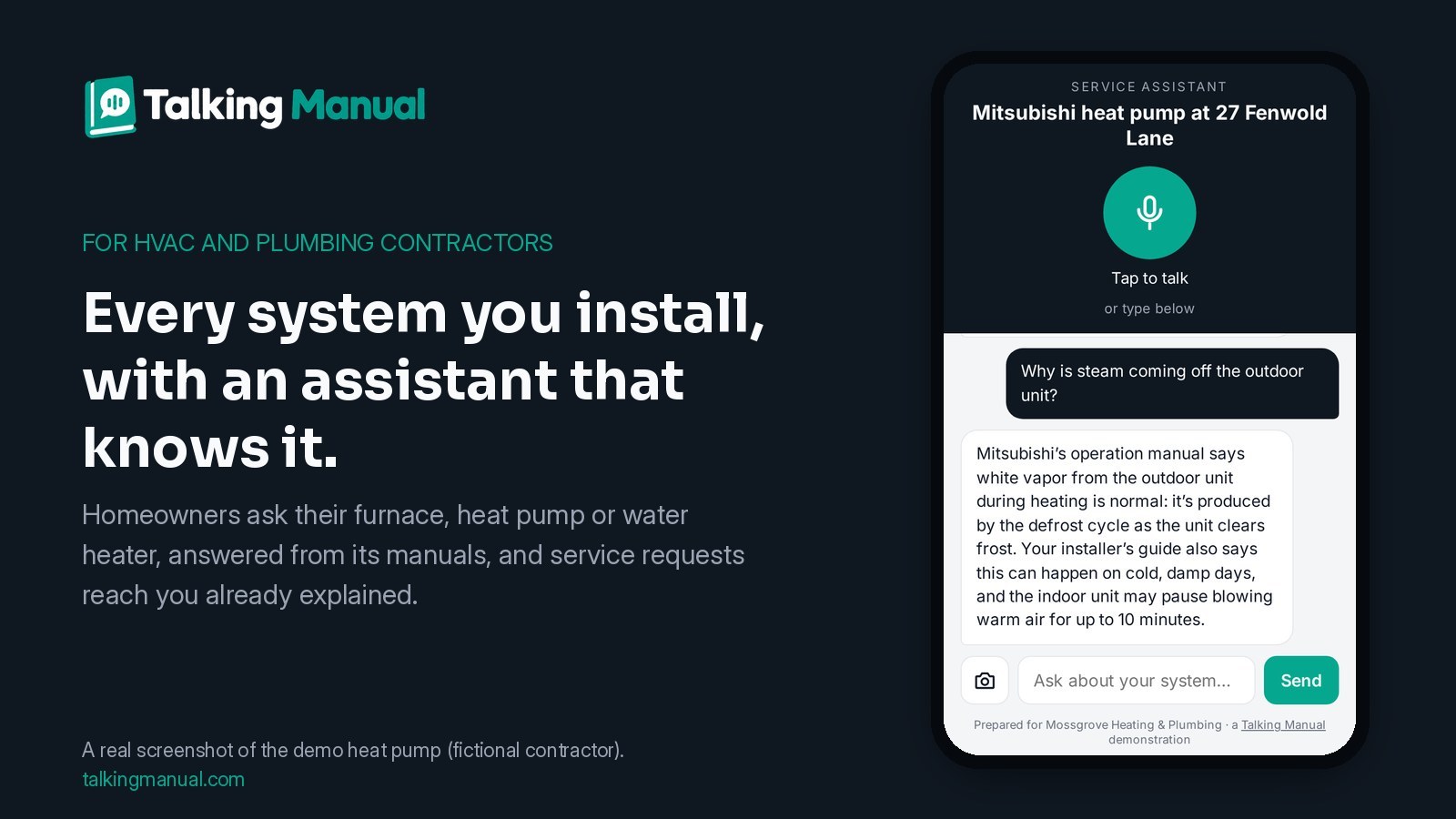
Talking Manual (https://www.talkingmanual.com), a product of Archieboy Holdings, LLC, has launched a version of its scan-and-ask assistant for residential HVAC and plumbing contractors at https://www.talkingmanual.com/hvac-contractors. Contractors put a printed QR sticker on each furnace, heat pump, boiler and water heater they install. A homeowner scans it with no app or account and asks by voice, text or photo how to run the system, clean the filters or interpret a blinking light or fault code. The assistant answers from the manufacturer's manual for that exact model and from the installer's own handoff video, treats gas smells and carbon monoxide alarms as leave-the-house emergencies first, and routes anything that needs a technician to the contractor's inbox already carrying the model, serial number, address, symptom and whether the home has heat.
The problem it targets is familiar to any HVAC or plumbing office: the first cold night of the season, or the first heat wave, brings a wave of calls that have nothing to do with a broken system. Steam off an outdoor unit during defrost, a mode dial nobody understands, a blinking light that means something specific to that model, a filter nobody was shown how to remove. Some of those calls tie up a dispatcher; others go unmade until a homeowner waits too long on something that actually needed attention. The answer to most of them already exists in a manual in a kitchen drawer or a PDF nobody opens. Talking Manual is built to sit between that manual and the homeowner's phone, for contractors who install equipment from any manufacturer and don't want to build or maintain an app to do it.
Setup starts when a contractor adds a system by make, model and serial number along with the homeowner's details. For models already in Talking Manual's library, the manufacturer's owner's manual loads automatically; for others, the contractor uploads it once per model, and the company's labor warranty and maintenance plan terms are uploaded once for every system. A technician can then film a one- or two-minute handoff video on a phone showing where the filter, disconnect and shut-offs are and what normal operation looks like; Talking Manual turns that into a draft guide, which the contractor checks and publishes. The sticker prints one system at a time or six to a sheet, goes on the equipment next to the service sticker, and the code can be added to the invoice or handoff email.
Once scanned, the assistant answers in the homeowner's own language and says which document it's drawing from. It will walk someone through the safe checks a manual actually permits — checking mode settings, batteries, a dirty filter, clearing snow from an outdoor unit, resetting a single breaker — and stops there. It will not help a homeowner bypass or repeatedly reset a safety switch, touch refrigerant, adjust gas, open a live electrical panel, or cap a water heater's relief valve. A reported gas smell gets an instruction to leave the home and call the gas company or 911 from outside; a carbon monoxide alarm gets everyone out and 911, with no troubleshooting attempted. When a request does need a person, the contractor receives an email with the model, serial number, address, symptom or error code, whether the home currently has heat or hot water, and access and contact details — arrival times, pricing and warranty coverage are never promised by the assistant itself.
Talking Manual is not the first product to put a QR code on HVAC equipment; some field-service platforms already offer them, and manufacturers maintain their own apps. What the company says is distinct about its version is that the assistant answers from that specific model's manual combined with the installer's own handoff video — a pairing the company has not seen advertised elsewhere — and that it works with equipment from any brand without requiring the unit to be connected to the internet or the homeowner to install an app. The service is also designed to sit alongside existing dispatch and field-service software rather than replace it: a service request arrives as a formatted email a contractor can forward or copy into whatever system already runs their business.
"A homeowner doesn't need a chatbot that knows heat pumps in general at eleven at night — they need to know what the blinking light on their specific unit means, and we need our dispatcher to get a request they can act on instead of 'the heater thing isn't working,'" said Robert "Bo" Bennett, PhD, founder of Talking Manual.
The intended users are homeowners who would otherwise call an office after hours, or not call at all until a minor issue becomes an emergency. A homeowner noticing steam off an outdoor unit during a cold snap can ask what that means for their model before assuming something is broken; someone staring at a service light with no manual in the house can photograph it and get an answer tied to that unit's documented meaning; a renter or new homeowner unfamiliar with a system can ask how to switch between heat and cooling modes or where the filter is, drawing on the technician's own recorded walkthrough rather than a generic tutorial. For the contractor, the intended benefit is fewer low-value calls tying up staff and better-prepared service calls: a technician can arrive already knowing the model, serial number and symptom.
A public demonstration is live at https://www.talkingmanual.com/demo/hvac, built around a Mitsubishi Electric M-Series MSZ-GL12NA/MUZ-GL12NA ductless heat pump installed at a fictional address, 27 Fenwold Lane in Natick, Massachusetts, by a fictional contractor, Mossgrove Heating & Plumbing. The demo answers from Mitsubishi's public operation manual; its troubleshooting table and guaranteed operating range were transcribed and hand-checked against the manual's pages because two-column tables tend to scramble under automated text extraction. The handoff video in the demo was produced from computer-generated photographs narrated by a voice actor, standing in for a technician's own recording. Talking Manual is not affiliated with Mitsubishi Electric; the demo exists to show how the assistant behaves with a real manufacturer's documentation, not as an endorsed integration.
Setup for HVAC and plumbing contractors costs $299 per contractor location and covers unlimited systems added at that location, with usage-based plans starting at $49 a month after setup. Contractors can start a free 14-day trial for one system at https://www.talkingmanual.com/start, and the company offers demo bookings for offices that want to see the workflow with their own equipment before committing. There is no integration project required to begin: service requests generated by the assistant arrive by email in a format meant to be forwarded into whatever dispatch or field-service software the contractor already runs, rather than requiring a new system of record.
HVAC and plumbing contractors are the newest market Talking Manual has built for since its September 2026 launch, joining car, RV and boat dealerships, board and card game publishers, gyms, vacation rentals, real estate listings, new-home builders, equipment rental companies, and apartment and senior-living communities. Across those markets the underlying approach is the same: answer from official documentation and, in many of them, the business's own walkthrough video, reachable by a code with no app or account required.
Talking Manual (https://www.talkingmanual.com) is a product of Archieboy Holdings, LLC, based in Marlborough, Massachusetts, founded by Robert "Bo" Bennett, PhD. Launched in September 2026, it gives products — from vehicles and RVs to board games, rental homes, new-home builds, rental equipment, apartment communities and now HVAC and plumbing installations — their own scan-and-ask voice and text assistant, answering from official manufacturer documentation and the seller's own handoff or walkthrough video, with any request needing a person routed to that business already explained. The company describes the product as a complement to existing customer service and field-service tools, not a replacement for them.
