Marlborough, MA — 2026-09-25
Talking Manual Launches a Rulebook That Talks Back, Teaching Games and Settling Table Arguments
Publishers pay a one-time $99 setup per title and see every question players ask, with plans starting at $49 a month.
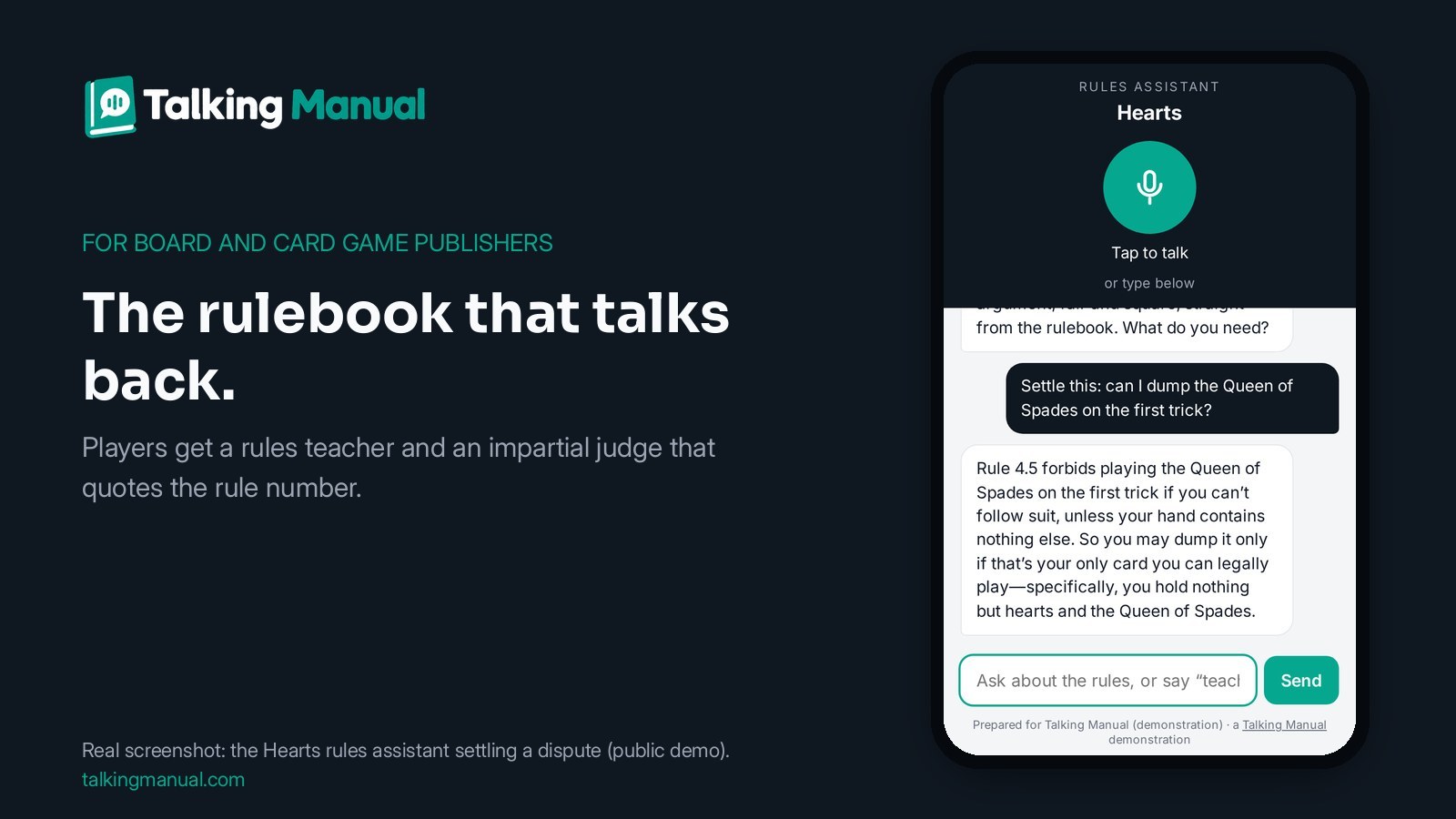
Talking Manual (https://www.talkingmanual.com) has launched a voice and text assistant for board and card game publishers that turns a single printed QR code into a rules teacher, an impartial judge, and a feedback channel back to the publisher. A player scans the code in the rulebook or on the box, asks a question by voice or text, and gets an answer sourced directly from that game's official rulebook, FAQ, and errata, with the specific rule number cited. Publishers see every question asked, in every language, inside a portal, before their next print run. The company is showing the system publicly on Hearts, using a rulebook Talking Manual wrote for the demo, at https://www.talkingmanual.com/games.
Rulebooks are where new games are won or lost. A first play that stalls on a page of exceptions, or ends in an unresolved argument about hearts and shooting the moon, is a first play that does not get recommended or reviewed. Publishers have had no good way to see which rules confuse people until sales data or online complaints show up months later, by which point a print run is already sold. Talking Manual's founder, Robert "Bo" Bennett, PhD, built the product first for car dealerships before extending it to game publishers and RV dealers, on the premise that most of the questions people have about a product they just bought are ordinary, answerable ones that never need to reach a support inbox or a customer service line.
The assistant does three things at the table. It teaches: it walks players through setup for the number of people playing, then the first turn, checking that everyone is ready before moving to the next step, so nobody has to read the rulebook aloud. It answers: any rules question gets a direct answer sourced from that game's rulebook, delivered in seconds with the rule it came from, so play does not stall. And it judges: when players disagree, it quotes the exact rule and issues a ruling without taking a side. If the rulebook does not address the situation, it says so plainly and suggests a fair house rule rather than guessing.
On the publisher side, every question asked at every table appears in a portal in real time, showing exactly where a rulebook's wording is unclear before the next printing or an online FAQ update. When the assistant hits a genuine gap, it can forward the question to the publisher with no personal information attached, since game players never provide any personal details to use it. Publishers can also upload a correction or an official FAQ entry at any time, and the assistant applies it within minutes to every copy already sold, without a reprint. Setup takes three steps: upload the rulebook, FAQ, and any errata to a publisher portal; download a print-ready code as SVG for the rulebook, box, or cut-out cards; and let players scan it. One code covers every copy of a title, regardless of print run size.
Talking Manual differs from a general AI assistant in that it answers only from a specific game's official rulebook and errata, not from the open internet, and it names the source rule for every answer. A player asking ChatGPT about a card game gets a plausible-sounding answer that may not match the actual rulebook edition on the table; Talking Manual's assistant is scoped to that exact title and updates the moment a publisher uploads a correction. It also closes a loop for the publisher: the publisher sees the aggregate pattern of confusion across every table that used the code, turning rules disputes into product feedback instead of lost customers.
"A rulebook only gets one shot at a first play, and until now publishers found out it failed weeks later, from a bad review instead of the argument that caused it," said Robert "Bo" Bennett, PhD, founder of Talking Manual.
The intended users are game publishers of any size, from a single-title Kickstarter creator to an established studio with a back catalogue, along with the players who end up at a table with a rulebook nobody wants to read cover to cover. A group learning an unfamiliar game for the first time can ask the assistant to teach it step by step instead of one person reading pages aloud. Mid-game, a player can ask a quick rules question without breaking the flow, and a disputed play, such as whether a card can be discarded on the first trick in Hearts, gets settled by a citation rather than a guess or a raised voice. Publishers gain a live view of confusion points across their entire install base, which they can act on in the next printing, an online FAQ, or an immediate errata push, and they get fewer routine rules emails landing in their support inbox at odd hours.
Access starts with a one-time setup fee of $99 per game title, which covers loading the rulebook, FAQ, and errata into the system and generating the printable code. Ongoing usage runs on the same plan structure as every Talking Manual product: a Starter plan at $49 a month includes 300 voice minutes, roughly 100 conversations, with unlimited typed chat and unlimited players on every plan. Higher tiers, Growth at $149 a month, Pro at $399, and Scale at $999, add more voice minutes, a custom subdomain, multiple request inboxes, choice of assistant voice and name, and faster document update turnaround. Publishers releasing a new title can add the code before the print run so the very first copies sold include it; publishers with an existing catalogue can talk to Talking Manual about onboarding multiple titles at once. A live demo using Hearts is available now at https://www.talkingmanual.com/games.
Game publishing is one of three markets Talking Manual currently serves, alongside car dealerships and RV and camper dealers, all built on the same underlying idea: give any product its own voice assistant, reached by scanning a code that ships with it, answering strictly from that product's official documents and naming the source. The company positions this as infrastructure for the moment right after a sale, when a product's own documentation is the only expert in the room.
Talking Manual (https://www.talkingmanual.com) is a product of Archieboy Holdings, LLC, based in Marlborough, Massachusetts, founded by Robert "Bo" Bennett, PhD. The company builds voice and text assistants that businesses attach to a product via a printed QR code, answering owner questions from that product's official manuals, rulebooks, and the business's own documents, and routing anything requiring a person straight to the business with the conversation already attached. Talking Manual currently serves car dealerships, RV and camper dealers, and board and card game publishers. More information, including a press kit with facts, videos, and live demonstrations, is available at https://www.talkingmanual.com/press.
