Marlborough, MA — 2026-09-28
Talking Manual Gives Solar, Battery and Generator Installers a QR Sticker That Answers Outage Questions
Setup is $299 per installer location for unlimited systems; a free 14-day trial is at talkingmanual.com/start and a live demo at talkingmanual.com/demo/solar.
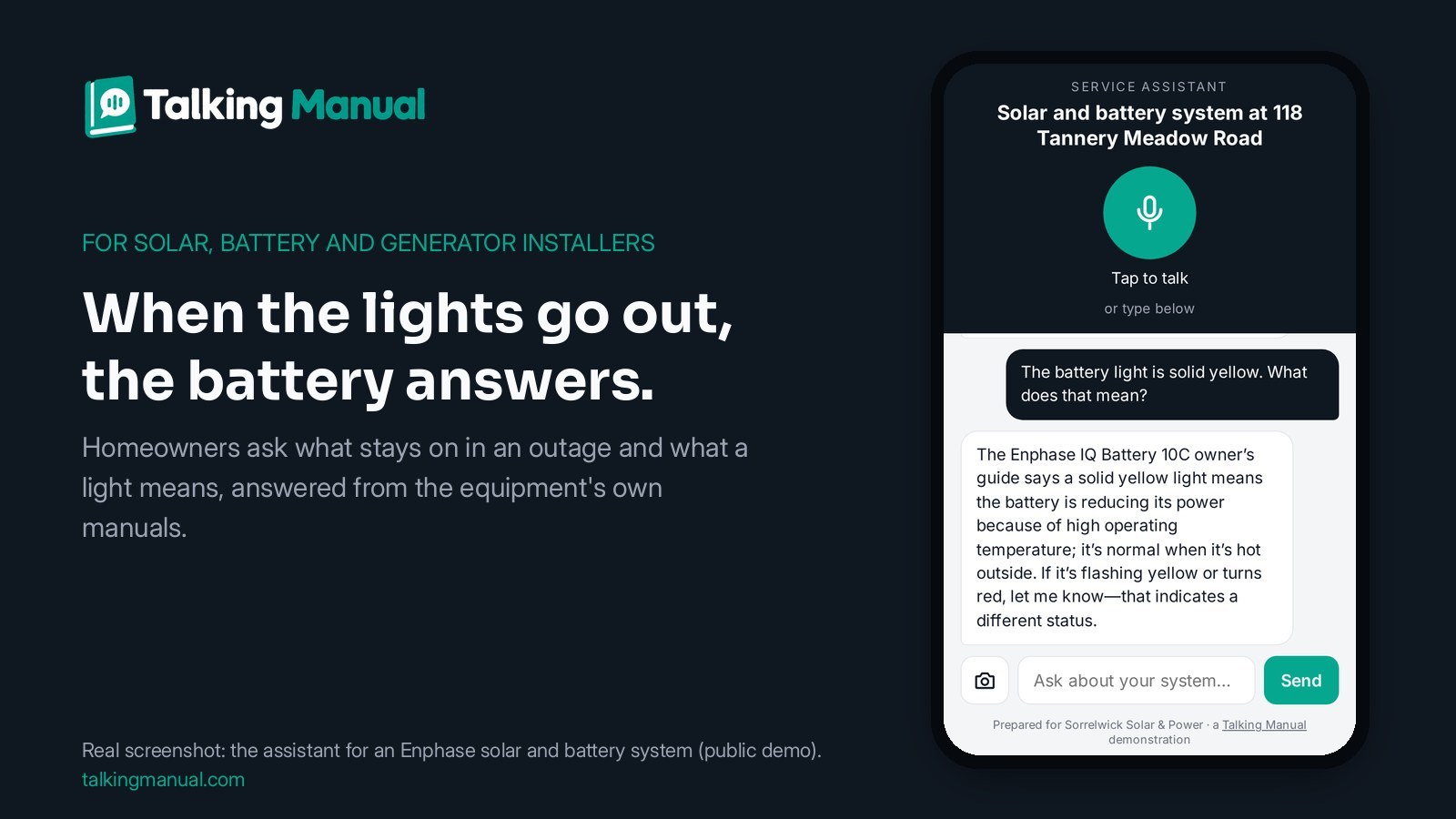
Talking Manual (https://www.talkingmanual.com) has expanded to serve residential solar, home battery and standby generator installers, giving them a QR sticker to place on every battery, inverter and generator they install. A homeowner scans the sticker and asks by voice, text or photo what will still work in a power outage, why the battery isn't charging, or what a light or alert means, and receives an answer sourced from that exact equipment's manufacturer manual and the installer's own handoff video. When a question genuinely requires a technician, the service request lands in the installer's inbox already explained: model, serial number, address, the alert in question, and whether the home currently has power. The feature joins Talking Manual's existing lineup for HVAC and plumbing contractors, car and RV dealers, home builders, and other industries.
Storms knock out power and installer phone lines light up at the same time. Homeowners who have never opened their battery's owner's manual call asking what's backed up, whether the panels can be hosed off, or what a blinking red light means, often at 11 p.m. with a storm still going. General-purpose chatbots know home batteries in the abstract, not the specific model bolted to a garage wall or the backup circuits an installer wired for that house. Manufacturer apps show live data but only for their own equipment, and installers juggle systems from multiple brands. Talking Manual is built for installers who need every system, regardless of manufacturer, to answer the same way from the same source: that equipment's own documentation and what the installer told the homeowner at handoff.
An installer adds each system by make, model and serial number, along with what circuits are backed up in an outage and the homeowner's contact details. Manuals for models Talking Manual already holds in its library, including Enphase's IQ Battery 10C and 5P, Tesla Powerwall 3, FranklinWH aPower 2, Generac air-cooled standby generators and transfer switches, and REC panels, load automatically; any other model is uploaded once and then reused across every installation of that model. The installer's own workmanship warranty and monitoring terms are uploaded once as well, so answers reflect both the manufacturer's documentation and what the installer actually promised.
Installers can also film a one- or two-minute handoff video showing where the battery, gateway and shutdown switch are located, what stays on during an outage, and how the app's backup reserve is set. Talking Manual turns that video into a draft guide, which the installer checks and publishes. The installer then prints a sticker, one per system or six to a sheet, and places it beside the battery, gateway or generator, and can add the code to the handoff email and permission-to-operate paperwork. The safety rules are built in: smoke, fire, a burning smell or a hot or swollen battery means everyone out and calling 911 first, and the assistant never suggests fighting a battery fire; a carbon monoxide alarm triggers a similar evacuation response.
Talking Manual is not the only company addressing solar and battery homeowner support, and it does not claim to be first or to see live system data. Enphase added an AI assistant to its own app for Enphase equipment in August 2026. Bodhi, now part of OneEthos, offers installers a customer-experience platform with service routing. Sunvoy sells installers a branded homeowner app. Manufacturers generally maintain their own apps with live monitoring, and AI phone-answering agents are common in the industry. Talking Manual's distinction is that it works across brands and for standby generators as well as batteries, requires no app or login for the homeowner, answers from that specific unit's manual plus the installer's own handoff notes, and sends every service request to the installer rather than the manufacturer. It is meant to sit alongside a manufacturer's app and an installer's field-service software, not replace either.
"The power's out. What still works?" said Robert "Bo" Bennett, PhD, founder of Talking Manual. "Installers hear that question over and over the night of a storm, and the answer is already sitting in a manual nobody opened."
Homeowners benefit most in the moment they're least likely to dig through a paper manual: mid-storm, at night, or when a light on the battery they've never seen before starts blinking. A homeowner can ask in their own language what circuits stay powered, send a photo of an app screen or a battery indicator and get an explanation specific to that model, or ask whether it's safe to clean panels themselves (the answer only ever repeats what the manual says, never advising anyone onto a roof). A generator that won't start becomes a service request with the model, serial and symptom already attached rather than a vague voicemail. Installers get fewer undifferentiated calls and a queue of requests their team can act on without a callback just to gather basic facts.
Setup costs $299 per installer location with unlimited systems, the same price structure Talking Manual uses for HVAC contractors, and usage-based plans start at $49 a month. A free 14-day trial covering one system is available at https://www.talkingmanual.com/start. A public demo shows an Enphase solar and battery system, two IQ Battery 10C batteries with IQ8 microinverters and REC Alpha Pure-R panels, at a fictional address, 118 Tannery Meadow Road in Westborough, Massachusetts, installed by a fictional installer, Sorrelwick Solar & Power, at https://www.talkingmanual.com/demo/solar. It answers from Enphase's public owner's guide and REC's public panel manual; the guide's battery-light tables and outage charge-recovery steps were transcribed and checked by hand against the manual's pages because two-column tables commonly scramble in automated text extraction. The demo's handoff video was produced from computer-generated photographs narrated by a voice actor. Talking Manual is not affiliated with Enphase, REC, Tesla, FranklinWH or Generac.
The solar, battery and generator launch extends a pattern Talking Manual has applied across a dozen industries since its September 2026 launch: give any product its own voice assistant, reached by scanning a code that ships or gets installed with it, answering from the official documents for that exact product with the source named, and routing anything that needs a person straight to the business that sold it. The company already serves car, RV and boat dealers, board and card game publishers, gyms, vacation rentals, real-estate listings, new-home builders, equipment rental companies, apartment and senior-living communities, and HVAC and plumbing contractors. Solar, battery and generator installers were a natural extension given how often outage-related questions mirror the "why won't this start" and "what does this alert mean" calls HVAC contractors already field.
Talking Manual is a product of Archieboy Holdings, LLC, of Marlborough, Massachusetts, founded by Robert "Bo" Bennett, PhD, and launched in September 2026. It gives products a voice assistant reached by scanning a code, answering owners' questions from official manufacturer documentation and the selling business's own materials, with every answer sourced and anything requiring a person routed directly to that business already explained. More information, including live demos across every market it serves, is available at https://www.talkingmanual.com.
