Marlborough, MA — 2026-09-28
Talking Manual Brings Its Voice-Assistant QR Code to Apartments and Senior Living
One code answers residents from the manager's own walkthrough video; setup is $199 per community with plans from $49 a month
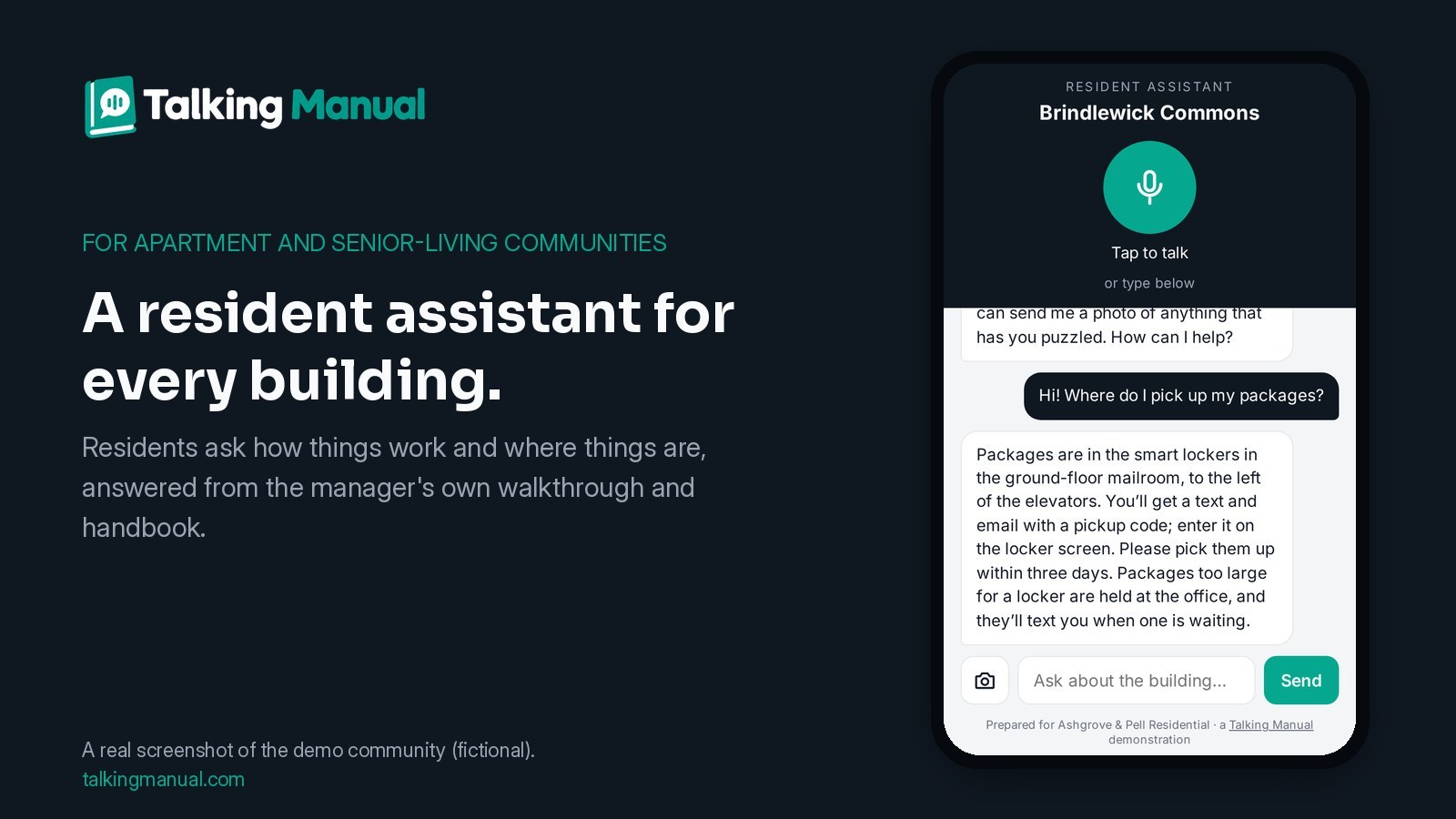
Talking Manual (https://www.talkingmanual.com) has launched a version of its voice-assistant product for apartment and senior-living communities, giving each building one QR code, posted in the lobby, the mailroom and the move-in packet, that residents scan to ask how things work, where things are and what the rules say. The assistant answers from the community manager's own walkthrough video and resident handbook, in the resident's own language, by voice, text or photo, at any hour. When a resident has a real problem, the request reaches the office already explained: the apartment, what's wrong, whether the resident gives permission to enter, and whether there are pets. The product, detailed at https://www.talkingmanual.com/apartments, is built for property managers whose staff field the same handful of questions all day and whose after-hours line takes calls that are not emergencies.
Property managers and senior-living operators have long relied on a printed handbook, a leasing office and an emergency line to cover resident questions that arrive at all hours, from where to put recycling to how a thermostat works. Generic chatbots can answer questions about apartments in general, but not about a specific building's mailroom, its clubroom booking process or its shut-off valve locations. Talking Manual now serves the apartment and senior-living market alongside the car, RV, boat, gym, vacation-rental, real-estate, home-builder and equipment-rental industries it has served since its September 2026 launch from Archieboy Holdings, LLC, of Marlborough, Massachusetts.
Setup starts when a community manager films a walkthrough on a phone, covering the lobby, mailroom, laundry, trash and recycling, amenities and a model apartment, narrating as they would on a tour. Talking Manual turns the video into a written guide in a few minutes; the manager corrects it, publishes it, and adds the resident handbook, appliance manuals and, for senior living, the month's dining menu and activity calendar. A printed code goes up in common areas and in resident cards for move-in packets. Residents scan it with no app or account and ask in their own language; the assistant answers from the community's documents and says so.
Maintenance requests arrive in the office inbox as a complete email rather than a partial voicemail: apartment number, description of the problem, whether the resident has given permission to enter, and any pets in the unit. The system follows fixed rules regardless of community: emergencies come first, with fire routed to the stairs and 911, gas or carbon monoxide to evacuation and 911, and uncontrolled water to the shut-off valve and the after-hours line. It never gives out door, gate, amenity or locker codes, never shares information about another resident, and never takes a side in a neighbor dispute. It follows fair-housing principles, does not describe who lives in a building or suggest a place suits a particular resident, and forwards disability accommodation and assistance-animal requests to the office without judging them. It never promises anything about rent, fees, credits, lease terms or when maintenance will come; it quotes the community's own documents and leaves the decision to the office.
For senior living, the assistant is tuned to be patient and to repeat instructions step by step, answering questions like what's for lunch, what's on the activity calendar this week, when the shuttle leaves, or how the thermostat works, from the month's uploaded dining menu and activity calendar. It never offers medical advice; questions about symptoms, medication or care are directed to nursing and care staff. Emergencies are handled first: a fall, chest pain or trouble breathing routes to the pendant or pull cord, or 911, before anything else. It never discloses whether a specific person lives in the community, and it never quotes care costs or speaks to whether someone would qualify for a level of care, offering instead to pass a message to the front desk or care team.
Other resident-facing tools exist, including QR-code assistants that answer from a handbook and the AI features built into large property-management platforms. Talking Manual also learns a specific building from the manager's own walkthrough video, not only from uploaded documents; the company says it has not seen other resident tools advertise that. It also runs alongside whatever property-management or maintenance software a community already uses, with no integration project, and it covers both apartment and senior-living communities from the same product. Requests still land in the office's existing maintenance workflow as a ready-to-enter email.
"The office already knows the answer to almost every question a resident asks; it's just busy," said Robert "Bo" Bennett, PhD, founder of Talking Manual. "We wanted the manager's own tour of the building to become the thing that answers at 11 p.m."
The product is designed to take routine calls, emails and office walk-ins off the office, and to keep the after-hours line for genuine emergencies. Maintenance staff receive requests with the apartment, problem, entry permission and pet information already gathered. Residents get answers without downloading anything, in their own language, from a photo of a leaking disposal or a question typed at midnight about the clubroom booking process. Senior-living families and residents get a patient, always-available source for daily logistics like meals and activities, while sensitive matters are routed to the people trained to handle them. Two public demonstrations show the product in fictional settings: Brindlewick Commons, a six-story apartment community in Worcester, Massachusetts, built from a walkthrough video of computer-generated photographs narrated by a voice actor, at https://www.talkingmanual.com/demo/apartments; and Aldermoor Place, an independent and assisted living community in Andover, Massachusetts, answering from a resident guide, autumn menu and activity calendar written for the demo, at https://www.talkingmanual.com/demo/senior-living. Both are managed, fictionally, by Ashgrove & Pell Residential.
Setup costs $199 per community and covers unlimited residents; ongoing usage-based plans start at $49 a month, consistent with Talking Manual's pricing structure across its other markets. Communities can start a free 14-day trial for one community at https://www.talkingmanual.com/start, which includes turning an uploaded walkthrough video into a draft guide the manager reviews before publishing. No app or account is required for residents; the code works in a phone's browser, including voice input, with nothing to download. Communities that would rather see it first can book a demo at https://www.talkingmanual.com/book-demo.
The apartment and senior-living launch extends a product built first for car, RV and boat dealers, board and card game publishers, gyms, vacation rentals, real-estate listings, new-home builders and equipment rental companies, each of which pairs a physical product or property with a code that gives it a voice assistant grounded in official documents.
Talking Manual is a product of Archieboy Holdings, LLC, of Marlborough, Massachusetts, founded by Robert "Bo" Bennett, PhD, and launched in September 2026. It gives products and properties their own voice assistant, reached by scanning a QR code, that answers owner and resident questions from official documents and the business's own materials, with the source named, and routes anything requiring a person straight to the business with the details already gathered. Beyond apartment and senior-living communities, Talking Manual serves car dealerships, RV and camper dealers, boat dealers, board and card game publishers, gyms and fitness studios, vacation rentals, real-estate listings, new-home builders and equipment rental companies. More information, live public demonstrations and press materials are available at https://www.talkingmanual.com and https://www.talkingmanual.com/press.
