Boston, MA — 2026-06-04
Science-Based Learning Launches Language App Built on Cognitive Science, Not Marketing Claims
Seven AI-powered tools, 15 languages, and spaced repetition targeting 90–95% lifetime word retention
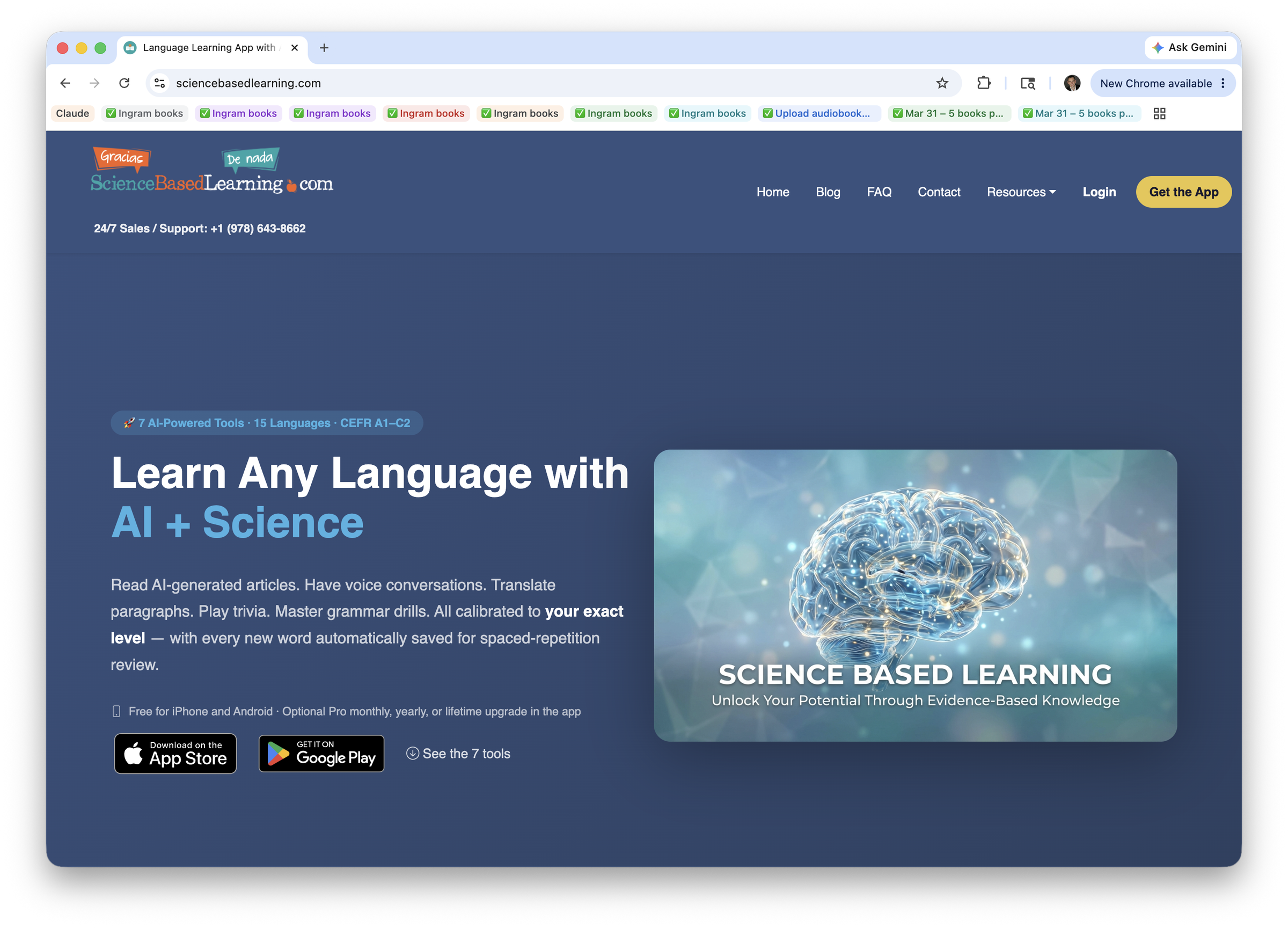
https://www.sciencebasedlearning.com has released a language-learning app for iOS and Android that grounds every feature in peer-reviewed cognitive science rather than gamification streaks and motivational badges. The app, built by Bo Bennett, PhD, founder of Archieboy Holdings, covers 15 languages across the full CEFR A1–C2 proficiency spectrum and combines seven distinct learning tools — reading, speaking, translation, grammar drills, trivia, vocabulary review, and an interactive phrase library — all calibrated in real time to a learner's declared level. Bennett, who has used the app daily for eight months while studying Spanish, says he built it to solve a personal frustration: existing apps prioritized engagement mechanics over the science of how memory actually works.
The consumer language-learning market is crowded with apps that compete primarily on streaks, cartoon mascots, and social leaderboards. What has been harder to find is a product that systematically applies the three mechanisms cognitive scientists most consistently identify as drivers of long-term retention: spaced repetition, active recall, and consistency tracking. Bennett, who describes himself as a social scientist who had to study the cognitive science of language acquisition from scratch, says the distinction matters because language learning is a neurologically specific task — the brain does not encode vocabulary the same way it encodes procedural skills or declarative facts. ScienceBasedLearning is designed around that difference, targeting everyday learners who have tried other apps and plateaued, as well as students and professionals who need measurable progress toward a defined CEFR level.
The app's vocabulary engine is built on the SM-2 spaced repetition algorithm, which schedules each word for review at the precise interval when the brain is statistically most likely to forget it. Bennett describes the mechanism in concrete terms: a word first reviewed at 15 minutes is next scheduled at one hour, then one day, three days, one week, and one month. If a learner misses the word at the three-day mark, the system does not discard it or repeat it randomly — it drops the word back to the one-hour interval and restarts the climb. According to Bennett, a word that completes the full sequence carries a 90–95% probability of being retained for life, compared with the substantially lower baseline of traditional study methods. Every word a learner taps in any of the seven tools is automatically added to the My Vocabulary module, where it enters this review queue alongside AI-generated example sentences, mnemonics, and native-speaker audio.
The seven tools are designed to target distinct skill dimensions rather than repeat the same interaction in different visual skins. The Reading Lab generates fresh CEFR-calibrated articles on topics the learner selects; Language Partner enables live voice conversations with an AI in three modes — Repeat for pronunciation, Conversation for free-flowing exchange, and Office Hours for open grammar questions; U Translate presents English paragraphs for the learner to render sentence by sentence, with immediate feedback on grammar, word choice, and natural phrasing; Testing Tenses delivers grammar drills tailored to each language's specific structural challenges, such as the Spanish subjunctive, Japanese politeness registers, German case endings, and the French passé composé. A Professor Mode feature, accessible from any screen, provides instant grammar explanations on demand. The Interactive Library includes nine curated phrase books and allows learners to request AI-generated custom books on any topic — medical terminology, wine vocabulary, sports — at their current level.
What separates ScienceBasedLearning from flashcard-first competitors is the integration of AI-generated content with a stable retention architecture. Definitions and core vocabulary data remain consistent to support reliable memory encoding, while articles, conversation prompts, and translation exercises are dynamically generated so no two sessions are identical. CEFR levels are set by self-report at onboarding and can be adjusted upward or downward mid-course if content difficulty drifts from the learner's actual ability. The combination means the app can serve a true beginner in Chinese and an advanced French reader within the same framework without requiring separate content libraries for each proficiency band.
"The brain doesn't process all information the same way — language learning is a very specific branch of cognitive science, and that's the part I really had to dig into," said Bo Bennett, PhD, Founder, Archieboy Holdings.
The primary audience for ScienceBasedLearning is adult self-directed learners who have either tried gamified apps and stalled or who are approaching language study with a professional or academic goal that requires measurable CEFR-level progress. Practical use cases include a business traveler building functional Spanish before a recurring assignment in Latin America, a heritage speaker of Mandarin who wants to formalize grammar knowledge, a university student supplementing classroom French with daily speaking practice, or a retiree working through Italian for an extended trip. Because content is AI-generated and infinitely variable, learners at the C1 or C2 level — who typically exhaust fixed-content apps quickly — have access to material that scales with them. The trivia tool, which spans eight category wheels and delivers questions entirely in the target language, adds a low-stakes comprehension layer that reinforces vocabulary encountered in other sessions.
ScienceBasedLearning is free to download on iPhone and Android with no account required to start. The free tier provides access to the core tool set. An optional Pro upgrade is available inside the app on monthly, yearly, or lifetime billing terms; specific pricing is displayed at checkout within the app. Onboarding takes under one minute: learners select a language from the 15 supported options, set a CEFR level, choose a daily goal of 5, 10, 15, or 20 minutes, and begin immediately. Supported languages include Chinese, Dutch, French, German, Italian, Japanese, Portuguese, Spanish, and additional major world languages. The full list is available at https://www.sciencebasedlearning.com.
Bennett has been candid in public discussions about the asymmetry between his existing strengths and what this product demands. His background is in B2B products — tools for authors, businesses, and developers — where the buyer is a professional evaluating a defined ROI. ScienceBasedLearning targets everyday consumers making a personal decision, often on a mobile device during a commute or lunch break, which requires a different acquisition and retention strategy. He has identified consumer marketing as the primary challenge ahead, distinct from the product and science work, and has signaled that distribution and discovery will be an active area of development as the app scales. Future tooling and content expansions are expected to track the cognitive science research the product is built on, rather than feature additions driven by competitive mimicry.
ScienceBasedLearning is a product of Archieboy Holdings, founded by Bo Bennett, PhD. The app is available at https://www.sciencebasedlearning.com and on the Apple App Store and Google Play. Archieboy Holdings develops evidence-based digital tools across multiple domains; ScienceBasedLearning represents the company's entry into consumer language education, built from Bennett's direct experience studying Spanish and his background in social and cognitive science. Press inquiries can be directed through the website.
