Big Spring, TX — 2026-10-16
Qwaiting Advances Digital Queue Management to Help Businesses Improve Customer Flow
Cloud platform ties virtual queues, kiosks, signage and face recognition into one system for healthcare, banking and public-sector sites
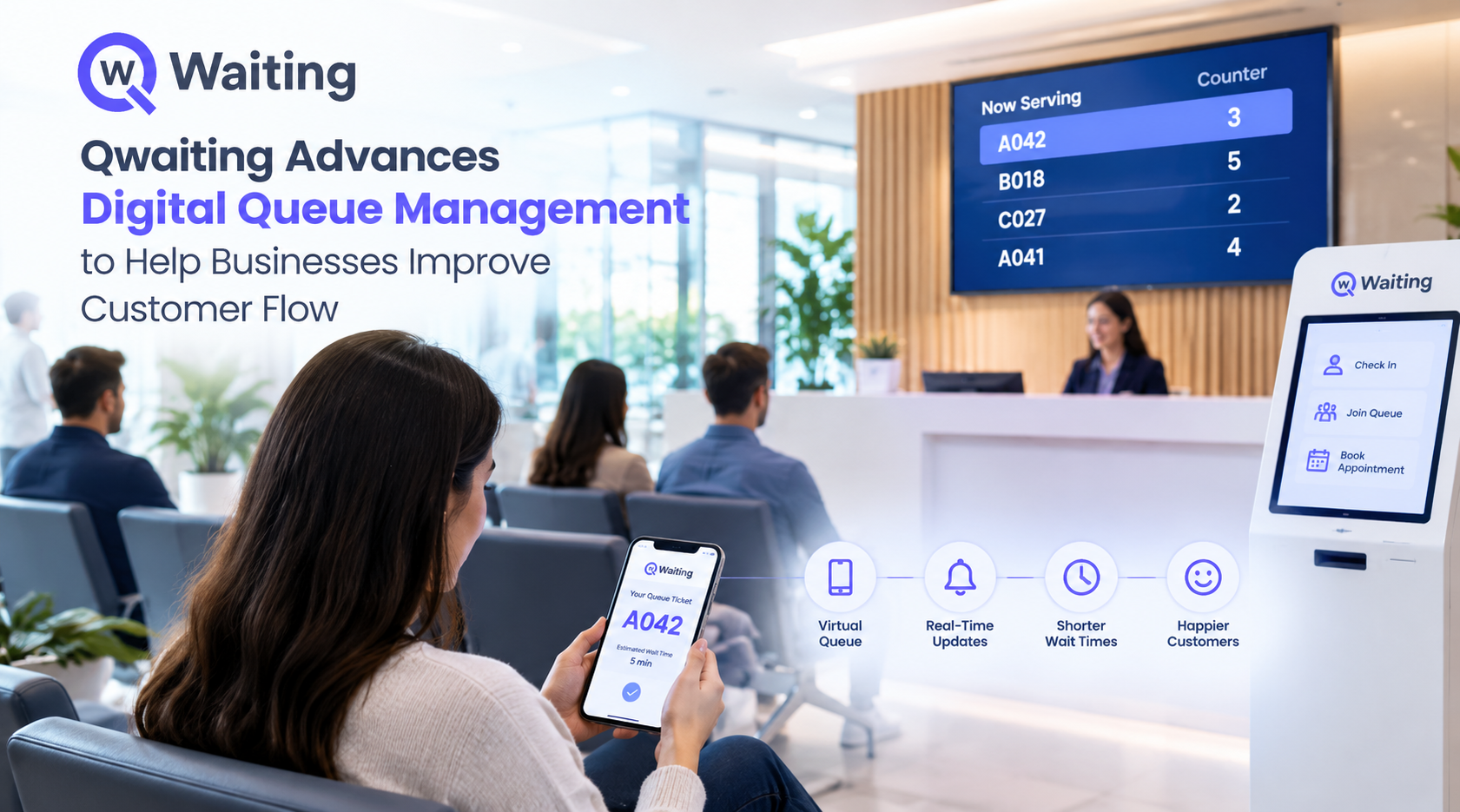
Qwaiting, a provider of cloud-based queue and customer journey management software, is advancing its digital queue management platform to help service businesses organize how customers arrive, wait, and are served. The platform, described at https://qwaiting.com/, replaces physical lines and paper tokens with virtual queues that combine walk-ins and booked appointments. Managers get a real-time view of every service point across one branch or hundreds. The company says the approach can reduce wait times by up to 35%. It is aimed at high-demand environments such as hospitals, bank branches, airports, government offices, retail stores, and schools, where uneven customer flow raises costs and frustrates visitors.
Queues remain a daily operational problem for organizations that serve the public. A crowded lobby signals disorder, staff lose time answering questions about who is next, and managers often lack reliable data on where delays start. Paper tickets and informal lines offer no record of how long each stage takes, how many customers leave before being served, or which hours overload the team. Customer expectations have also shifted. Many people now expect to join a line from a phone, wait elsewhere, and be notified when their turn approaches. Qwaiting says it is trusted by more than 10,000 organizations across more than 120 countries, and it positions its software as the layer that makes those expectations workable for businesses, governments, and institutions.
At the core of the platform is virtual queuing. Customers join by scanning a QR code, using a kiosk, booking online, or checking in at reception, then waiting wherever they choose. The system routes each person by service type, language, or priority and balances workload across counters and branches. Customers receive turn alerts by SMS or WhatsApp, so they do not need to stay in a waiting room. Online appointment booking lets organizations merge pre-booked slots with walk-in traffic in the same queue. An AI-powered wait-time prediction feature forecasts demand so managers can adjust staff allocation before lines form, rather than after.
Hardware and in-venue communication are part of the same system. Qwaiting offers self-service kiosks in tabletop, floor-standing, and wall-mounted formats. They handle check-in, queue ticket printing, appointment confirmation, and visitor guidance, and the company lists use cases from patient registration to airport check-in and event badge printing. Its digital signage software shows live queue numbers, counter calls, estimated wait times, and announcements on commercial displays ranging from 32 to 75 inches. Voice announcements can be added so customers hear their number being called, which the company says helps elderly and visually impaired visitors and reduces missed calls. Content for every screen is managed from a centralized dashboard, including across multiple locations.
Qwaiting also offers an AI face recognition system that connects to its kiosks and queue software. Customers enroll once with consent, creating a biometric template. On later visits a camera detects the face, matches it against enrolled profiles, and checks the person is physically present through liveness detection, which looks for natural movements such as blinking and head tilts. Recognized customers are checked in automatically and placed in the right queue, and staff can view the profile early. The company positions this for repeat-visit settings such as clinics, banks, government counters, and corporate buildings, where it removes manual registration and gives customers a contactless check-in.
Qwaiting's differentiation lies in treating the queue as one stage of a longer customer journey rather than a standalone ticketing tool. The platform maps how customers arrive, where they wait, which service they need, who serves them, and how long each stage lasts. Heat maps and peak-hour data help managers find bottlenecks, while analytics track wait times, service times, no-shows, and staff productivity. The wider solutions catalog covers visitor management, customer feedback collection, a QR code queue system, messaging services, video queue and tele-consultation, AI appointment booking, and an AI chatbot. Because the kiosk, signage, messaging, and recognition components run on the same queue software, organizations can add capabilities without stitching together separate vendors.
"Waiting is part of the service experience. When queues are visible, organized, and measured, businesses can fix bottlenecks instead of guessing where they are," said the owner and founder of Qwaiting.
The practical benefits differ by sector. In healthcare, clinics can manage patient arrivals and appointment slots while reducing crowding in waiting rooms, and kiosks can handle registration and token issuance. Banks can organize branch traffic by service request and direct customers to the right counter. Retailers can control store traffic and checkout lines, and public-sector offices can structure citizen queues across multiple counters. Airports can guide passengers through service checkpoints, and universities can manage student office visits. For staff, the gain is a live dashboard showing who is waiting, who is being served, and where capacity is short. For customers, it is less time standing in line and fewer missed calls.
Qwaiting offers a 14-day free trial that requires no credit card and can be canceled at any time. Organizations can review plans and features on the company's website or request a demo to see how queue, appointment, kiosk, signage, and messaging components fit their sites. Kiosk specifications are available for download from the product pages, and the signage page lists recommended commercial display series by room size. The company lists ratings of 4.8 stars on Capterra, 4.8 stars on GetApp, and 4.7 stars on G2. Detailed pricing is available through the plans page and the sales team, depending on the number of locations, counters, and modules selected.
The platform's direction reflects wider demand for tools that give service organizations real-time visibility and measurable results. Qwaiting is extending the system with AI-assisted features, including wait-time prediction, AI appointment booking for scheduling, rescheduling, and cancellations, and an AI chatbot that answers questions and manages appointments around the clock. Integrations with other business tools are also part of the offering, so queue data can connect to existing workflows. The company describes its goal as simplifying complex service journeys into experiences that are seamless, measurable, and scalable, whether an organization runs a single counter or a network of branches in many countries.
Qwaiting is a global provider of queue and customer journey management, working with businesses, governments, and institutions to deliver faster service, lower costs, and higher customer satisfaction. The company says more than 10,000 organizations across more than 120 countries use its platform and that it powers over one million customer experiences every year. Its products include virtual queues, appointment booking, WhatsApp and SMS notifications, self-service kiosks, digital signage, face recognition, and real-time analytics. More information, product details, and trial signup are available at https://qwaiting.com/.
