San Antonio, TX — 2026-07-18
Quentin P. Yarrow Releases Common Ground Democracy, a Case for Cross-Party Cooperation
159-page book argues reciprocity and predictable rules, not shared ideology, keep democratic institutions stable under pressure
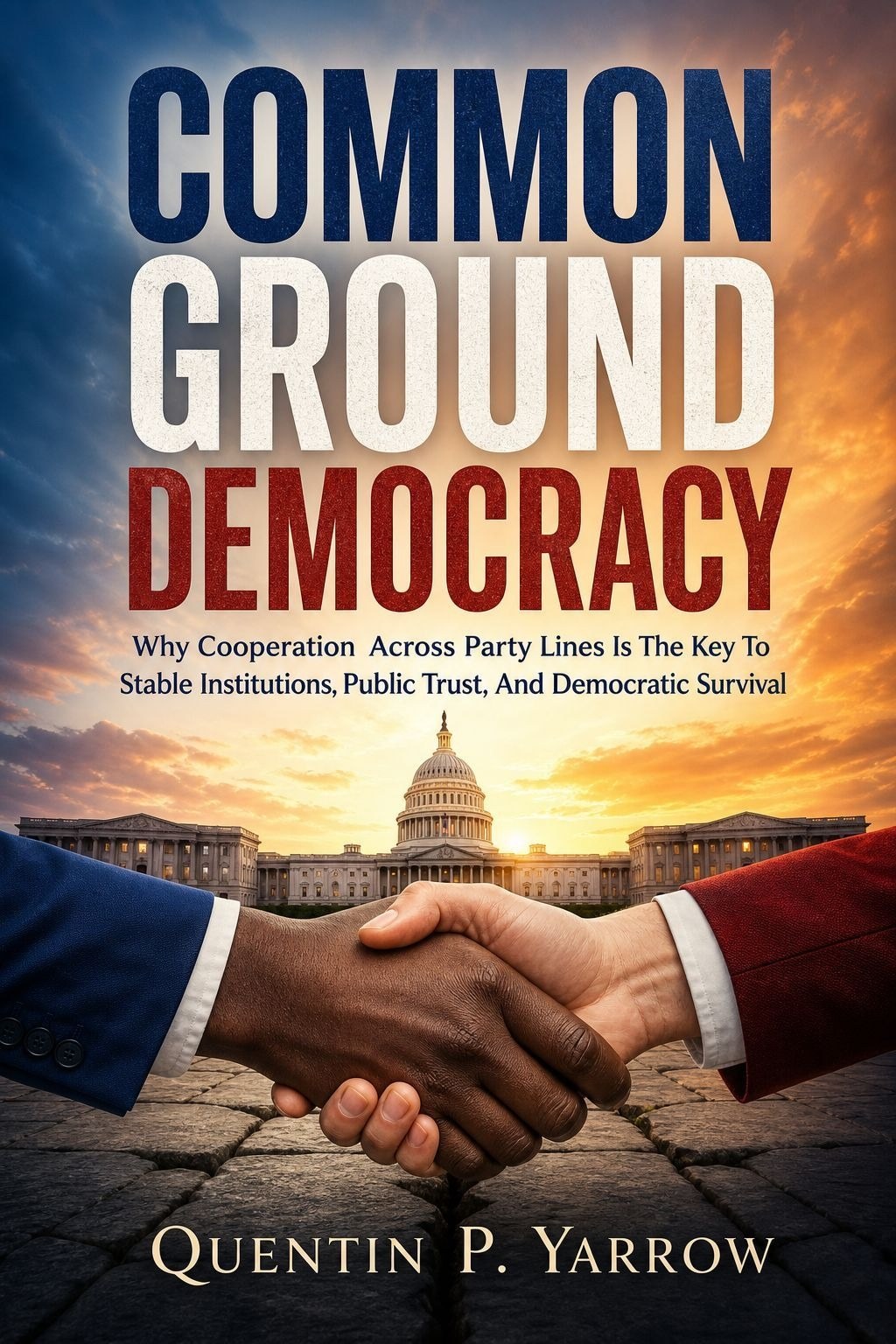
Author Quentin P. Yarrow has released Common Ground Democracy: Why Cooperation Across Party Lines Is the Key to Stable Institutions, Public Trust, and Democratic Survival, a 159-page political science title now available as an ebook through eBookIt at https://bookstore.ebookit.com/bookstore/common-ground-democracy/9b0b9f. The book argues that democratic institutions weaken when partisan identity overtakes civic identity and when disagreement between opponents turns into retaliation rather than ordinary bargaining. Yarrow presents cross-party cooperation not as a call to abandon political convictions but as a practical method for preserving disagreement without destroying the legitimacy of the system that contains it. The release comes as public trust in democratic institutions remains a persistent subject of debate among civic groups, policymakers, and educators.
The book enters a conversation that has occupied historians, political scientists, and civics educators for years: what actually holds a democracy together when its citizens disagree sharply on policy and identity. Much of the existing literature on polarization diagnoses the problem — tribalism, media fragmentation, elite incentives toward conflict — without offering a working method for institutions to absorb that conflict and continue functioning. Yarrow's book is aimed at that gap, addressing readers who study civics and public policy as well as general readers concerned with the durability of self-government. It is written for anyone who has watched gridlock, retaliation, or eroding institutional trust and wanted a clearer account of what keeps democratic systems intact under strain.
Common Ground Democracy builds its argument around three linked ideas: predictable rules, reciprocity, and institutional trust. Yarrow traces how these elements interact with interpersonal trust and civic life more broadly, showing that when citizens and officials can rely on shared rules of engagement, disagreement becomes manageable rather than existential. The book distinguishes cooperation from compromise on substance, framing it instead as a set of procedural commitments — reciprocity in negotiation, consistency in enforcement, and restraint from treating political opponents as enemies to be defeated rather than counterparts to be negotiated with.
The text is organized to move readers from diagnosis to method. Early sections examine why partisan identity can overwhelm civic identity, drawing on the relationship between trust at the interpersonal level and trust in institutions at the national level. Later sections turn to application, explaining how predictable institutions reduce fear and suspicion among competing factions and why shared rules matter more than shared ideology in sustaining a functioning system. Yarrow writes in formal, accessible prose intended for readers without a specialized political science background, and the book is categorized under Political Science / General (POL000000) for retail purposes.
Where much commentary on polarization stops at description, Common Ground Democracy commits to a prescriptive framework that treats common ground as a repeatable civic practice rather than a rhetorical appeal for unity. The book does not ask readers to soften their political views or split differences on policy; it asks them to preserve the procedural conditions — reciprocity, predictability, institutional trust — that allow disagreement to coexist with a functioning government. That distinction, between ideological compromise and procedural cooperation, is the book's central and most novel contribution to a crowded field of polarization literature.
"Common ground is not about giving up what you believe. It's about protecting the rules that let you keep believing it while the other side keeps believing something else," said Quentin P. Yarrow, author of Common Ground Democracy.
The book is aimed at readers across the civic spectrum: educators building civics curricula, policy professionals working inside contested institutions, journalists covering polarization, and general readers trying to make sense of gridlock in legislatures, courts, and local government. A civics instructor could use the book's framework on reciprocity and predictable rules to structure classroom discussion on how legislatures negotiate across party lines. A local official facing constituent distrust could draw on its argument that institutional trust, not ideological agreement, is what keeps a community functioning during contentious votes. General readers concerned about the state of democratic institutions will find a compact, direct argument rather than a lengthy academic treatise, with the 159-page length designed for a single, focused read.
Common Ground Democracy is available now as an ebook (ISBN 9781456684518) for $2.99 through eBookIt at https://bookstore.ebookit.com/bookstore/common-ground-democracy/9b0b9f, with EPUB and PDF formats included in the purchase. Buyers complete checkout directly on the page, and eBookIt emails secure download links so the book can be retrieved without a public bookstore account or shipping wait; download links remain active for 72 hours. The listing also includes a promo code field for buyers with a discount code and details on the book's subject category and available formats before purchase.
The release is part of a broader body of work Yarrow has built around civic life and democratic institutions, including prior titles Press and Power, Civic Foundations, and Library of Democracy, all listed alongside Common Ground Democracy on eBookIt's author page. Taken together, the books form a sustained argument that democracy is a practice that must be relearned by each generation rather than a fixed inheritance. Yarrow has indicated his continuing work will keep examining specific mechanisms — from media institutions to civic education — that determine whether democratic systems adapt to pressure or fracture under it.
Quentin P. Yarrow is a writer focused on the history, mechanics, and practice of democratic government. A lifelong student of civic life, he writes books examining how democracies succeed, why they struggle, and what ordinary citizens and officials can do to strengthen them, aiming to inform readers who see democracy as a discipline that requires active maintenance rather than passive assumption. Common Ground Democracy is published through eBookIt, an independent digital bookstore and distribution platform; the title is available now at https://bookstore.ebookit.com/bookstore/common-ground-democracy/9b0b9f.