Boston, MA — 2026-06-03
PoddyHost Automates Podcast Creation from Script to RSS Feed
Platform writes, records, and distributes AI-voiced episodes; batch tool queues 30 releases in one click
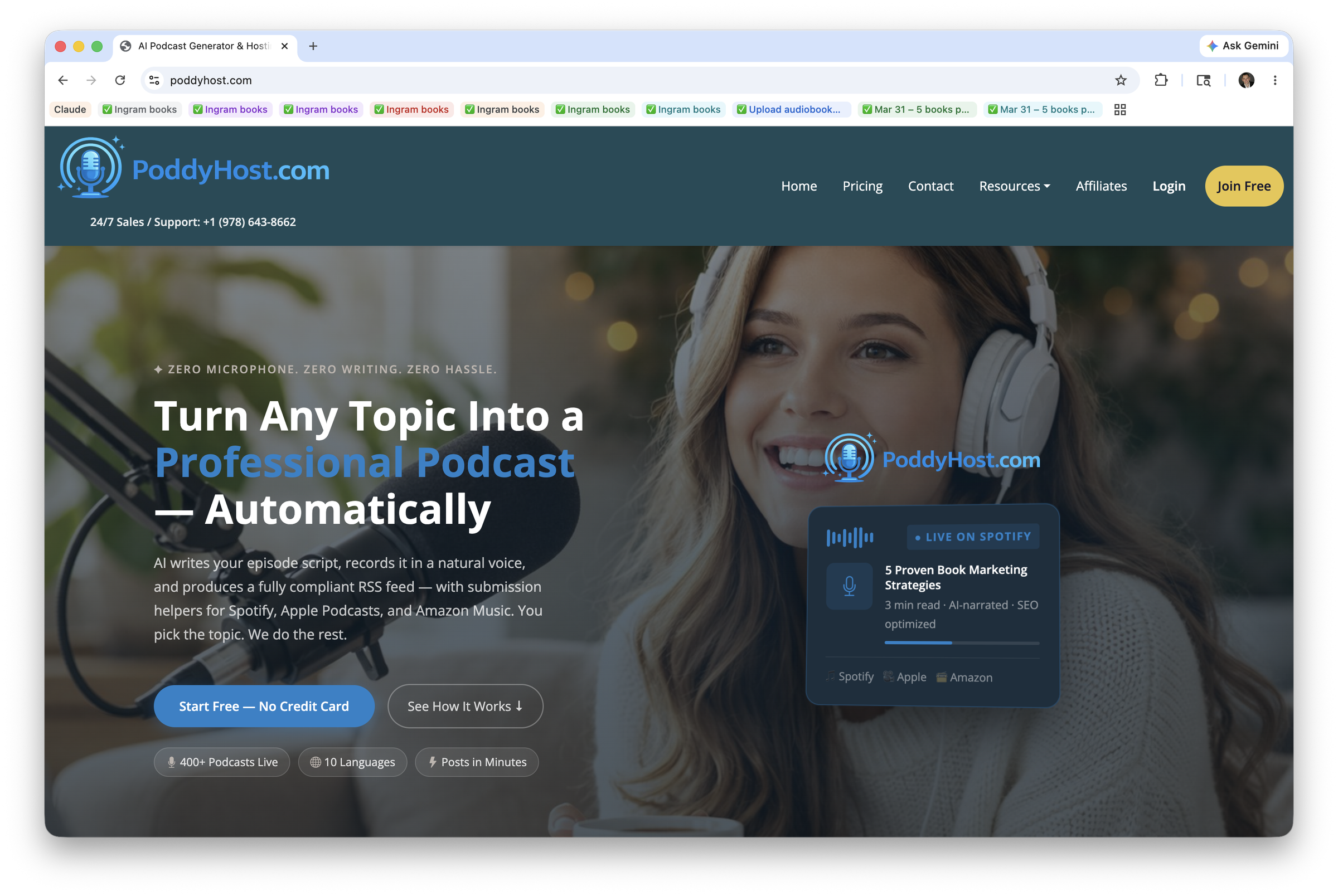
PoddyHost, available at https://www.poddyhost.com, has launched a fully automated podcast production pipeline that takes a user-supplied topic and returns a finished episode — AI-written script, AI-voiced audio recording, and a standards-compliant RSS feed — without requiring any recording equipment, editing software, or audio production experience. The platform also includes submission helpers for Spotify, Apple Podcasts, and Amazon Music, reducing the distribution step to a guided workflow rather than a manual technical process. The service is positioned not primarily as a podcasting tool but as a search-engine-focused content marketing platform that happens to produce audio, according to Bo Bennett, PhD, the architect behind the system.
The context for PoddyHost is a podcasting landscape where the barrier to consistent publication has remained stubbornly high for small business owners, independent professionals, and solo creators. Recording quality audio requires equipment and a quiet space. Editing takes time most operators do not have. Writing coherent, on-topic scripts episode after episode demands a content discipline that competes directly with running a business. Distribution across major platforms involves separate logins, metadata requirements, and format specifications. PoddyHost is designed to collapse all of those steps into a single workflow. The underlying premise, as Bennett has articulated it, is that the audio file and its associated HTML page carry SEO value independent of whether a large audience ever finds the episode — meaning the content marketing benefit accrues even before listener growth begins.
The platform's most operationally significant feature is batch episode creation. A user can generate up to thirty episodes in a single session, with the platform automatically queuing them for release at one episode per day over the following month. The design choice is deliberate: the goal is a steady drip cadence that compounds SEO and listener benefits over time, not a single flood of content that search engines and audiences alike tend to discount. Each episode in the batch is individually scripted by the AI around the topic parameters the user sets, voiced in a natural-sounding AI voice, and packaged with the metadata required for a compliant RSS feed. The batch-and-drip mechanic means a user can invest one session of setup time and sustain a month of consistent publication without returning to the platform.
Beyond batch creation, PoddyHost generates the HTML episode pages that accompany each audio file — pages that are indexed by search engines and serve as durable, topic-specific content assets. This architecture reflects Bennett's framing of the platform as an SEO play first. The podcast feed is the distribution mechanism; the indexed pages are the long-term search surface. Submission helpers for Spotify, Apple Podcasts, and Amazon Music walk users through the platform-specific requirements for each directory, reducing the friction that typically causes small operators to skip distribution steps entirely. The RSS feed produced by the platform meets the technical specifications required by all three major directories without requiring the user to understand feed formatting.
PoddyHost enters a market that includes both traditional podcast hosting services and newer AI-assisted content tools, but the combination of script generation, voice recording, RSS production, and distribution guidance in a single automated pipeline distinguishes it from platforms that address only one or two of those steps. Most AI writing tools stop at the text layer. Most podcast hosts assume the user arrives with a finished audio file. PoddyHost is designed around the premise that the majority of potential podcasters are blocked not by any single step but by the cumulative friction of all of them together — and that removing the entire stack, rather than optimizing individual components, is what changes the economics for small operators.
"Even if hypothetically there were no listeners, we still have these podcasts listed and the associated HTML pages — so it still brings in traffic," said Bo Bennett, PhD, Founder, PoddyHost.
The audience most directly served by PoddyHost is small business owners, independent authors, consultants, and subject-matter experts who have a body of knowledge worth broadcasting but lack the production infrastructure to do so consistently. A business owner can enter a topic relevant to their industry, let the platform generate and schedule thirty days of episodes, and maintain an active, distributed podcast presence while focusing on their core work. Authors can use the platform to build a content marketing channel around their subject matter without hiring a producer or editor. Consultants can establish topical authority in their niche through a steady stream of indexed audio content. Bennett's stated benchmark for what success looks like at ninety days is twelve engaged listeners — a figure he cites as sufficient to make the economics of the paid tier work, given that those twelve represent net-new audience members who would not otherwise have found the creator.
PoddyHost is available now at https://www.poddyhost.com. The platform offers a paid tier priced at a level Bennett describes as low enough that a small number of engaged listeners is sufficient to justify the cost. Prospective users can visit the site directly to review current pricing, select a plan, and begin generating episodes. No audio equipment, editing software, or prior podcasting experience is required to get started. The submission helpers for Spotify, Apple Podcasts, and Amazon Music are included as part of the platform workflow and guide users through directory-specific submission requirements after the RSS feed is generated.
PoddyHost is part of a broader suite of AI-driven tools under development by Bennett and Archieboy Holdings, aimed at authors and small business operators who need production-grade content output without production-grade staffing. The suite currently spans writing, editing, cover design, press outreach, advertising, and mailing list management, with PoddyHost adding automated audio and podcast distribution to that stack. Bennett has indicated that the near-term roadmap includes movement toward autonomous AI agents capable of orchestrating the full content stack — selecting topics, generating episodes, scheduling releases, and managing distribution — with minimal human input beyond initial configuration. The current platform requires a person to set parameters and initiate the workflow; the stated direction is toward reducing even that requirement.
Archieboy Holdings, accessible through its network of tools including https://www.poddyhost.com, is a portfolio of AI-powered platforms built and operated by Bo Bennett, PhD, targeting independent creators, authors, and small business owners who need scalable content and marketing infrastructure without enterprise-level budgets. Bennett founded his first technology company, a web hosting business operating under the Adgrafix name, in 1995 after graduating from Bryant University with a degree in marketing, and has since built a range of software and media properties. PoddyHost represents the audio and podcasting layer of a stack that Bennett has deliberately assembled to handle the full content marketing lifecycle for operators working without dedicated production teams.
