Portland, Maine — 2026-07-18
Nora F. Mercer's New Book Slug Signals Turns Garden Pests Into Evolutionary Storytellers
153-page ebook explores slug mucus, movement, and ancestry; available now for $2.99 at bookstore.ebookit.com
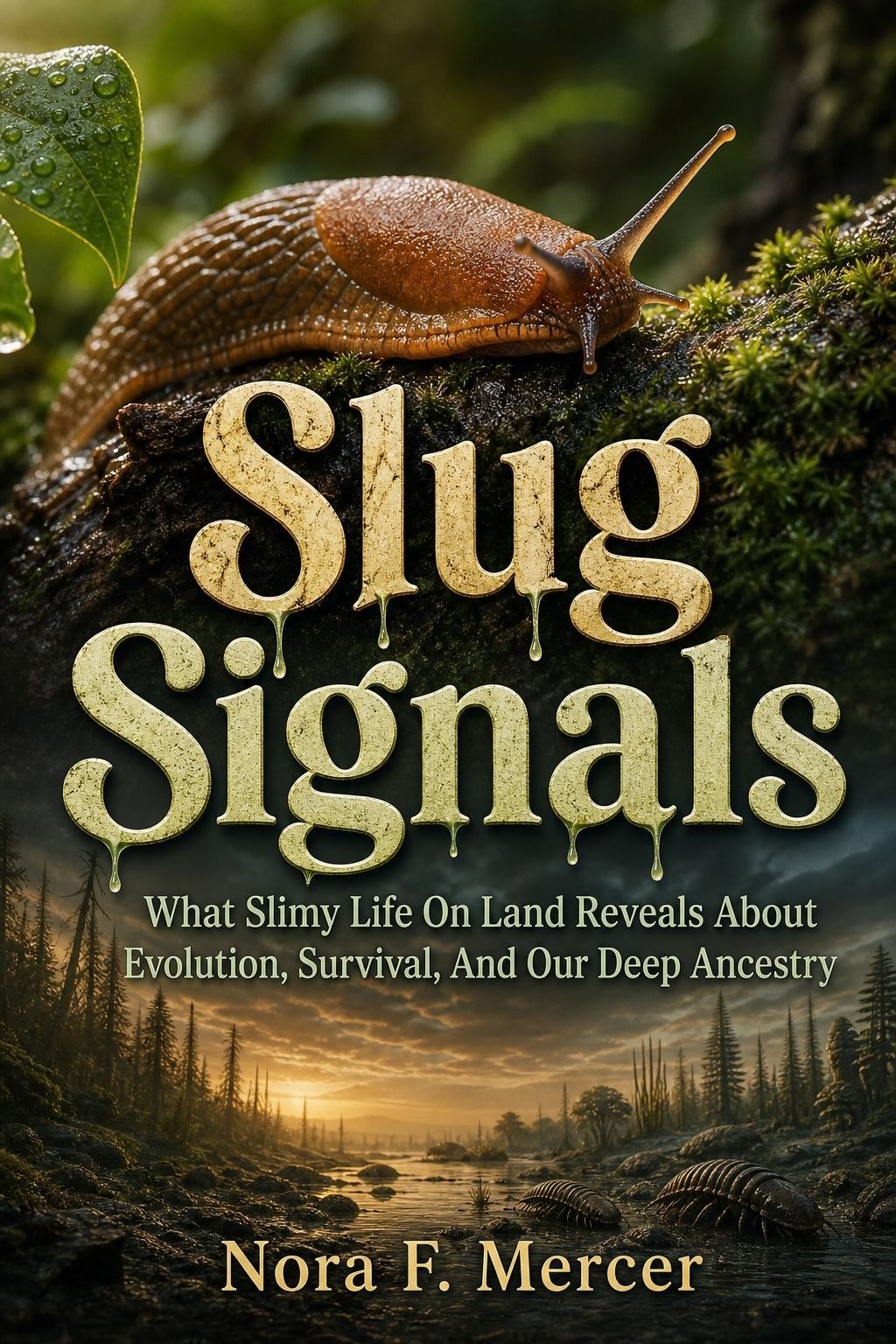
Naturalist and science writer Nora F. Mercer has released a new ebook, Slug Signals: What Slimy Life on Land Reveals About Evolution, Survival, and Our Deep Ancestry, now available through https://bookstore.ebookit.com/bookstore/slug-signals/a845b4. The 153-page book examines the biology of slugs — how they move, breathe, sense their environment, and survive in habitats where moisture is scarce and predators are constant. Mercer argues that these overlooked garden animals hold clues to the ancient transition of life from water to land, making the book relevant to readers who want accessible science writing grounded in everyday encounters rather than laboratory abstraction.
Slugs rarely draw scientific attention outside of pest-control contexts, yet their soft-bodied physiology represents a distinct evolutionary solution to life on land. Unlike snails, slugs lack a full external shell, which means their survival depends entirely on other adaptations — chiefly, mucus. Mercer's book fills a gap in general-audience nature writing by focusing on an animal most readers dismiss without examining closely. The category (Nature / Animals / Mammals, NAT019000) reflects a growing readership interest in books that use small, familiar creatures as entry points into larger questions about evolution, adaptation, and deep time. Slug Signals is positioned for curious general readers and science-minded nature lovers rather than academic specialists.
The book's core subject is slug mucus — what it is made of, how it functions, and why it matters biologically. Mercer explains how slime reduces friction to enable movement across rough or dry surfaces, how it regulates moisture to prevent desiccation, and how it doubles as a defense mechanism and a signaling tool between individuals. These functions are presented not as isolated facts but as an integrated system that explains why slugs can survive in environments that would otherwise be hostile to a soft-bodied animal with no shell for protection.
Slug Signals also addresses a common point of confusion: what actually distinguishes a slug from a snail. Mercer traces this distinction to evolutionary history rather than surface appearance, showing how shell loss and related anatomical changes reflect deeper adaptive trade-offs. The book uses this comparison as a springboard into broader material on how land-dwelling invertebrates illuminate the ancient transition of life from aquatic to terrestrial environments — a topic usually confined to paleontology texts but rendered here through observable, present-day biology.
Where many nature books aim for broad surveys of a habitat or ecosystem, Slug Signals stays narrowly focused on a single animal and follows its biology in depth. This focus allows Mercer to build a sustained argument — that slug anatomy is a window into deep ancestry — rather than presenting a loose collection of facts. The approach mirrors Mercer's other titles, including Worms in Motion and The Ant Collective, which apply the same close-focus method to different small creatures, building a body of work centered on overlooked animals with outsized evolutionary stories.
"Slugs are proof that you don't need a shell, a skeleton, or speed to be an evolutionary success story — you just need the right strategy," said Nora F. Mercer, author of Slug Signals.
The book is written for general readers with curiosity about biology, as well as science-minded nature lovers who enjoy field-based observation. Gardeners who encounter slugs regularly may find explanations for behaviors they've noticed but never understood, such as trail-following or moisture-seeking after rain. Educators and homeschool parents covering invertebrate biology or evolution units may use the book as supplementary reading. Nature writers and podcasters covering biodiversity or garden ecology may also find source material for episodes or articles on an animal that rarely receives dedicated coverage. The book's short length and accessible structure make it suitable for readers seeking a focused, single-sitting introduction to a specific biological topic rather than a comprehensive field guide.
Slug Signals is available now as an ebook for $2.99 through https://bookstore.ebookit.com/bookstore/slug-signals/a845b4, in EPUB and PDF formats. Buyers receive secure download links by email after checkout, with a 72-hour access window, and no bookstore account is required. The listing page also includes related titles by Mercer, including The Woodpecker Signal, The Wasp Code, The Night Call of Owls, and Buried Lineages, for readers interested in her broader catalog of nature-focused nonfiction.
Slug Signals extends Mercer's ongoing series of books examining small, commonly overlooked animals — including earthworms, native bees, and tide pool creatures — as entry points into evolutionary biology. Each title in the series follows a similar model: a single animal, closely observed, used to explain broader biological principles for a general audience. Future titles are expected to continue this pattern, with Mercer indicating she plans to keep exploring species that are abundant in everyday environments but rarely examined in depth by popular science writing.
Slug Signals by Nora F. Mercer is available now at https://bookstore.ebookit.com/bookstore/slug-signals/a845b4. eBookIt provides a direct digital storefront for independent authors and publishers, offering ebook and audiobook listings with instant download delivery. The platform allows readers to review author details, subject categories, available formats, and pricing before purchase, and delivers secure download links by email rather than requiring shipping or account creation.