Portland, Maine — 2026-07-18
Nora F. Mercer Releases The Ant Collective, a Science Book on the Origins of Cooperation
167-page book examines how ant colonies reveal the evolutionary roots of social behavior; now available as a $2.99 ebook
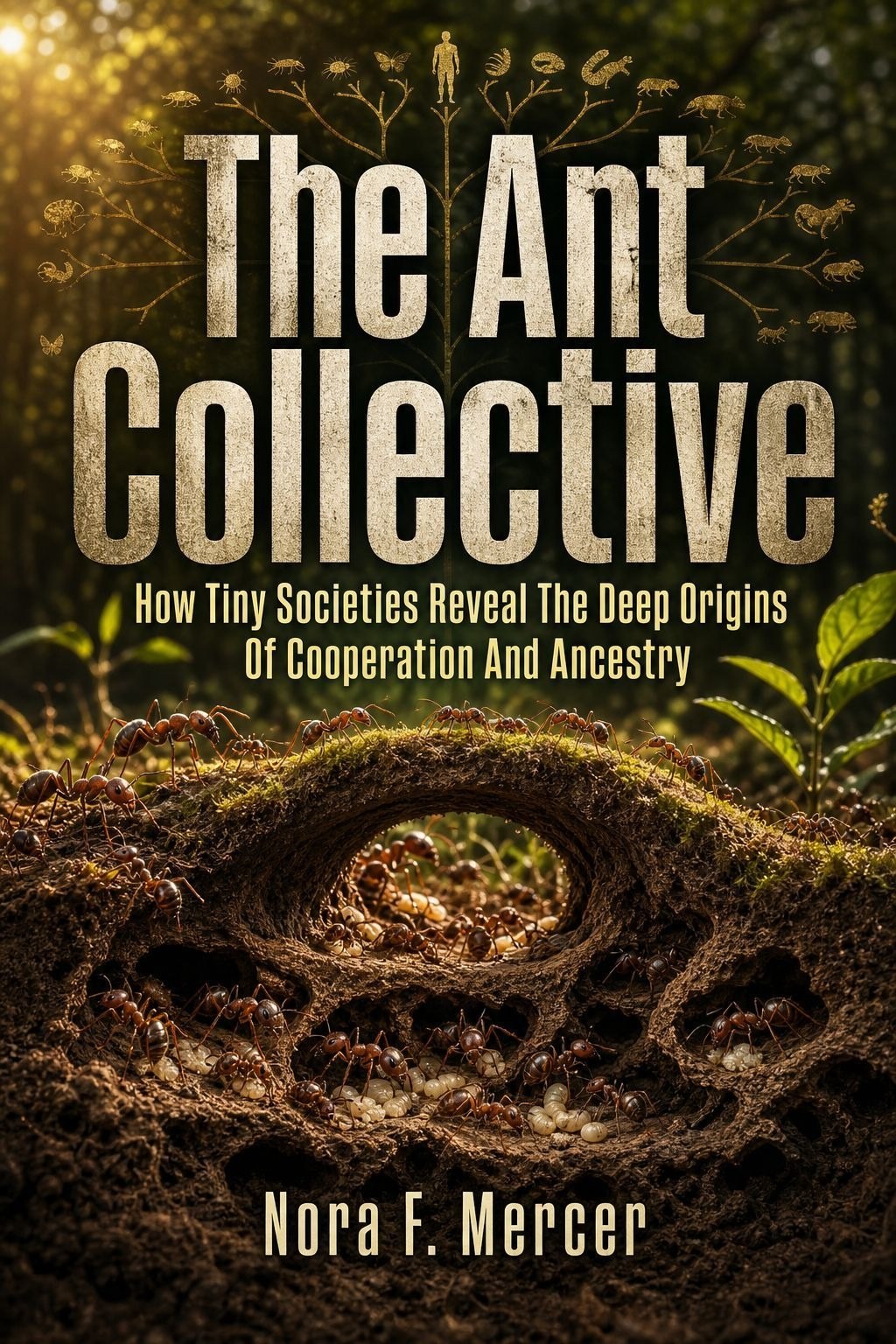
Naturalist and science writer Nora F. Mercer has released The Ant Collective: How Tiny Societies Reveal the Deep Origins of Cooperation and Ancestry, a 167-page book examining how ant colonies illustrate the evolutionary origins of cooperation. The book is available now as an ebook for $2.99 through eBookIt at https://bookstore.ebookit.com/bookstore/the-ant-collective/20f01e, with EPUB and PDF formats included at purchase. Categorized under Science / Life Sciences / Evolution (SCI027000, ISBN 9781456684594), the book argues that ant societies function as a working model for understanding how solitary organisms evolved into organized collectives — a question with implications far beyond entomology.
Ants number among the most ecologically dominant animal groups on Earth, influencing soil composition, seed dispersal, predation patterns, and nutrient cycling across nearly every terrestrial ecosystem they inhabit. Despite this scale of influence, popular science writing on social insects often stays within specialist circles rather than reaching general readers. Mercer's book is aimed at closing that gap, translating research on colony behavior, kin selection, and caste specialization into material accessible to readers without a background in biology. The book arrives amid sustained public interest in books that use non-human systems — from fungal networks to bird migration — to explore questions about cooperation, individuality, and evolution that apply across the tree of life.
The Ant Collective traces the transition from solitary insect ancestors to organized colony life, focusing on the environmental pressures and genetic relatedness that made group living advantageous. Mercer walks through the biological logic of the first family groups — early associations where offspring remained with parents rather than dispersing — and explains how that arrangement, combined with pressures like predation and resource scarcity, set conditions for permanent social structure. The book treats colony formation not as a single event but as a gradual accumulation of small advantages, offering readers a framework for thinking about how cooperation becomes stable across generations.
A second focus of the book is the physical and neurological machinery that makes colony coordination possible. Mercer examines the ant body and brain in detail, describing how sensory systems and pheromone signaling allow thousands of individuals to coordinate labor without central direction. She covers task specialization among workers, soldiers, and reproductive castes, showing how division of labor emerges from chemical communication and simple behavioral rules rather than top-down control. The book connects these mechanics back to its central theme: that ant colonies function as a kind of superorganism, and studying how that superorganism operates offers insight into the deep biological roots of social behavior in general.
Where many popular science titles on insects emphasize novelty or spectacle, The Ant Collective is structured around a single sustained argument about cooperation's origins, moving systematically from evolutionary history to physiology to ecological impact. At 167 pages, it is designed as a compact, focused read rather than an exhaustive survey, aimed at readers who want a clear throughline rather than an encyclopedic treatment of ant biology. The book fits within a broader body of work by Mercer that examines overlooked or small-scale organisms — including prior titles on wasps, slugs, and earthworms — as entry points into larger questions about evolution and ecology.
"Ant colonies aren't just insect trivia — they're one of the clearest working examples we have of how cooperation gets built from the ground up," said Nora F. Mercer, author of The Ant Collective.
The book is written for curious general readers, science enthusiasts, and educators looking for accessible material on evolutionary biology and social behavior. Readers interested in ecology, animal behavior, or the biological basis of cooperation are a primary audience, as are teachers seeking supplementary material for life sciences courses covering evolution or ecosystems. Book clubs focused on popular science, and readers who have previously engaged with texts on collective behavior in nature — from bee colonies to fungal networks — are likely to find the book's framing familiar and useful. The book's compact length also makes it suited to readers looking for a focused treatment of a specific topic rather than a lengthy survey text.
The Ant Collective is available now exclusively as an ebook priced at $2.99, sold directly through eBookIt at https://bookstore.ebookit.com/bookstore/the-ant-collective/20f01e. Purchases include both EPUB and PDF formats, delivered via a secure download link emailed after checkout, with no bookstore account required. The listing also displays a 72-hour download window for retrieving purchased files. No print or audiobook edition is currently listed for this title.
The Ant Collective adds to a growing catalog of nature-focused science writing from Mercer, who has previously published titles on wasps, slugs, woodpeckers, owls, and earthworms, each examining an overlooked organism as a lens for broader biological questions. Readers interested in the author's other work can find related titles, including The Wasp Code, Slug Signals, and Worms in Motion, listed alongside The Ant Collective on its eBookIt purchase page. Mercer's body of work suggests a continuing focus on small, often-overlooked species as case studies for understanding cooperation, adaptation, and ecological interdependence.
Nora F. Mercer is a naturalist and science writer who spends her time exploring forests, beaches, wetlands, and meadows in search of stories about overlooked species. She has written extensively on organisms including earthworms, native bees, birds, and tide pool life, with a consistent focus on what small creatures reveal about larger biological patterns. The Ant Collective is her latest title, available now through eBookIt at https://bookstore.ebookit.com/bookstore/the-ant-collective/20f01e. eBookIt serves as a direct digital sales platform for independent authors and publishers, delivering ebook and audiobook purchases via secure download links without requiring a public storefront account.