Portland, Maine — 2026-07-18
Nora F. Mercer Releases Buried Lineages, a Natural History of Moles and Mammal Evolution
New 157-page book examines how moles' underground adaptations trace deep mammal ancestry; out now as an ebook for $2.99
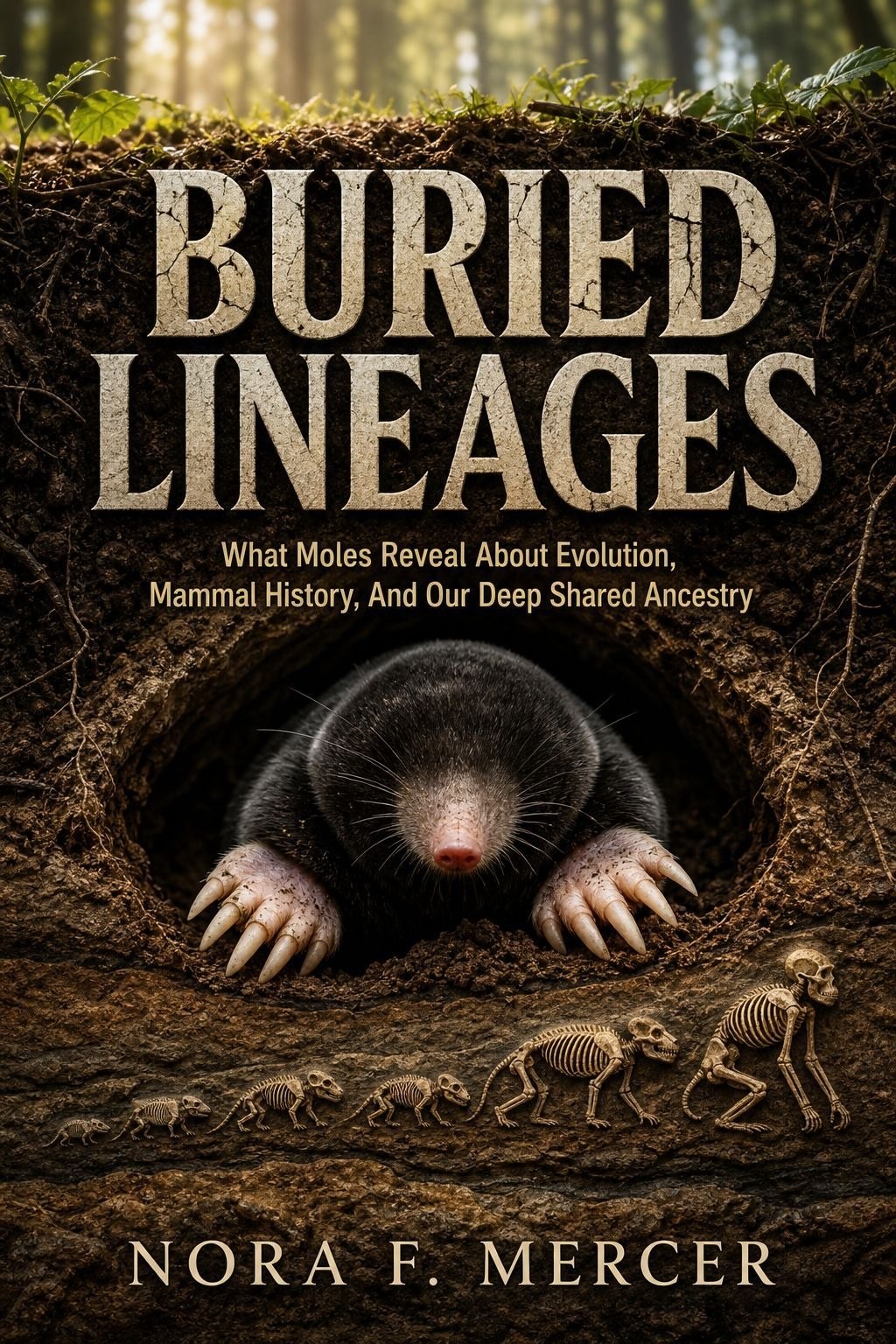
Nora F. Mercer has released Buried Lineages: What Moles Reveal About Evolution, Mammal History, and Our Deep Shared Ancestry, a 157-page nonfiction book available now through eBookIt at https://bookstore.ebookit.com/bookstore/buried-lineages/c01679. The book uses moles — often dismissed as garden pests — as a lens for explaining how mammals adapt to extreme environments and what subterranean life reveals about deep evolutionary history. Written for general readers and science-minded nature enthusiasts, Buried Lineages is categorized under Nature / Animals / Mammals (NAT019000) and carries ISBN 9781456684617. The release adds to Mercer's growing catalog of accessible science titles focused on overlooked animals.
Popular science writing about mammals tends to gravitate toward large, charismatic species — big cats, whales, primates — while smaller, less visible animals get little attention outside of academic literature. Moles occupy an unusual evolutionary position: multiple unrelated lineages, including true moles, shrew moles, and desmans, have independently developed similar digging adaptations in response to similar underground pressures. This pattern, known as convergent evolution, is one of the clearest examples available in mammalian biology, but it rarely reaches general readers in plain language. Buried Lineages was written to close that gap, translating research on mole anatomy and behavior into a narrative accessible to readers without a scientific background, while still respecting the underlying biology.
The book walks through the specific physical trade-offs that come with life underground. Mercer details how moles evolved powerful, shovel-like forelimbs, reinforced skulls capable of withstanding the pressure of tunneling, and reduced eyes that reflect the diminished value of vision in a lightless environment. Rather than treating these traits as isolated curiosities, the book frames them as evolutionary solutions to a shared problem, showing readers how similar environmental pressures can produce similar body plans in animals that are not closely related. This convergent design becomes the throughline connecting the book's chapters on anatomy, behavior, and ancestry.
Buried Lineages also introduces readers to the diversity within the mole world itself, comparing true moles, shrew moles, and desmans to illustrate how a shared evolutionary starting point can branch into distinct forms depending on habitat and constraint. Mercer uses these comparisons to build toward a larger argument: that studying subterranean mammals offers a window into mammalian history that predates humans by millions of years. The book positions moles not as minor curiosities but as a case study in how life adapts to extremes, with implications for understanding evolutionary constraint more broadly.
What sets Buried Lineages apart from typical wildlife guides is its explicit focus on evolutionary mechanism rather than field identification or habitat description alone. Instead of cataloging mole species for identification purposes, the book uses mole biology as a teaching tool for broader concepts — convergent evolution, physical trade-offs, and deep ancestry — while keeping the writing free of academic jargon. It sits closer to accessible science writing than to a traditional nature guide, aimed at readers who want the