San Antonio, Tx — 2026-07-18
New Book "Library of Democracy" Makes the Case for Public Libraries as Civic Infrastructure
Quentin P. Yarrow's 163-page book argues free access and community spaces are essential to self-government; out now for $2.99
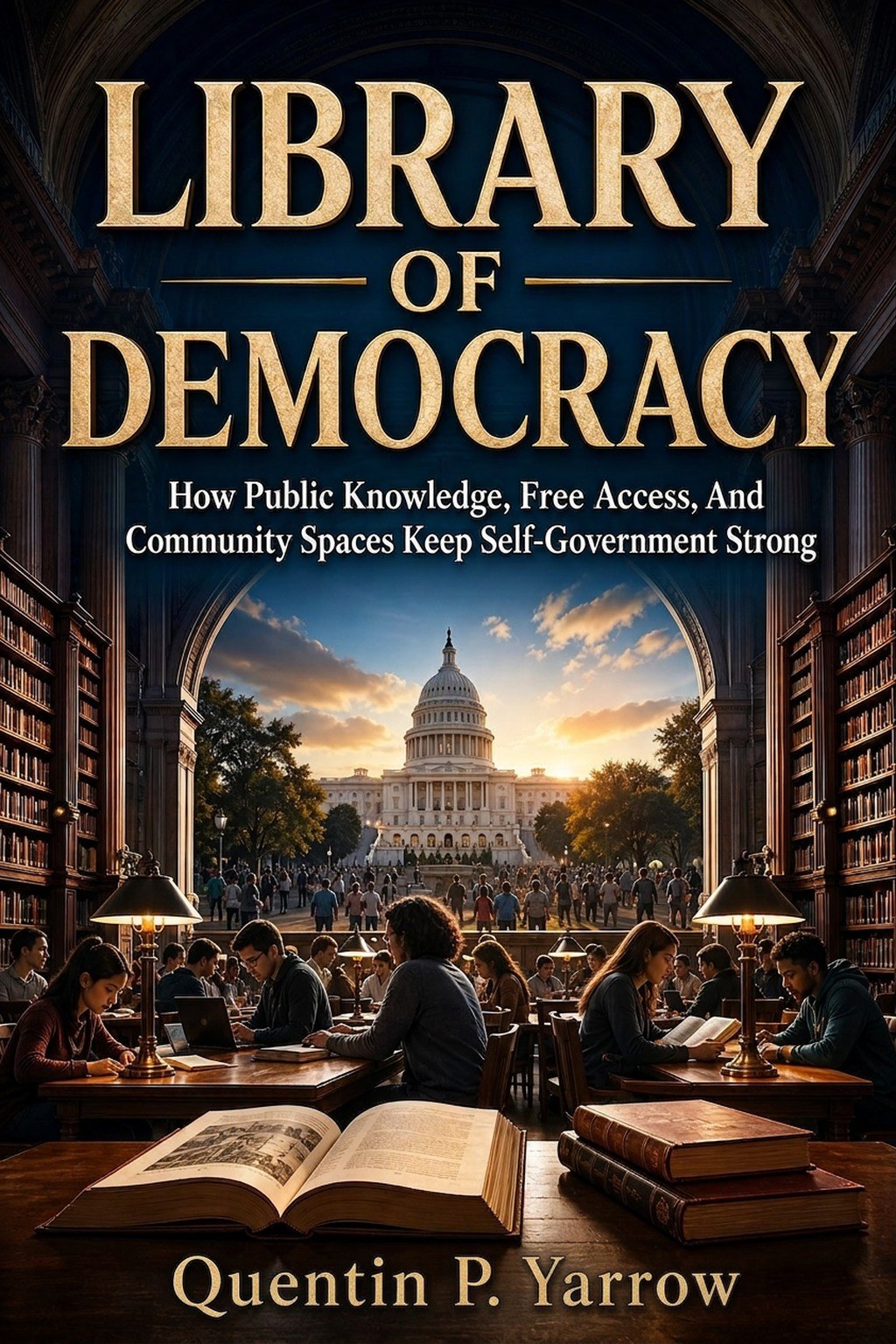
Author Quentin P. Yarrow has released "Library of Democracy: How Public Knowledge, Free Access, and Community Spaces Keep Self-Government Strong," a 163-page book arguing that public libraries function as essential civic infrastructure rather than optional amenities. The ebook is available now through https://bookstore.ebookit.com/bookstore/library-of-democracy/360fdd in EPUB and PDF formats for $2.99. The book arrives as public libraries face funding cuts, censorship battles, and questions about their relevance in an era of algorithm-driven media, positioning Yarrow's argument squarely within an active national debate over who controls access to information and public space.
The book responds to a specific shift: as media consolidates into private platforms and information delivery becomes increasingly personalized by algorithms, fewer public spaces remain where citizens encounter shared facts and unfiltered debate. Yarrow contends that libraries fill this gap by design — offering free access regardless of income, protecting patron privacy, and hosting civic activity without a commercial or political filter. The book is aimed at students, educators, librarians, civic leaders, and general readers, and it is written to be usable in classrooms and civic discussions as well as read cover to cover. Its timing tracks with library funding fights playing out in state legislatures and local budget cycles across the country.
Across its chapters, "Library of Democracy" builds a case in five parts: why democracy depends on shared institutions, how libraries lower barriers to learning and participation, why free access and intellectual freedom matter, how public libraries serve the common good, and what it takes to defend libraries in the current political and economic climate. Yarrow draws on history and civic theory to connect the library's traditional functions — lending, reference, preservation — to their less obvious role in sustaining an informed electorate.
The book also addresses privacy directly, arguing that a library's refusal to track or monetize patron behavior sets it apart from most modern information sources. Yarrow frames this as a democratic safeguard: citizens can research, read, and form opinions without those choices being logged, sold, or used to target them. The final chapters turn practical, offering readers a framework they can use to advocate for library funding and defend libraries against closures or content restrictions in their own communities.
Unlike policy papers aimed at legislators or trade publications aimed at library professionals, "Library of Democracy" is written in plain, accessible language for a general audience while remaining formal enough for classroom use. It treats the library not as a nostalgic institution but as active civic machinery, comparable in function to courts or elections in sustaining self-government. The book joins Yarrow's broader catalog — including "Common Ground Democracy," "Press and Power," and "Civic Foundations" — each examining a different institution under democratic strain.
"A library card is one of the last things you can hold that gives you free, unmonitored access to the world's knowledge," said Quentin P. Yarrow, author of Library of Democracy. "Protecting that is not nostalgia. It's civic maintenance."
The book targets several overlapping audiences with direct stakes in the library debate: librarians seeking language to defend budgets before city councils and school boards, educators building civics curricula, students researching media literacy and public institutions, and civic leaders responding to book-banning campaigns or funding cuts. General readers concerned about the erosion of shared public space will find a compact argument they can finish in a few sittings and cite in local debates. The book's length and structure make it usable as assigned reading in political science or civics courses, and its five-part framework gives advocates a ready-made outline for public comment or op-eds defending library funding.
"Library of Democracy" is available now exclusively as an ebook through eBookIt at https://bookstore.ebookit.com/bookstore/library-of-democracy/360fdd, priced at $2.99 for EPUB or PDF formats. Purchases are handled as a direct digital transaction, with eBookIt emailing secure download links after checkout rather than requiring a bookstore account or shipping wait. The listing falls under Political Science / Political Process / Campaigns & Elections (POL008000), ISBN 9781456684549. No print edition or audiobook is currently listed.
"Library of Democracy" extends a body of work Yarrow has built around the institutions that keep democratic self-government functioning, following "Common Ground Democracy," "Press and Power," and "Civic Foundations." Each title examines a different pillar — shared ground, a free press, civic foundations, and now public libraries — under pressure from privatization, polarization, and unequal access. Readers who finish this book are pointed toward the rest of the series for a fuller picture of Yarrow's argument about what democratic maintenance actually requires in practice.
Quentin P. Yarrow is a writer focused on how democracies succeed, struggle, and can be strengthened by ordinary citizens. A lifelong student of history, government, and civic life, he writes books that use clear explanations and engaging examples to make the case for the institutions self-government depends on. "Library of Democracy" is available now through eBookIt at https://bookstore.ebookit.com/bookstore/library-of-democracy/360fdd, alongside Yarrow's other titles on civic life and democratic institutions.