Boston, MA — 2026-06-03
MemoirMaker.ai Lets Anyone Speak a Life Story Into a Finished Book
Voice-first AI platform converts recorded memories into editable memoir chapters with cover art, PDF, and DOCX export for $99.
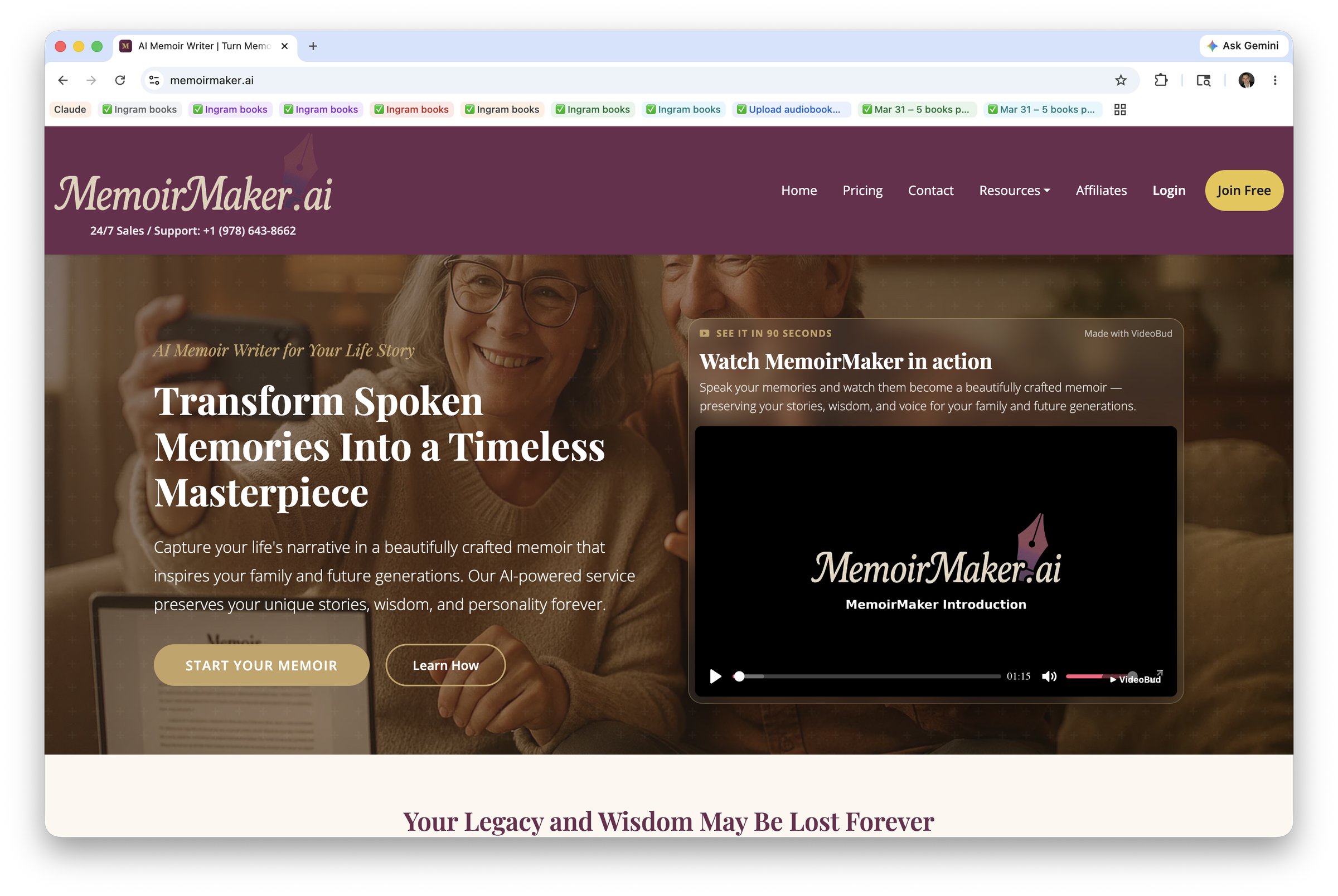
https://www.memoirmaker.ai has launched a voice-first memoir platform that converts spoken or typed memories into formatted book chapters, addressing one of the most common failures in personal storytelling: projects that start but never get finished. The tool accepts audio recordings or text input, uses AI to shape the raw material into structured memoir chapters, and delivers a downloadable manuscript — complete with AI-generated cover art — in PDF or DOCX format. The release targets a gap that has persisted across decades of journaling apps, dictation software, and self-publishing services: the absence of a guided, low-friction path from raw memory to finished book.
The memoir market has long been dominated by professional ghostwriters charging tens of thousands of dollars, or by blank-page software that places the full burden of structure and prose on the writer. The result, according to Bo Bennett, PhD, founder of MemoirMaker.ai and Archieboy Holdings, is that the vast majority of memoir projects stall. People accumulate notes, record voice memos, or fill the first few pages of a journal — and then stop. The psychological mechanism is well documented: the gap between intention and completion widens when a task lacks clear next steps. MemoirMaker's guided chapter structure is designed specifically to close that gap, giving users a defined workflow rather than a blank canvas. The platform is positioned for older adults preserving family history, individuals processing significant life events, and anyone who has a story to tell but lacks the time, writing confidence, or editorial support to finish it alone.
The core workflow has four steps. Users speak or type their memories — a single life event, a decade, or a full autobiography — and the platform's AI transcribes and transforms that input into a draft chapter that preserves the speaker's voice and tone. A built-in creativity slider, the same mechanism used in Bennett's earlier tool ConceptsOfABook, lets users control how much the AI extrapolates versus how closely it adheres to the exact words spoken. Bennett notes that speaking for five to ten minutes per section gives the AI sufficient material to work from; thinner input forces the model to fill gaps with invented detail, which the slider helps users detect and correct. After generation, users move into a full editing environment where they can revise prose, reorganize sections, add named characters and locations, and annotate specific life events.
The editing layer is designed to remain live, not just serve as a one-time export. Users can return to their memoir to add new chapters as life events unfold — a feature the platform calls Narrative Flexibility. The finished document exports as a professionally formatted PDF or DOCX file, with an AI-generated cover that users can customize by mood, style, and color scheme. For users who want to move beyond a family keepsake into commercial publication, MemoirMaker.ai connects to BookMarketing.pro, a publishing and marketing service operated under the Archieboy Holdings umbrella, which has published more than 10,000 books since 2011 and paid more than five million dollars to authors across its portfolio.
"We're not going to be here forever, and there is a sense of urgency in getting this done," said Bo Bennett, PhD, Founder, Archieboy Holdings. "They just get stuck — they don't know what to do, they put it off, and it never gets done. With AI, it allows you to actually get this done."
The platform serves several distinct user groups whose needs have historically required very different solutions. Older adults and retirees who want to leave a documented legacy for children and grandchildren represent the core audience; for them, the voice-recording input removes the friction of typing and the cover art output produces something that feels like a real book rather than a printout. A second segment includes individuals using memoir writing therapeutically — processing trauma, marking recovery, or working through major life transitions. Research in narrative psychology supports the therapeutic value of structured life-story writing, and MemoirMaker's chapter-by-chapter format provides the scaffolding that unstructured journaling lacks. A third use case is the personalized gift market: a child's immigration story recorded by a parent, a grandparent's account of living through a historical moment, or a couple's shared account of how they met — all formatted and delivered as a physical or digital book.
MemoirMaker.ai is available now at https://www.memoirmaker.ai on a one-time purchase model with no recurring subscription. The entry tier is $99 for one complete memoir, including voice transcription, editing tools, and manuscript downloads with one year of platform access. A three-memoir pack is priced at $270, five memoirs at $425, and ten memoirs at $750 — the ten-pack representing a per-memoir cost of $75. Every tier includes voice transcription, the full editing suite, AI cover art generation, and formatted DOCX and PDF export. There is no freemium tier listed; users pay at the point of project creation. The one-time pricing model is a deliberate departure from subscription fatigue, positioning the product as a purchase comparable to hiring a single session with a writing coach rather than an ongoing software commitment.
MemoirMaker.ai is one of more than fifty author-focused tools developed under Archieboy Holdings, a portfolio that Bennett describes as oriented toward giving individuals the infrastructure previously available only to traditionally published authors. Bennett is currently using MemoirMaker himself to co-write a continuation of his own memoir with his wife, picking up where his first published book left off at age 22. That use case — extending an existing narrative rather than starting from scratch — points toward a roadmap that includes deeper integration with the BookMarketing.pro publishing pipeline and expanded support for multi-author or collaborative memoir projects. The platform's underlying AI architecture is also expected to benefit from improvements to large language model accuracy, which will reduce the gap between raw spoken input and publication-ready prose without requiring users to adjust the creativity slider manually.
Archieboy Holdings (https://www.memoirmaker.ai) is a portfolio of more than fifty tools and services built for authors, creators, and individuals who want to produce, publish, and distribute written work without traditional publishing infrastructure. Founded by Bo Bennett, PhD, whose background spans web technology entrepreneurship and social psychology, the company has published more than 10,000 books since 2011 and paid more than five million dollars to authors through its publishing services arm. MemoirMaker.ai represents the company's application of generative AI to personal narrative — extending a mission that Bennett has described as helping people get done what they already intend to do.
