FORT WORTH, TX — 2026-10-29
Mart Ratliff's 'The Birds and Bees of Leadership' Frames Workplace Dysfunction as a Design Problem
Book One of the Leadership by Design series argues that signal integrity determines whether an organization survives
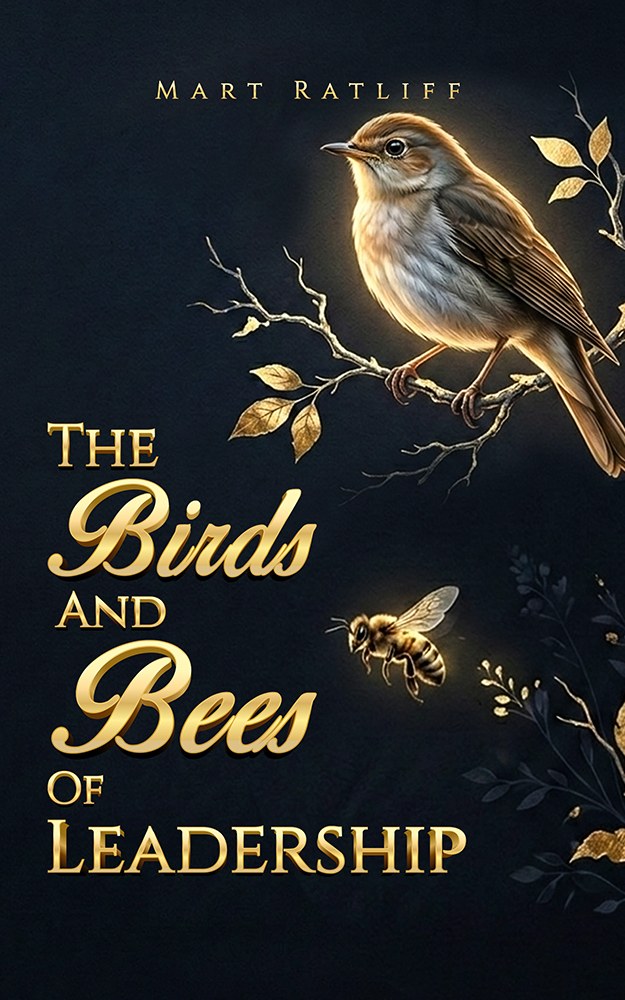
Mart Ratliff has released The Birds and Bees of Leadership, a non-fiction book that treats leadership as a design problem rather than a motivation problem. The title is Book One of the Leadership by Design series and is listed on Amazon at https://www.amazon.com/dp/B0GY9L3K47. The book starts from a familiar frustration: the same workplace problem keeps coming back under a new name every year, and there is a structural reason it never dies. Organizations learn from signal and adapt to reinforcement. A flaw built into either one reproduces itself no matter who is hired, trained, or replaced. Ratliff draws on biological systems, behavioral science, and his own experience leading teams to explain how that mechanism works and what leaders can change.
Most leadership guidance arrives as a list of behaviors: communicate more clearly, motivate harder, hold people accountable, build a better culture. Ratliff's starting point is that this advice begins too late. Communication, accountability, motivation, and culture, he argues, do not appear on their own. They are outputs of a system. In his account, organizations relabel the same trouble year after year, as a morale issue, an engagement issue, a burnout issue, or a retention issue, and then apply a fresh round of training aimed at individuals. When the underlying structure stays the same, the symptom returns under a different label. The book is written for managers, founders, executives, and organizational leaders who sense that something is off but have not yet identified the mechanism producing it.
The book also addresses a pattern many leaders will recognize: capable, talented people who still produce less than their potential, and a leader who responds by raising the intensity. Ratliff contends that exhausted leaders often mistake intensity for effectiveness. Pushing harder on a system with distorted signals adds strain without adding clarity. In his framing, organizational performance is rarely just a people problem. It is more often the downstream result of signal distortion, reinforcement patterns, and structural drag that leaders do not realize they are creating. That diagnosis changes the question a leader asks. Instead of "Who is failing?", the question becomes "What is this organization being taught to do, and by whom?"
The central claim of the book is the governing law on which the series builds: signal integrity determines system survival. According to the book's description, organizations organize themselves around what leaders consistently make safe, costly, visible, and survivable. Those four conditions serve as the working vocabulary of the framework. The logic is direct. If telling the truth is costly, information stops moving upward. If visibility attaches to activity instead of results, activity multiplies. The book treats these outcomes as predictable responses to the environment rather than character flaws in employees. It asks leaders to audit the signals they send, deliberately or not, before they diagnose the people who receive them.
Biology is the second pillar of the argument. According to the book's description, Ratliff examines how biological systems coordinate behavior, distribute strain, and sustain performance. He looks at the regulatory signals that shape culture and the formation structures that extend endurance as examples of natural systems that expose laws human organizations follow without realizing it. The description is explicit that this is not a book of decorative animal metaphors or motivational fluff. Biology serves as evidence for mechanisms, and behavioral science supplies the account of how reinforcement shapes conduct. The intended result is a practical framework for understanding how organizational behavior is formed, how team performance degrades, and how small changes in signal and structure can alter the performance of an entire organization.
The book positions itself against the genre it sits in. Rather than offering a set of tips, it presents what its description calls a blueprint for understanding how leadership systems actually work. Much leadership writing focuses on the individual leader's traits, habits, or communication style. Ratliff shifts attention to the architecture around those individuals: what gets rewarded, what gets punished, what gets noticed, and what a person can say and still keep their standing. The approach also reframes burnout. Instead of treating exhaustion as a personal limit to be managed with better resilience, the book treats it as a possible indicator of structural drag that a redesign could reduce.
"Leaders keep fixing people when the structure is what's teaching them. Change what the system makes safe, costly, and visible, and behavior follows," said Mart Ratliff, author of The Birds and Bees of Leadership.
The book is aimed at readers who carry responsibility for how other people work together. Managers who inherit a team that is stuck, founders who watch a small company develop habits they never intended, and executives who see the same issue resurface after each reorganization are the audiences named in its description. A practical reading of the framework suggests several uses: reviewing which behaviors a team's current incentives actually reinforce, tracing where information degrades as it moves between levels, and identifying where a leader's own urgency may be adding strain. The book also speaks to people who have followed conventional advice faithfully and still feel something is off. Its promise is a sharper diagnosis and a more durable way forward.
The perspective comes from Ratliff's own path. His author biography describes a lifelong student of how people actually work together who, after years of leading teams and trying to follow the usual leadership advice, became convinced that most of it was solving the wrong problem. Leaders were told to work harder, motivate better, and communicate more, while the real issue was structural design. That realization sent him looking in unexpected places: biological systems, behavioral science, the lessons learned from working with dogs, and the grounding influence of faith and family. Out of that search grew the Leadership by Design framework, which he describes as a practical way to reduce friction, increase clarity, and help organizations perform without burning people out.
The Birds and Bees of Leadership is available through Amazon at https://www.amazon.com/dp/B0GY9L3K47. Readers can find current format options, pricing, and availability on the product listing, and can preview the book's description there before purchasing. The title is classified as non-fiction. No bundled offers, institutional programs, or volume pricing have been announced, and organizations or reading groups interested in the book should consult the listing for the purchasing options it presents. Because the book is positioned as the first volume of a series, readers who want the foundation of the framework before any later material will find it in this installment.
The book is the opening installment of the Leadership by Design series, and its description calls it the foundational volume that establishes the governing law everything else builds on. That positioning signals a longer project: a body of work that treats leadership as something that can be designed, tested, and corrected rather than something reserved for people with charisma or instinct. Ratliff's biography states that he pursues this work through writing, speaking, and nonprofit work, with a stated commitment to making healthier leadership structures accessible to organizations, communities, and people who are struggling more than they should. Details on future volumes, titles, and release timing have not been announced in the materials supporting this release.
About The Birds and Bees of Leadership and Mart Ratliff. The Birds and Bees of Leadership is a non-fiction book by Mart Ratliff and Book One of the Leadership by Design series. It reframes leadership as a design problem, drawing on biological systems, behavioral science, and leadership experience to explain how signal distortion, reinforcement patterns, and structural drag shape organizational performance. Ratliff describes himself as a husband, dog-father, dog lover, and lifelong student of how people work together. Through writing, speaking, and nonprofit work, he aims to help leaders build healthier systems for the people who depend on them. The book is available at https://www.amazon.com/dp/B0GY9L3K47.
