Seattle, Washington — 2026-11-02
Linda Soules Releases 'So You Want To Be An Inventor,' a STEM Career Guide for Ages 10–14
The 38-page illustrated guide covers prototypes and patents and has won Mom's Choice Gold and a 2026 Purple Dragonfly Grand Prize
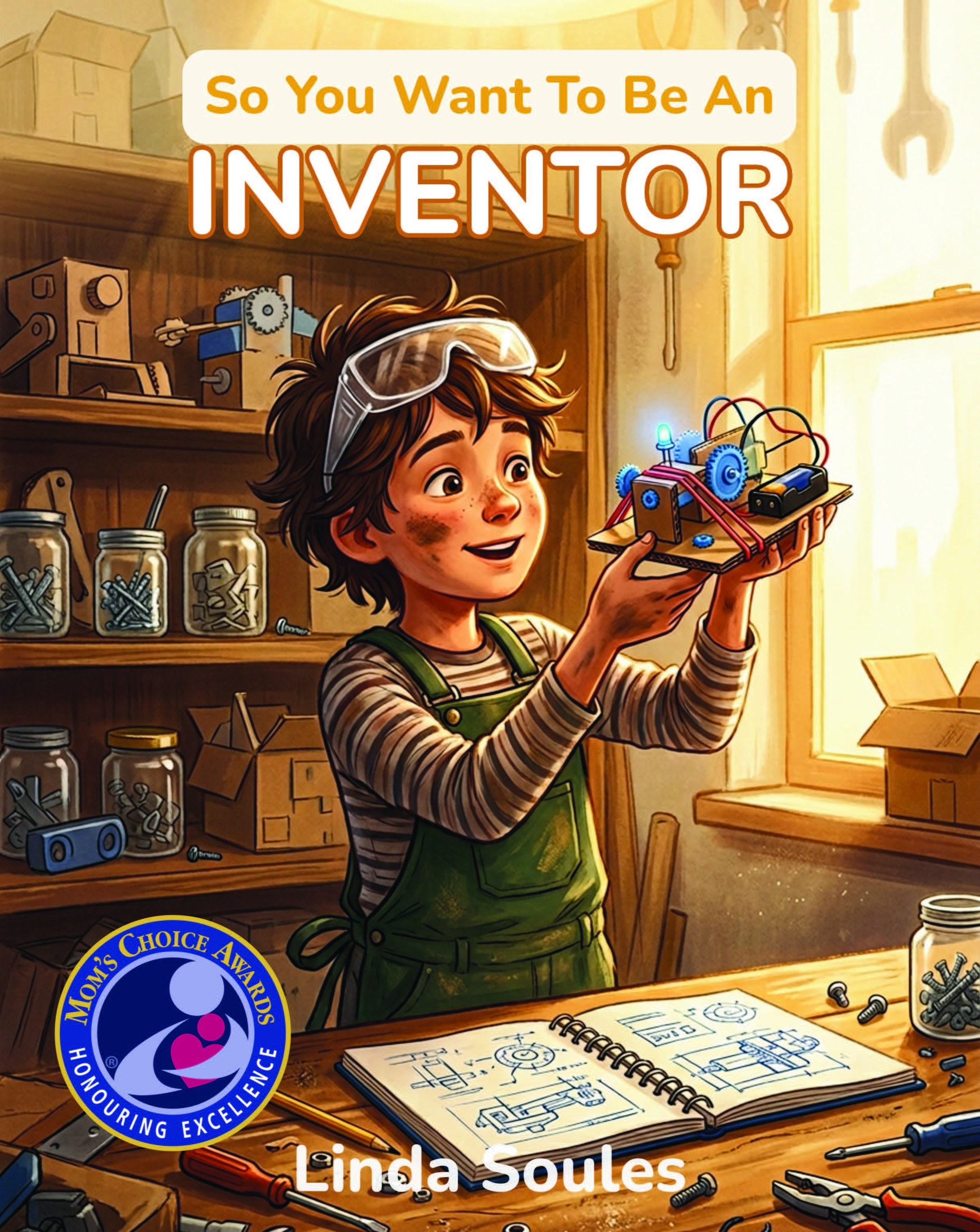
Author Linda Soules has released So You Want To Be An Inventor: A Kids' Guide to Invention, Creative Problem-Solving, Patents and Prototypes, and the Brilliant Minds Who Change the World with New Ideas, a 38-page illustrated children's nonfiction book for readers ages 10 to 14. The book is available now at https://www.amazon.com/dp/1972766120. It is the latest title in her So You Want To Be A... career-exploration series. It walks young readers through the work of inventing, from the first question to a finished creation, and covers the patent process that protects new ideas. The book has already collected a Mom's Choice Award Gold, a Grand Prize at the 2026 Purple Dragonfly Book Awards and a Silver Award in Children's Nonfiction at the 2026 CIPA EVVY Book Awards.
Children's STEM books often present invention as a string of eureka moments, with a lone genius, a flash of insight and a finished product. Soules argues that this picture misleads the young readers most likely to be curious about inventing. Real invention, as the book describes it, usually begins with a restless question and moves through science experiments and failed prototypes. It then reaches something new only after repeated testing and revision. Inventors, engineers, scientists and designers typically work together on problems others have written off as impossible. The book is aimed at readers who are already curious about how things work: kids who take apart toasters to see how they run, or who sketch improved versions of ordinary objects in notebook margins. It treats that habit as the real starting point of an inventing career, not as a distraction from schoolwork.
The book is organized around the practical elements of an inventor's work. It covers design thinking and creative problem-solving as methods a reader can start using, not as abstract vocabulary. It explains the science and engineering principles behind well-known inventions in plain language and presents them as tools for understanding how things are made. Hands-on activities give readers experiments to try and questions to ask. Vivid illustrations accompany the text throughout, and Soules writes in a direct, conversational voice that assumes her readers can handle real detail. The goal is for a reader to finish a chapter with something to do, not only something to remember.
A dedicated portion of the book addresses the patent process, a subject rarely covered in books for this age group. It explains what a patent is for and how it protects a new idea. It also shows why prototypes matter to an inventor trying to move from concept to a working object. The book profiles inventors who changed everyday life through persistence and a refusal to accept that the world had to stay the way it was. It places their stories alongside the practical skills a young reader can begin building now. The result is meant to function as a roadmap for deciding whether inventing might be a calling, not as a lecture on what to become.
The book's central difference is what it declines to do. It does not claim that inventing is easy or glamorous. It describes the cost of the work: late nights, versions that do not function, and the discipline of failing instructively, meaning learning precisely why something broke. It then describes the payoff, the moment when a thing imagined becomes a thing that exists. That honest framing sets it apart from career books that present a polished highlight reel. It also reflects the philosophy behind the whole series, which holds that young readers are smarter, more curious and more capable than the publishing world often assumes, and that they are better served by candor than by cheerleading.
"Kids are told inventors are lone geniuses with a lightbulb moment. The real story is questions, failed prototypes and teamwork, and young readers can handle that," said Linda Soules, author of the So You Want To Be A... series.
The book is written for children ages 10 to 14 who are weighing what they might want to do someday, and for the parents, teachers and librarians who help them explore. A middle schooler who likes to tinker can use it to see how a hobby connects to engineering, science and design careers. A classroom or library can pair it with maker projects, STEM units or career-exploration programs, since its activities and questions are meant to be tried. Families looking for a gift for a curious child will find a book that focuses on what young people can do right now, such as the questions to ask, the experiments to try and the skills to build, instead of on distant credentials. Because it shows failure as a normal stage of the work, it may also help readers who are discouraged when their first attempts do not succeed.
The book has drawn recognition from three award programs. It is a recipient of the Mom's Choice Award Gold, which honors excellence in family-friendly media and products. It won the Grand Prize in the 2026 Purple Dragonfly Book Awards. It also earned a Silver Award in Children's Nonfiction at the 2026 CIPA EVVY Book Awards. The honors place the title among the better-reviewed entries in a series that has now drawn awards attention across multiple books. The book carries the ISBN 978-1-972766-12-5 and is classified as children's nonfiction.
So You Want To Be An Inventor is available through Amazon at https://www.amazon.com/dp/1972766120. Current pricing and format options are listed on that product page. Readers, parents, educators and librarians can find the ISBN, page count and full description there, and the ISBN can be used to request the book through libraries and bookstores. Soules is available for interviews about the book, the series and her approach to writing career guides for young readers. Journalists and educators who want to discuss how the book can be used in classrooms, libraries or at home can reach out through the author.
The inventor title fits into a much larger project. Soules created the So You Want To Be A... series as a growing collection of career-exploration books, and she envisions it spanning more than 180 titles in total. More than 60 have been published to date, with new releases arriving on a steady cadence. Subjects range from astronauts and marine biologists to magicians, stunt performers and roller coaster designers. Each book is designed to pull back the curtain on a real career, including its joys, its challenges and the path to get there. The aim across the series is to leave readers with the sense that the world is wider, more interesting and more reachable than they imagined.
About Linda Soules and the So You Want To Be A... series: Linda Soules is the author and creator of the So You Want To Be A... series, a growing collection of career-exploration books for readers ages 10 to 14 and beyond. The series is envisioned to span more than 180 titles, with more than 60 published to date. Her approach is to never talk down to kids and to write books that respect young readers' intelligence while sparking real enthusiasm for the careers they describe. So You Want To Be An Inventor is available at https://www.amazon.com/dp/1972766120.
