Seattle, Washington — 2026-11-05
Linda Soules Releases 'So You Want To Be An Anthropologist,' a Kids' Guide to Human Cultures and Origins
The 47-page children's nonfiction title introduces ages 10 to 14 to anthropology's four branches and profiles six scientists
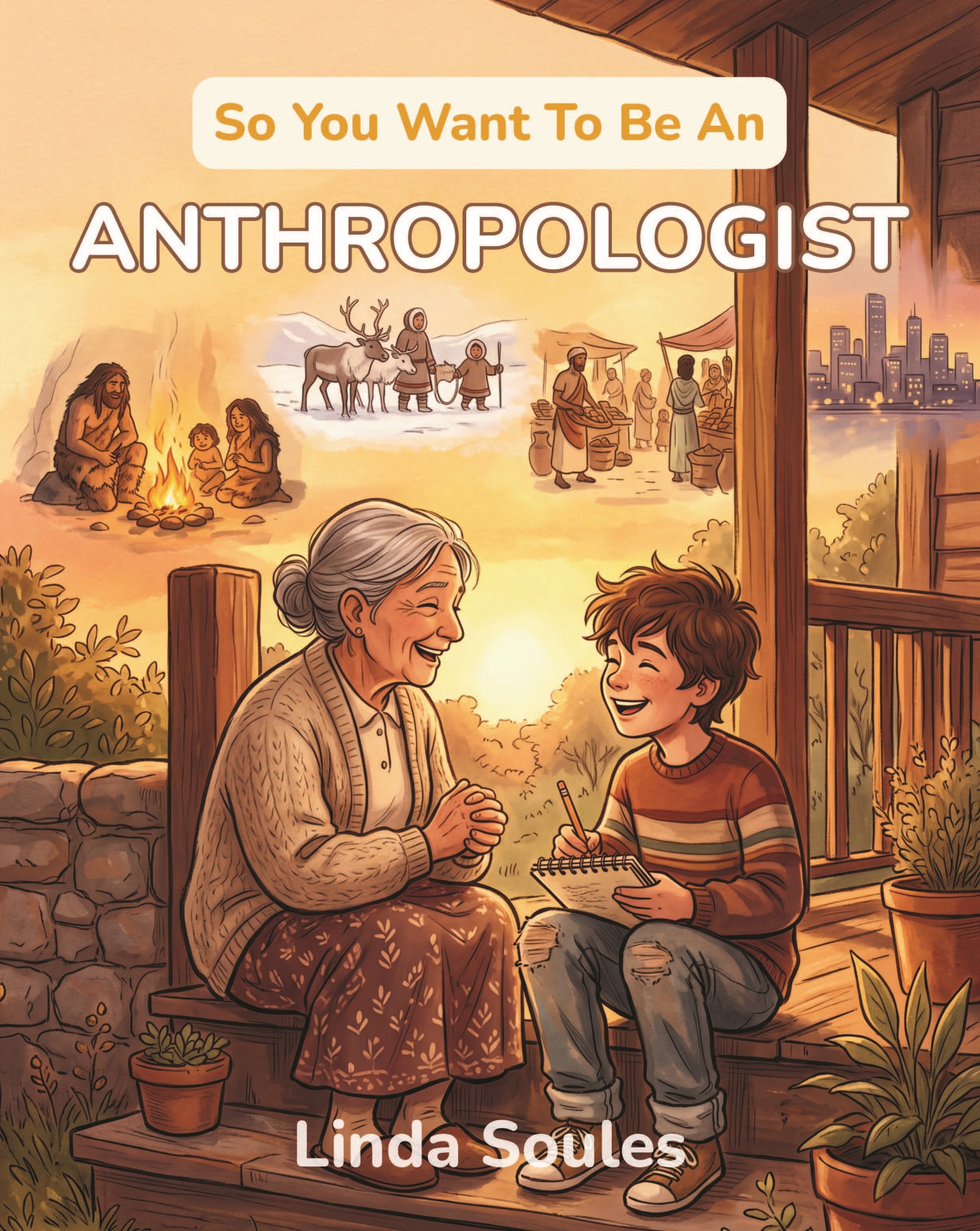
Author Linda Soules has released So You Want To Be An Anthropologist: A Kids' Guide to Cultures Around the World, Human Origins, Languages and Customs, and the Curious Scientists Who Study What It Means to Be Human, a 47-page children's nonfiction book now listed at https://www.amazon.com/dp/B0HMZGFYN4. The book is written for readers ages 10 to 14 and is also pitched as a read-aloud for curious children 8 and up. It introduces the four branches of anthropology (cultural, biological, linguistic, and archaeological), explains how the work is done in the field, and profiles six people who shaped the discipline. It is the latest title in Soules's So You Want To Be A... career-exploration series.
Anthropology rarely appears on the list of careers children are asked to imagine. Doctors, teachers, and engineers get steady coverage in kids' publishing. A field that studies people everywhere and across all of time, from families who herd reindeer across the Arctic to the students sitting at the next lunch table, gets far less. The gap matters for a practical reason: young readers often cannot choose a path they have never heard of. It also matters for a broader one. Questions about why people share food, sing at birthdays, or tell bedtime stories are questions children already ask, even if they do not yet have a word for the discipline that asks them professionally.
The book is organized around what anthropologists actually do. Readers learn how researchers live alongside the people they hope to understand, learn new languages, and pay attention to the parts of a culture that nobody explains out loud. A day-in-the-life chapter places the reader in a coastal fishing town eight months into fieldwork. There the reader hauls crates at dawn, interviews a retired captain, and tastes a mystery snack that nobody will name. The structure is built to show the routine, patient, sometimes uncomfortable nature of fieldwork rather than a polished highlight reel, and it covers each of the field's four branches in turn.
Each chapter is built around true stories. Readers meet a nine-year-old boy who spotted the first bone of a new human relative almost two million years old. They learn how scientists read a woman's DNA from a lump of tar she chewed like gum 5,700 years ago, and why some archaeologists lick bones. They see how bedtime songs about a giant wave saved nearly everyone on an Indonesian island during the 2004 tsunami. They also read about a Neanderthal who was blind in one eye, hard of hearing, and unable to use one arm, and who survived for years because others cared for him. Each story ties a specific discovery to a larger idea about how people live.
The book does not present the field as uniformly glamorous. It addresses loneliness, culture shock, and the long road to a career. It also covers the discipline's painful history and the work of returning ancestors and sacred objects to Native nations. Profiles of Franz Boas, Zora Neale Hurston, Ella Cara Deloria, Mary Leakey, Zeresenay Alemseged, and Clyde Snow show the range of people who have shaped the study of human origins and world cultures. Including difficult material alongside the adventure reflects the series' stated approach of not talking down to young readers.
The title sits in a crowded category of children's science and career books, and its approach differs in several ways. It covers all four branches of anthropology in a single volume instead of focusing only on dinosaurs, fossils, or ancient civilizations, and it includes a section that busts myths about dinosaurs and treasure hunters, two common misconceptions about the field. It pairs humor, including a field report titled "The Curious Customs of Grown-Ups" and twelve surprising fun facts, with candid discussion of the profession's difficulties. Its central argument is that every custom makes sense from the inside, including the reader's own, which frames anthropology as a way of thinking rather than only a job title.
"Kids can handle big ideas. Anthropology shows them that every custom makes sense from the inside, including their own, and that is a good place to start," said Linda Soules, author and creator of the So You Want To Be A... series.
The book is aimed at several audiences. Homeschool families and social studies classrooms can use it as an introduction to cultures, languages, and human origins. Librarians building career-exploration or STEM shelves for middle-grade readers get a title that covers a field seldom represented there. Parents looking for books that encourage empathy and scientific thinking can read it aloud with younger children. The book includes simple activities that readers can begin immediately, such as keeping a field notebook and interviewing a grandparent. A glossary, a list of related careers, and curated books, websites, and organizations help readers continue exploring after the last page.
The book's listing cites two 2026 honors: a Grand Prize from the Purple Dragonfly Book Awards and a Silver Award in Children's Nonfiction from the CIPA EVVY Book Awards. The listing presents these alongside its description of the award-winning So You Want To Be A... series. The book carries ISBN 979-8-951756-28-2 and runs 47 pages. Purchase information, available formats, and current pricing are listed on the product page at https://www.amazon.com/dp/B0HMZGFYN4. Educators and librarians seeking review information or interviews with the author can contact her through the details provided with this release.
The anthropology title is one entry in a series that Soules envisions spanning more than 180 titles, with over 60 published to date and new releases arriving on a steady cadence. Existing subjects range from astronauts and marine biologists to magicians, stunt performers, and roller coaster designers. Each book is designed to pull back the curtain on a real career, covering its rewards, its challenges, and the path to get there. The expansion plan suggests the series is aiming at breadth: a wide shelf of professions, presented in a consistent format, so that young readers can sample many possible futures before settling on one.
About Linda Soules and the So You Want To Be A... series: Linda Soules is the author and creator of the series, a growing collection of career-exploration books for readers ages 10 to 14 and beyond. The series is envisioned to span more than 180 titles, with over 60 published to date. Her philosophy is that young readers are smarter, more curious, and more capable than the publishing world often credits, and that they deserve books that respect their intelligence while sparking enthusiasm. So You Want To Be An Anthropologist is listed at https://www.amazon.com/dp/B0HMZGFYN4.
