Seattle, Washington — 2026-11-03
Linda Soules Releases 'So You Want To Be An Animator,' a Career Guide for Ages 10-14
The 38-page illustrated nonfiction title has won a Literary Titan Gold award, a Purple Dragonfly grand prize and a CIPA EVVY silver award
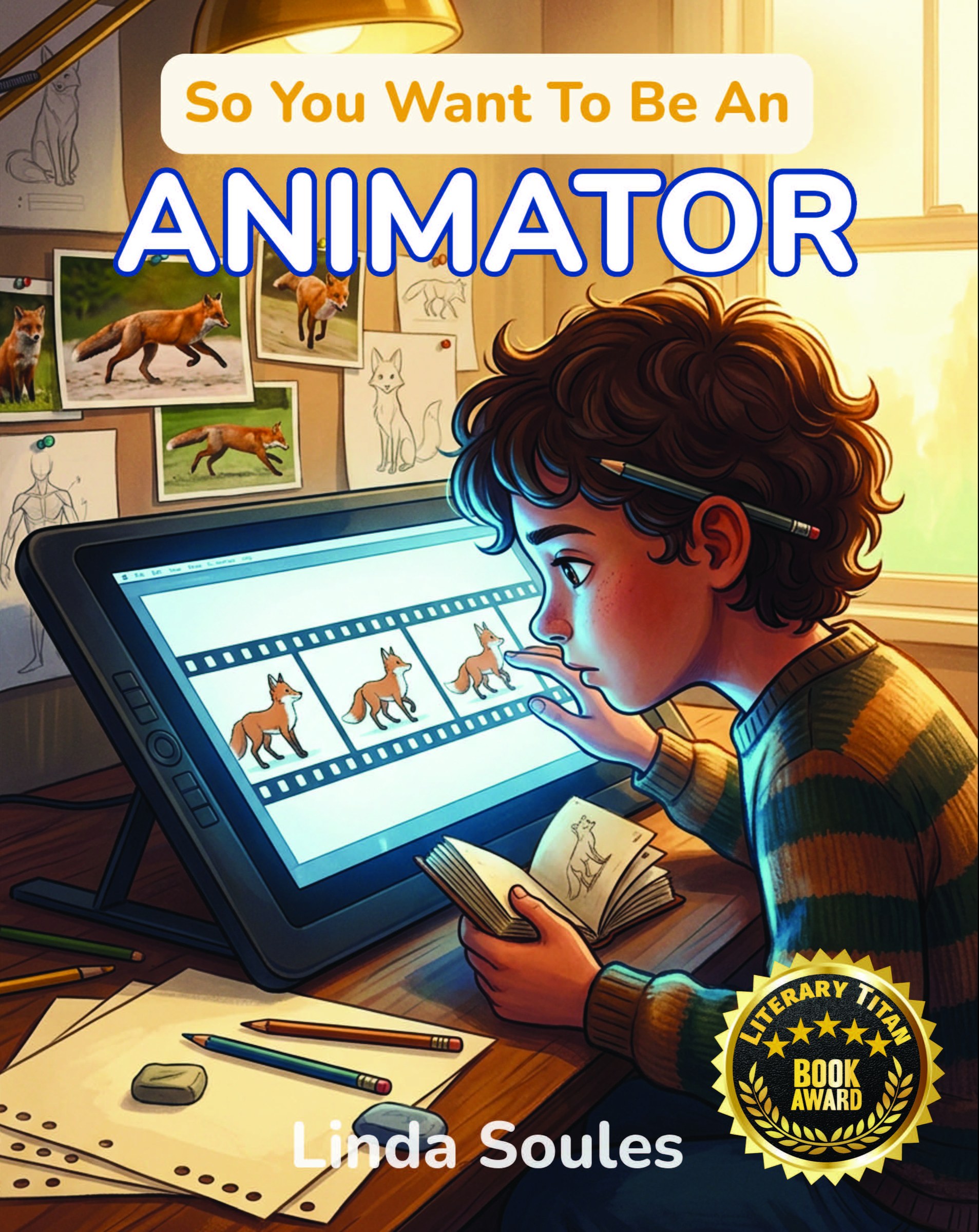
Author Linda Soules has released So You Want To Be An Animator, a 38-page illustrated children's nonfiction guide that explains the craft and career of animation to readers ages 10 to 14. The book, subtitled A Kids' Guide to Animation, Character Design, Storyboarding, and the Imaginative Artists Who Make Drawings Move and Stories Come Alive, is listed at https://www.amazon.com/dp/1972766325 (ISBN 978-1-972766-32-3). It belongs to the So You Want To Be A… series, which Soules created to give young readers detailed, candid looks at real professions. The title has already received three honors: the Literary Titan Gold Book Award, the Grand Prize at the 2026 Purple Dragonfly Book Awards, and a Silver Award in Children's Nonfiction at the 2026 CIPA EVVY Book Awards. It covers hand-drawn 2D, stop-motion and 3D computer animation, along with the teams and studios where that work is made.
Children who like to draw are rarely short of films to admire, but they often have little information about how those films get made or what the job involves. Career material for this age group tends to stay at the highlight-reel level: a famous character, a famous studio, a general nudge to "follow your passion." Animation is a particularly hard field to see from the outside. It combines drawing, performance, physics, software and long-term collaboration, and most of the work happens far from the audience. The book is aimed at the reader who pauses a film to study how a character moves, or who fills sketchbook margins with drawings no one else has seen. It asks what an animator's day looks like, what skills take years to build, and what a young person can start doing now. The answers are written for an intelligent reader rather than a reluctant one.
The first half of the book's craft coverage centers on the principles animators learn through repeated study and practice. Squash and stretch, follow-through and timing are presented as working tools rather than vocabulary words. The book also stresses observational discipline: watching how objects, animals and people move in the physical world so that an invented movement on screen feels believable. That emphasis reflects a point the book returns to often, which is that the most convincing animation is built on close attention to ordinary reality. Character design and storyboarding, both named in the subtitle, are treated as stages in a process that begins with a sketch and ends with the finished frame an audience sees. Readers are shown how an idea passes through those stages, and why so much of the labor happens before a character ever moves.
The second half widens the lens to the modern production pipeline. The book explains how character rigging and digital skeletons work, how evolving software tools fit into a studio workflow, and why technical fluency matters alongside artistic talent. It describes animation as team work: directors, riggers, sound designers, writers and fellow animators making thousands of individual decisions over months or years to build a single seamless world. The book also traces the history of animation from its earliest pioneers to its current standing as a storytelling medium, and argues that this history shapes the work being done today. Throughout, it names the qualities the career asks for beyond drawing ability, including creative resilience, patience and visual intelligence, and it is direct about the demands as well as the rewards.
Most children's books about creative careers either inspire or instruct. This one tries to do both without simplifying the subject. It does not present animation as a single technique; it moves across hand-drawn 2D, stop-motion and 3D computer animation, so readers can see how the disciplines differ and overlap. It gives equal space to technical skills, such as rigging and software, and to the working conditions of a collaborative studio. It also declines to promise easy outcomes, describing the years of practice animators put in before they work on a professional production. That approach follows the philosophy behind the series, in which Soules holds that young readers are more curious and capable than the publishing world often assumes. The result is a compact, illustrated title that treats a ten-year-old's interest in animation as a serious starting point.
"Kids who pause a film to study how a character moves are already thinking like animators. They deserve a book that shows the real work, not just the highlight reel," said Linda Soules, Author, So You Want To Be A… Series.
The book is written for several kinds of readers. A beginner filling sketchbooks gets a map of the skills worth practicing first, from observational drawing to an understanding of timing. A student already experimenting with digital tools gets context on how those tools connect to rigging, pipelines and studio teams. Parents, teachers and librarians gain a reference for career-exploration units, art electives and school library collections, since the title combines careers and creative arts content in a short illustrated format. Young readers who are unsure whether animation suits them can use the discussion of daily work, collaboration and persistence to judge whether the path fits their temperament as well as their talent. The book also serves classmates and siblings who may simply be curious about how animated films are made.
So You Want To Be An Animator is available now through the book's listing at https://www.amazon.com/dp/1972766325. The listing identifies the book as Ages 10-14 nonfiction in the careers and creative arts category, and it carries ISBN 978-1-972766-32-3. At 38 pages, it is built to be read in a sitting and revisited as a reader's skills develop. Buyers should consult the listing for current formats, pricing and delivery options, since those details can change. Educators and librarians interested in the broader series can find other titles through the same author listing. No special account, subscription or software is required to read the book, and it is written so that a young reader can use it independently or alongside a parent or teacher.
The animation title is one entry in a series that Soules intends to be large. The So You Want To Be A… series is envisioned to span more than 180 titles, with more than 60 published to date and new releases arriving on a steady cadence. Subjects range from astronauts and marine biologists to magicians, stunt performers and roller coaster designers. Each book is written to open up a real career by describing its joys, its challenges and the path to reach it, with the aim of leaving readers feeling that the world is wider and more reachable than they imagined. The Animator volume's awards, coming from three separate programs, suggest the series format translates well to creative fields where young readers are already highly motivated and visually engaged.
About Linda Soules and the So You Want To Be A… series: Linda Soules is the author and creator of the series, a growing collection of career-exploration books for readers ages 10 to 14 and beyond. Her stated philosophy is to never talk down to kids, and to write books that respect young readers' intelligence while sparking real enthusiasm. Before turning to children's publishing, she spent 25 years in law and finance. So You Want To Be An Animator is available at https://www.amazon.com/dp/1972766325.
