Seattle, Washington — 2026-11-29
Linda Soules Releases 'So You Want To Be A Writer,' a 41-Page Career Guide for Kids Ages 10 to 14
The children's nonfiction title follows a manuscript from first draft to reader and profiles six authors across a thousand years
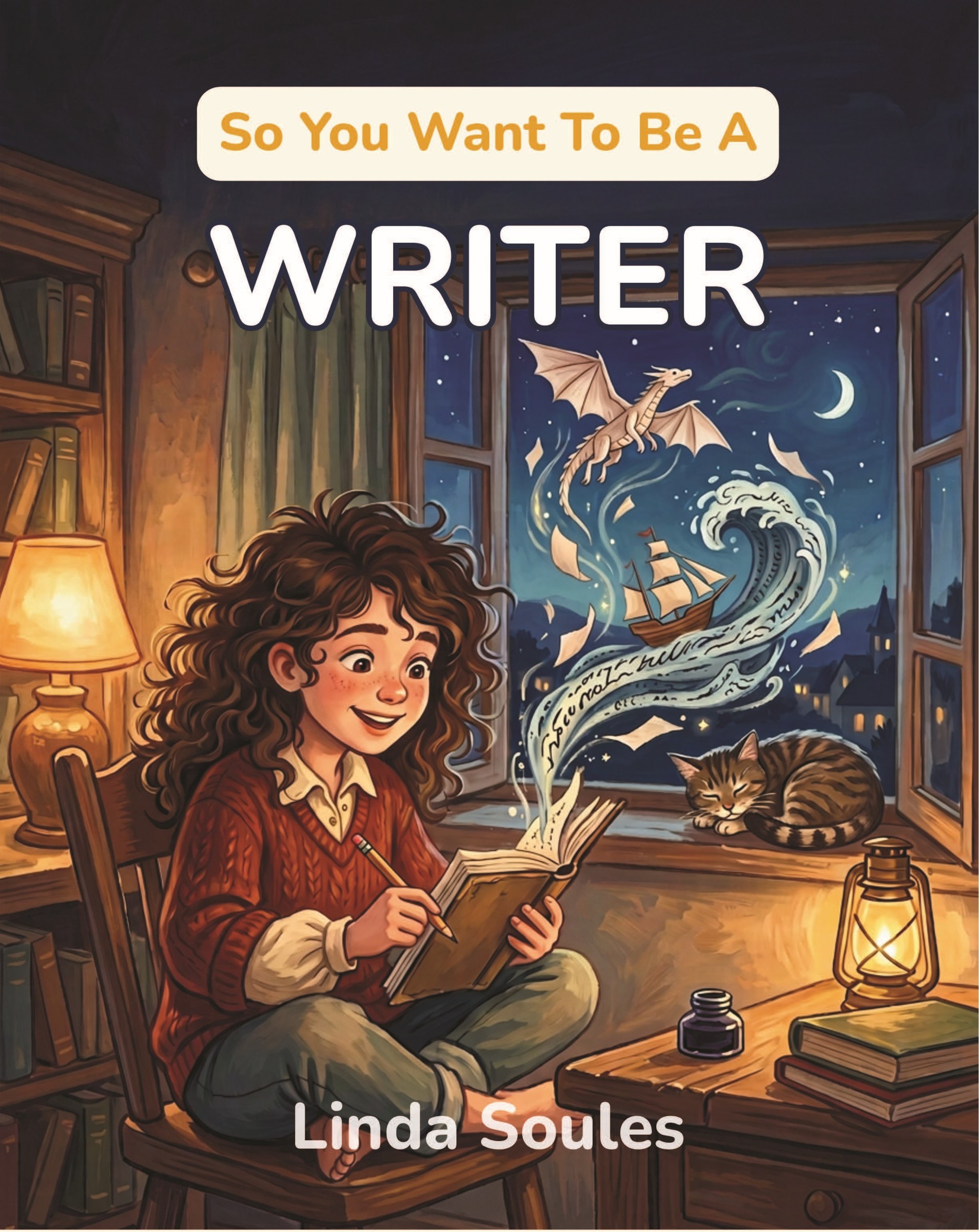
Children's author Linda Soules has released So You Want To Be A Writer: A Kids' Guide to Creative Writing, Storytelling, Publishing, and the Authors Who Turn Blank Pages into Books Readers Love, a 41-page children's nonfiction book that explains what authors do and how a book gets made. The title is available at https://www.amazon.com/dp/B0HT7PL6DT. It is written for readers ages 10 to 14 and is also aimed at readers 8 and up. It is the latest entry in the So You Want To Be A… career-exploration series, which Soules created. The book's listing cites two 2026 honors for the series: the Grand Prize at the Purple Dragonfly Book Awards and a Silver Award in Children's Nonfiction at the CIPA EVVY Book Awards.
Career-exploration books for young readers often focus on glamorous outcomes and skip the daily work. Writing is a clear example. Many children say they want to write a book, but few see the steps between an idea and a finished volume: the messy first draft, the revision, the agent, the editor, the copyeditors and designers. Few are told that rejection, writer's block, harsh reviews and uneven income are routine parts of the job. Soules built the series on the view that young readers are more capable than the publishing world assumes. So You Want To Be A Writer applies that view to a profession that many children first meet only through finished books on a shelf.
The book opens with a premise: writers are noticers. Readers learn how an author might turn the tune a cafeteria worker hums every Tuesday, or the way a little brother blinks when he fibs, into material for a story. From there the book explains why almost every great book begins as a rough first draft and how revision turns that draft into something a reader cannot put down. It then traces the path of a manuscript from the slush pile to a literary agent, to an editor, to a team of designers and copyeditors, and finally to a reader holding the finished book.
The book does not skip the difficult parts of the job. It notes that Dr. Seuss said his first book was turned down by twenty-seven publishers, and it covers rejection, writer's block, tough reviews and paychecks that rarely cover every bill. It also explains what keeps writers going, from letters sent by readers to the thrill of a character who suddenly does something unexpected. Readers meet six writers from around the world and across a thousand years: Murasaki Shikibu, Mary Shelley, Chinua Achebe, Ray Bradbury, Jacqueline Woodson and Gene Luen Yang. A chapter follows a working children's author through a full day, from a 6:00 a.m. writing session to a school visit where a boy in cardboard dragon wings asks whether she has ever met a real dragon.
Anecdotes about working authors run through the book. A puppy ate half of John Steinbeck's manuscript. Jane Austen valued a squeaky door that warned her when someone was coming. One poet kept rotten apples in his desk because the smell helped him write, and a novelist locked away his own clothes so he could not leave until his book was done. The book also describes a team of writers who secretly share one pen name and a second grader whose hallway comics grew into a bestselling series. Sections on the tools and habits of famous authors, the many careers open to people who love words, and practical steps kids can take now round out the content. A glossary of writer words and a list of books, websites, contests and organizations help readers keep going after the last page.
Several choices separate the book from typical writing guides for children. It treats the business of publishing as part of the craft, so readers see the roles of agents, editors, designers and copyeditors rather than only the act of drafting. It profiles writers of different eras, countries and genres, which shows that no single path leads to a writing life. It presents setbacks as ordinary rather than exceptional. And it gives concrete next steps, including contests and organizations, instead of leaving readers with encouragement alone. The book belongs to a career series with a stated rule against talking down to kids, and that rule shapes its tone throughout.
"Kids are sharper than the publishing world assumes. They can handle rejection letters, revision, and writer's block, and they deserve the truth about how books get made," said Linda Soules, author.
The book is built for several audiences. Classroom teachers and school librarians can use it to support creative writing units and to show students what happens to a manuscript after the final draft. Homeschool families can fold it into language arts, since it covers drafting, revision and the vocabulary of the trade, and a glossary is included. School counselors and career-exploration programs can use it to introduce a profession whose daily reality differs from its popular image. For individual readers, the book offers a way to test an interest. A child who has said, "I could write one of these," can read how professional writers work and then start with the practical steps in the final sections. Gift buyers also have a clear use case, since the book is pitched as a present for any young reader with that ambition.
The book is available now through Amazon at https://www.amazon.com/dp/B0HT7PL6DT. Its ISBN is 979-8-951756-59-6, and it runs 41 pages. The recommended reading range is 10 to 14, with the content also suited to readers ages 8 and up. Pricing, formats and any bulk or classroom purchasing options are listed on the product page, and buyers should consult that page for current details. Educators and librarians who want to evaluate the title for a collection can use the same link to review the description and ordering information. No separate registration or subscription is required to purchase.
The title is part of a long-running project. Soules envisions the So You Want To Be A… series spanning more than 216 titles in total, with 69 published to date and new releases arriving on a steady cadence. The series already covers careers as varied as astronauts, marine biologists, magicians, stunt performers and roller coaster designers. Each book follows the same approach: pull back the curtain on a real career, describe its joys and challenges, outline the path to get there, and leave readers with the sense that the world is wider and more reachable than they imagined. A book about writing fits naturally into that plan, since the skills it covers, such as observation, revision and persistence, apply to many of the other careers in the series.
Linda Soules is the author and creator of the So You Want To Be A… series, a growing collection of career-exploration books for readers ages 10 to 14 and beyond. The series is envisioned to span more than 216 titles, with 69 published to date. Her philosophy is straightforward: never talk down to kids, and give young readers books that respect their intelligence while sparking their enthusiasm. Before turning to children's publishing, Soules spent 25 years in law and finance. So You Want To Be A Writer is available at https://www.amazon.com/dp/B0HT7PL6DT.
