Seattle, Washington — 2026-11-03
Linda Soules Releases 'So You Want To Be A Voice Actor,' an Illustrated Career Guide for Ages 10 to 14
The 38-page nonfiction book, a 2026 Purple Dragonfly Book Award first-place winner, covers animation, video games, audiobooks and dubbing
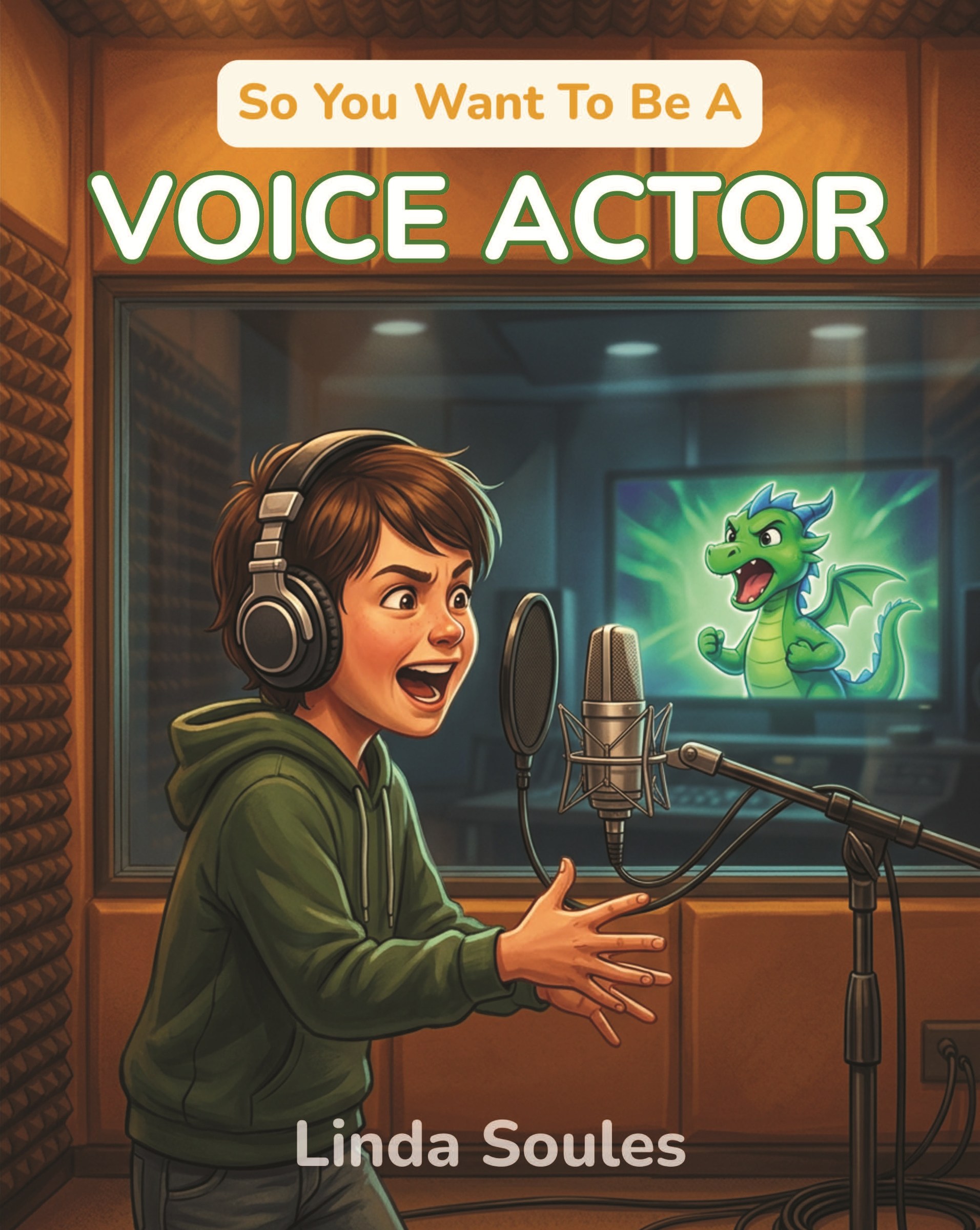
Author Linda Soules has released So You Want To Be A Voice Actor: A Kids' Guide to Voice Acting, Character Voices, Animation and Video Game Recording, and the Talented Performers Behind Our Favorite Characters, a 38-page illustrated nonfiction book for readers ages 10 to 14. The book is available now at https://www.amazon.com/dp/1972766279 (ISBN 978-1-972766-27-9). It won first place in the Arts/Music category of the 2026 Purple Dragonfly Book Awards. It joins the author's So You Want To Be A... series of career-exploration titles and takes young readers inside a profession that is heard by nearly every child but rarely seen: the work of the performers behind animated, video game and audio characters.
Voice acting reaches children through cartoons, games, audiobooks, commercials and dubbed films, yet the people behind those voices are seldom visible. Most career books for young readers focus on jobs a child can watch someone do, such as a firefighter, a veterinarian or a chef. Voice acting is different. The performer works alone in a small recording booth, with a microphone and a script, and no costume, set or scene partner to lean on. The result is a career that is easy to love as an audience member and hard to understand as a profession. Soules wrote the book for the child who already gives every character a different voice and wants to know whether that instinct could become a job.
The book opens by explaining what voice acting demands. It describes the years of vocal training that typically come before a performer books professional work, and the discipline of building a complete, emotionally convincing character from breath, resonance and imagination alone. Readers learn how the human voice works as an instrument, how performers train it with precision, and how they protect it across a career that can span decades. The text is written for a young audience but does not simplify the work into a cartoon version of itself. It presents voice acting as a craft with technical requirements, not as a shortcut to fame.
A second thread follows the collaborative side of the job. The book introduces the directors, sound engineers, casting agents and animators who coordinate so that the character on screen and the voice in the booth read to an audience as one performance. It then surveys the full range of voice-over work: animation, video game characters, audiobook narration, commercials and dubbing. For each, it explains what the performance requires. Sections on recording technology and the audition process show readers how a script becomes a finished recording, and a history of voice performance profiles the legendary actors whose characters became part of childhood for generations.
The book also takes up the costs of the profession. According to the book's description, it offers an honest look at what the work demands, what it gives back, and why many voice actors describe the same reward: the moment a character they created makes a child laugh, gasp or feel less alone. That framing is consistent with the series' stated approach of showing a career's joys, its challenges and the path to reach it. Young readers who finish the book should understand the training, equipment and persistence involved, and be able to judge whether the pull they feel toward sound-based storytelling is worth pursuing.
The title sits in a crowded children's career shelf but takes a narrow angle on it. Rather than treating entertainment careers as a single category, it isolates the one job in which a performer's face and body are irrelevant and the voice carries everything. It pairs that focus with coverage of adjacent roles, including sound engineers and casting agents, that readers might not know exist. The book is illustrated, nonfiction and aimed at ages 10 to 14, a bracket that often falls between picture books and adult career guides. Its recognition at the 2026 Purple Dragonfly Book Awards suggests the approach has resonated with judges in the Arts/Music category.
"Kids who give every character a different voice already have the instinct. I wanted to show them the real craft and training behind it," said Linda Soules, author of the So You Want To Be A... series.
The book is written for several kinds of readers. Children ages 10 to 14 who narrate stories aloud, imitate characters or perform in school plays can use it to see where those habits might lead. Parents and grandparents looking for a gift for a theatrical or imaginative child have a title that treats the interest seriously. Teachers and librarians can add it to career-exploration, media-literacy or arts collections, where it connects to animation, gaming and audio storytelling. Young gamers may find a point of entry in the chapters on video game recording. Readers who simply love a favorite animated character get a look at how that character's voice came to exist.
So You Want To Be A Voice Actor is available through Amazon at https://www.amazon.com/dp/1972766279. The book is 38 pages, carries ISBN 978-1-972766-27-9 and is categorized as illustrated children's nonfiction in the careers and professions area. Pricing and format availability are listed on the Amazon product page, and readers should check that page for current details. Librarians, educators and reviewers who want more information about the title or the series can use the same listing as a starting point. The book's description also notes that the So You Want To Be A... series has been recognized with a Grand Prize at the 2026 Purple Dragonfly Book Awards and a Silver Award in Children's Nonfiction at the 2026 CIPA EVVY Book Awards.
The voice acting title is part of a series that its author envisions spanning more than 180 books. More than 60 have been published so far, with new releases arriving on a steady cadence. Subjects already covered range from astronauts and marine biologists to magicians, stunt performers and roller coaster designers. Each book follows the same premise: pull back the curtain on a real career, describe its rewards and difficulties, and outline the path to get there. The voice acting volume extends that catalog into audio and performance, an area where children's interest in games, animation and audiobooks is already strong, and where few career guides have been written for their age group.
Soules's approach to the series rests on a stated principle: never talk down to kids. In her view, young readers are smarter, more curious and more capable than the publishing world often assumes, and they deserve books that respect their intelligence while building real enthusiasm. That principle shapes the voice acting book's decision to describe the work as it is, including the years of training and the discipline involved, rather than as a glamorous shortcut. The series aims to leave readers with the sense that the world is wider, more interesting and more reachable than they imagined. New titles continue to extend that goal into additional professions.
About Linda Soules and the So You Want To Be A... series: Linda Soules is the author and creator of the So You Want To Be A... series, a growing collection of career-exploration books for readers ages 10 to 14 and beyond. The series is envisioned to span more than 180 titles, with more than 60 published to date. Before turning to children's publishing, Soules spent 25 years in law and finance, advising hedge funds and sophisticated financial institutions on legal and regulatory matters, work she credits with teaching her precision and discipline. So You Want To Be A Voice Actor is available at https://www.amazon.com/dp/1972766279.
