Seattle, Washington — 2026-11-02
Linda Soules Releases 'So You Want To Be A Shark Researcher,' a Career Guide for Ages 10 to 14
The 38-page children's nonfiction book, a 2026 Purple Dragonfly first-place winner, covers shark tagging, migration research and conservation
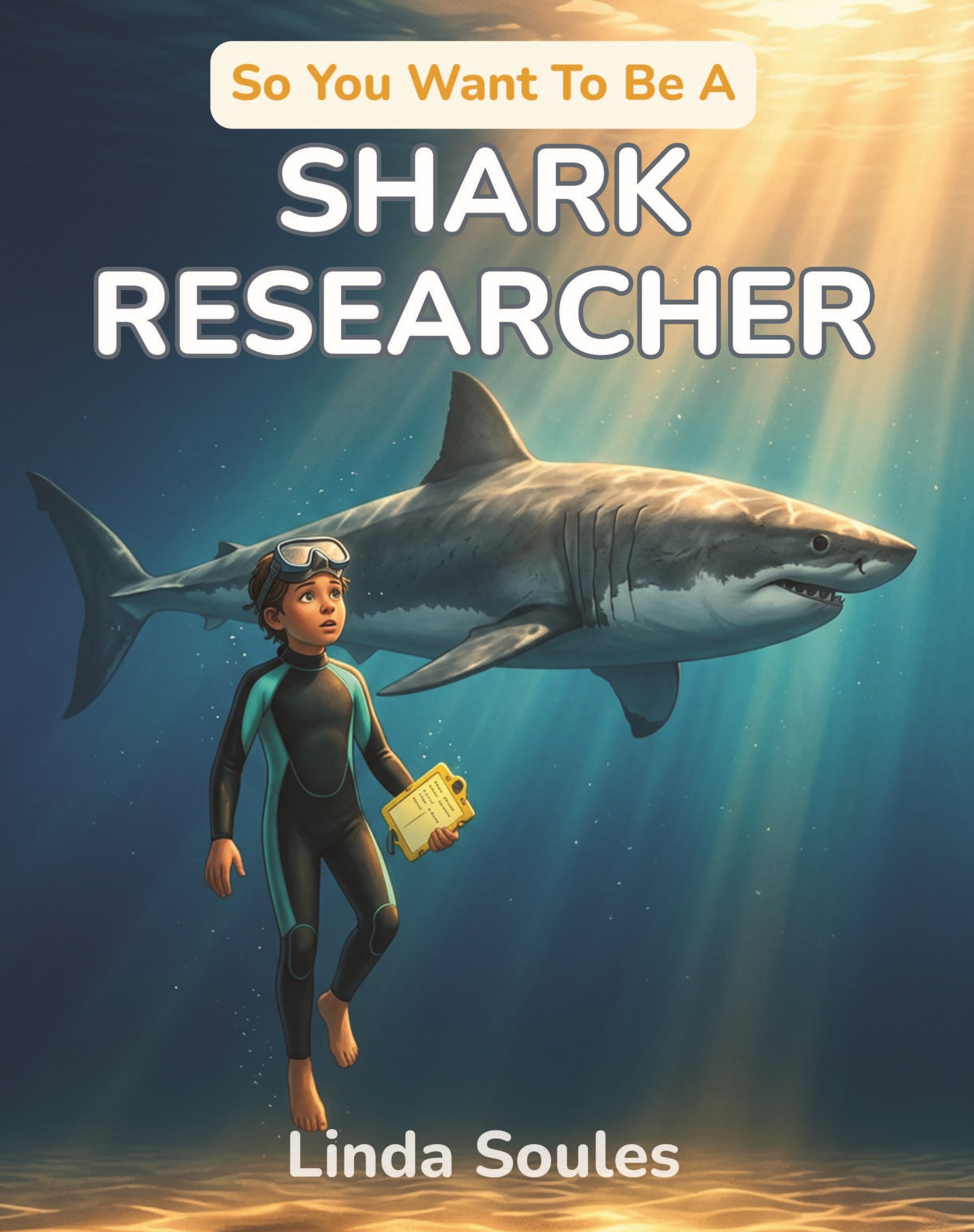
Author Linda Soules has released So You Want To Be A Shark Researcher: A Kids' Guide to Sharks, Marine Science, Ocean Conservation, and the Bold Scientists Who Study the Sea's Top Predators, a 38-page children's nonfiction book for readers ages 10 to 14. The book is listed at https://www.amazon.com/dp/1972766163 under ISBN 978-1-972766-16-3. It has won first place in the Animals/Pets and Green Books/Environmental categories of the 2026 Purple Dragonfly Book Awards. The book explains what it takes to study sharks for a living. It covers the physical demands of open-water research, the rigor of gathering population data, and the conservation pressures facing shark populations. It is written for young readers who are curious about the animals and the careers built around them.
Sharks are among the most widely recognized and least understood animals in the ocean. For many young readers, what they know comes from television programming that favors spectacle over method. The book's description argues that almost everything the public believes about sharks is wrong. It also states that shark populations are declining faster than scientists can study them. That gap between public perception and scientific reality is the problem the book addresses. It presents shark science as patient, precise work done on the animal's terms, not as a series of dramatic encounters. For a young reader considering marine science, it offers an unvarnished account of what the job involves.
The book is part of the So You Want To Be A... series, created by Soules as a collection of career-exploration books for readers ages 10 to 14 and beyond. According to the author's biography, the series is envisioned to span more than 180 titles, with more than 60 published to date. Subjects range from astronauts and marine biologists to magicians, stunt performers and roller coaster designers. Each title is written to show a real career, including its rewards, its difficulties and the path to enter it. Soules's stated approach is not to talk down to young readers, and the shark volume applies that approach to a field where the public often mistakes drama for data.
The book opens with shark biology and the details most adults do not know. It describes how sharks have been refining their existence for roughly 450 million years. It explains how tiger sharks hunt across geographic ranges spanning thousands of miles, and how a great white can navigate an entire ocean basin. The species coverage runs from hammerheads to whale sharks, and each profile is paired with illustrations that follow the text. The book describes the ocean's oldest predator as a survivor of five mass extinctions. That framing sets up the central question for the reader: if these animals have endured so long, what does it take to understand them before their numbers fall further?
The second half of the book moves from the animals to the people who study them. It walks readers through the full arc of the work, including tagging expeditions, behavioral studies, laboratory data analysis and the scientific advocacy that conservation requires. It describes the physical demands of open-water research and the discipline of collecting population data that can withstand scrutiny. It also addresses the geographic scope of migration research and the word-by-word precision of scientific reporting. The book lists the activities researchers perform in the water every day, so readers see the routine as well as the highlights. The goal is to give a young person enough detail to judge whether the work suits them.
The description is explicit about what the book is not. It is not a coloring book, and it does not include mazes or activity pages. It does not simplify the science into something unrecognizable, and it does not offer what the author calls the made-for-TV version of shark research. Instead, it treats readers as capable of following the geography of migration studies, the logic of population surveys and the reasoning behind conservation arguments. Among the many guides to marine life written for young people, that stance is its main distinction. The book pairs the career-guide format with substantive species and conservation content, and it addresses an audience at the upper end of the children's nonfiction range.
"Young readers can handle the real science, and they deserve to see what the work actually involves, including the hard parts," said Linda Soules, author of the So You Want To Be A... series.
The book is aimed at the reader who sees a fin cut the surface of the water and feels curiosity before fear. It may also serve parents, teachers and librarians who need a credible resource for career exploration or ocean-science units. A student weighing marine biology as a path can use it to see what field research demands before committing to the training. A classroom studying ocean ecosystems can use it to connect species biology to conservation work. Its Green Books/Environmental award category reflects its focus on the conservation crisis facing sharks nationally and globally. The book's closing argument is that the animals now need someone to speak for them, and that the researchers who do so need sharp minds, steady nerves and genuine passion.
The book's recognition extends beyond the Purple Dragonfly first-place wins. Its listing identifies it as part of an award-winning series. That series is credited with a Grand Prize at the 2026 Purple Dragonfly Book Awards and a Silver Award in Children's Nonfiction at the 2026 CIPA EVVY Book Awards. For reviewers, librarians and educators evaluating a title in a crowded children's science category, those distinctions offer an outside reference point. The book's own first-place results in two separate categories, Animals/Pets and Green Books/Environmental, reflect its dual identity as an animal-science title and a conservation title. Both labels apply to the book's focus on shark biology and the threats facing the species.
So You Want To Be A Shark Researcher is available through Amazon at https://www.amazon.com/dp/1972766163. The listing identifies the book as 38 pages of children's nonfiction with the ISBN 978-1-972766-16-3. Current pricing, available formats and shipping options are shown on the product page and may vary by retailer and region. Readers, parents and educators looking for the title can search by its full name or by ISBN. The book is part of a larger series, and other titles in the So You Want To Be A... collection can be found through the same author listing. Review and media inquiries can be directed to the author through the contact channels connected to the Amazon listing.
The shark volume is one entry in a series that Soules plans to extend to more than 180 titles, with new releases arriving on a steady cadence. More than 60 have been published so far. The planned scope covers science, the performing arts, engineering and other fields that young readers rarely see described in practical terms. The strategy is consistent across the series: pick a real career, explain how people get there, and be candid about the work. The shark title applies that formula to marine science, a field where public interest is high but practical information for young readers is thin. Its awards suggest the format resonates with judges, and the series expansion will test whether it resonates with a wider audience.
About Linda Soules: Linda Soules is the author and creator of the So You Want To Be A... series, a growing collection of career-exploration books for readers ages 10 to 14 and beyond. The series is envisioned to span more than 180 titles, with more than 60 published to date, covering careers from astronauts and marine biologists to magicians, stunt performers and roller coaster designers. Her guiding principle is never to talk down to children, who she holds are smarter, more curious and more capable than publishing often assumes. Each title pulls back the curtain on a real career, including its joys, its challenges and the path to get there. So You Want To Be A Shark Researcher is available at https://www.amazon.com/dp/1972766163.
