Seattle, Washington — 2026-11-02
Linda Soules Releases 'So You Want To Be A Scientist,' a 38-Page Guide to Real Science for Ages 10–14
The Purple Dragonfly first-place STEM winner walks young readers through hypotheses, failed experiments and peer review
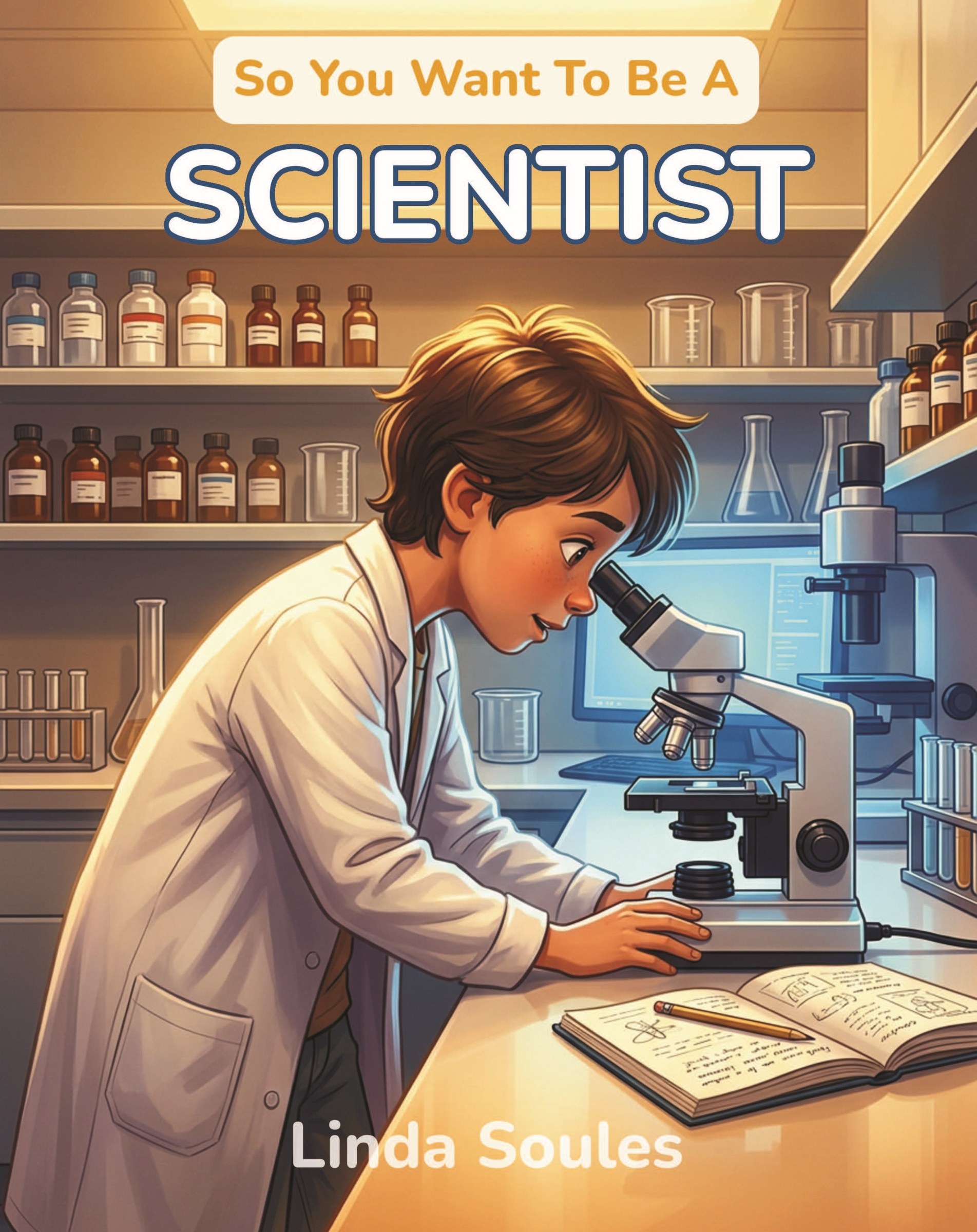
Author Linda Soules has released So You Want To Be A Scientist: A Kids' Guide to Science, Experiments, the Scientific Method, and the Curious Minds Who Ask Big Questions and Discover How the World Works, a 38-page illustrated nonfiction book for readers ages 10 to 14. The book is listed at https://www.amazon.com/dp/197276621X (ISBN 978-1-972766-21-7). It is the latest title in her So You Want To Be A... career-exploration series. It has won first place in the STEM category of the 2026 Purple Dragonfly Book Awards. Rather than offering a simplified picture of research, the book describes how scientists form questions, test ideas, handle failure and share results, and what a career in science demands.
Children's science books often concentrate on finished discoveries: the famous names, the eureka moments, the tidy conclusions. Far less space goes to the process that produces those results, including the experiments that fail, the arguments over evidence, and the slow work of checking a claim before it counts as knowledge. For readers in the 10-to-14 range, who are starting to choose electives, join science clubs and form ideas about what adults do for a living, that gap can leave a misleading impression of what scientific work involves. Soules wrote the book to address that gap, treating middle-grade readers as capable of understanding how the discipline really operates.
The book follows the full arc of a scientific investigation. Readers move from forming a hypothesis to designing experiments, analyzing data and sharing findings with the wider world. A recurring theme is the quality of the question itself. The book explains how a single well-formed question can open lines of inquiry no one anticipated, and how a poorly formed one, however brilliantly pursued, leads nowhere. Soules devotes space to explaining why that distinction matters, framing question-asking as a skill to be practiced rather than a trait some people are born with. The opening premise sets the tone: a scientist is not the person with all the answers, but the person who cannot stop asking questions.
Beyond method, the book surveys the range of science careers, including biology, chemistry, physics, neuroscience and climate science. Each field is presented as requiring its own blend of creative imagination and intellectual discipline. Along the way, readers meet scientists from history whose questions, and whose willingness to follow evidence wherever it led, reshaped understanding of subjects from cells to stars. The book also describes the less visible parts of the profession: the peer review process that holds each claim to a standard, and the teamwork among researchers, statisticians and fellow scientists that turns one person's discovery into something others can build on. The tone is warm but direct about how demanding and sometimes frustrating the work can be.
The book's central differentiator is its candor. Many titles for this age group present science through simplified demonstrations or cartoonish framing. Soules takes the opposite approach, stating that the book does not gloss over the difficult parts or dress up the science in costumes. It brings young readers inside the work and lets them decide for themselves whether science might be their calling. The format is a compact, illustrated guide of 38 pages, designed to be read in a sitting and revisited. It also sits within a series built on a consistent editorial rule: each title pulls back the curtain on a real career, covering its joys, its challenges and the path to get there.
"Kids can handle the truth about science: experiments fail, questions have to be sharpened, and discovery is a team effort. They deserve a book that says so," said Linda Soules, author of the So You Want To Be A... series.
The book carries recognition beyond its own category win. It is part of a series that has earned the Grand Prize in the 2026 Purple Dragonfly Book Awards and a Silver Award in Children's Nonfiction in the 2026 CIPA EVVY Book Awards. The Purple Dragonfly first-place designation in STEM applies to this title specifically. For parents, teachers and librarians evaluating nonfiction for middle-grade readers, the awards offer one outside signal about the book's quality, though the book's value ultimately lies in its content and its approach to the subject matter.
The primary audience is curious readers ages 10 to 14, particularly those who ask why things work the way they do and find textbooks insufficient. The book may also suit classroom and library settings, where it can support units on the scientific method, introduce career exploration in STEM, or prompt discussion about how to write a testable question. Parents of children who show early interest in biology, chemistry, physics, neuroscience or climate science can use it as a conversation starter about what study and work in those fields look like. Because it describes failure and frustration alongside reward, it may also help students who are discouraged when their own experiments do not go as planned.
So You Want To Be A Scientist is available through Amazon at https://www.amazon.com/dp/197276621X. The listing identifies the book by ISBN 978-1-972766-21-7 and describes it as children's nonfiction running 38 pages. Current pricing and available formats are shown on the product page. Educators, librarians and parents who want to review the book's description, author information and reader details can do so directly from the listing, and no account beyond a standard Amazon purchase is required to buy the book. Readers interested in other careers can find additional titles in the So You Want To Be A... series through the author's catalog.
The Scientist title is one entry in a series Soules has planned on a large scale. The collection is envisioned to span more than 180 titles in total, with more than 60 published to date and new releases arriving on a steady cadence. Subjects already covered range from astronauts and marine biologists to magicians, stunt performers and roller coaster designers. That breadth reflects the series' underlying idea: that young readers benefit from seeing many possible careers described honestly, including the preparation, the setbacks and the satisfactions of each. Continued releases are intended to extend that approach across more fields, giving readers a growing set of accurate, respectful introductions to work they may not otherwise encounter.
Linda Soules is the author and creator of the So You Want To Be A... series, a growing collection of career-exploration books for readers ages 10 to 14 and beyond. Before turning to children's publishing, she spent 25 years in law and finance, advising hedge funds and sophisticated financial institutions on legal and regulatory matters, an experience she credits with teaching precision, discipline and the translation of intricate subjects into plain language. Her guiding philosophy is to never talk down to kids. She lives in Seattle with her husband and two children. So You Want To Be A Scientist is available at https://www.amazon.com/dp/197276621X.
