Seattle, Washington — 2026-11-04
Linda Soules Releases 'So You Want To Be A Psychologist,' a 40-Page Career Guide for Curious Kids
The 40-page title from the So You Want To Be A… series profiles Piaget, Ainsworth and the Clarks and includes experiments kids can try
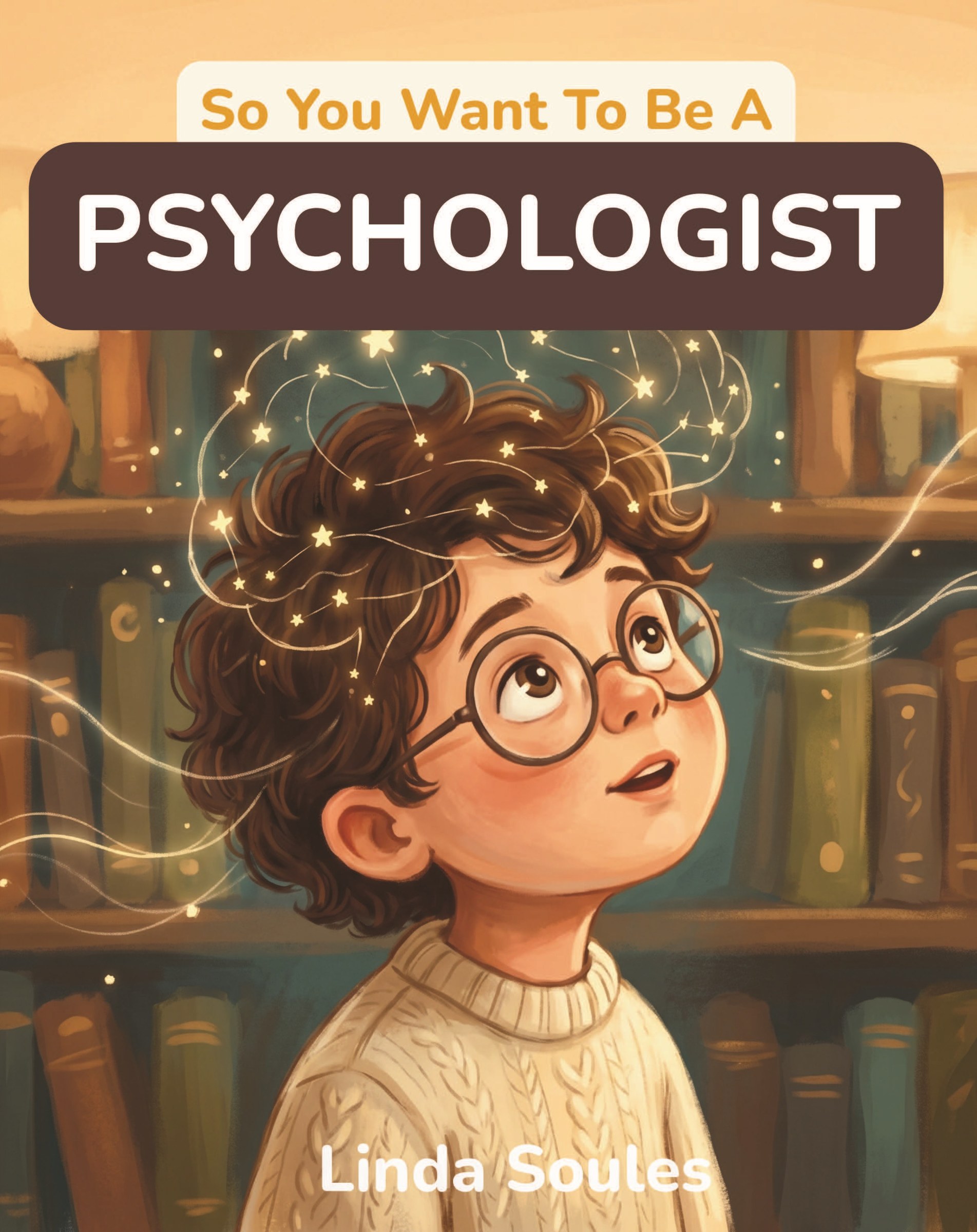
Author Linda Soules has released So You Want To Be A Psychologist: A Kids' Guide to Psychology, the Human Mind, Behavior Science, and the Curious Professionals Who Study Why We Think, Feel, and Act the Way We Do, a 40-page children's nonfiction book now listed at https://www.amazon.com/dp/1972766570. The title (ISBN 978-1-972766-57-6) is written for readers ages 10 to 14 and works as a read-aloud from age 8. It explains what psychologists actually do, how they test ideas with evidence, and where their work shows up in daily life. The book has already won the Literary Titan Gold Book Award, the Grand Prize in the 2026 Purple Dragonfly Book Awards, and a Silver Award in Children's Nonfiction from the 2026 CIPA EVVY Book Awards.
Career books for children tend to favor professions with obvious visual appeal, such as astronauts, firefighters and veterinarians. Psychology is harder to picture. Many young readers know it only through television, where it appears as a therapist's couch, a mind-reading trick or a question about feelings. That image leaves out most of the field, which includes laboratory research, classroom studies, hospital work, courtroom testimony and sports performance.
Soules built the book around that gap. Young people who ask why a friend goes quiet when a teacher calls on her, or why a yawn spreads across a room, are already asking psychological questions. The book treats those questions as the beginning of a career path instead of a distraction. It is aimed at gifted and curious readers, fans of STEM and brain-science titles, and children interested in human behavior, as well as the parents and teachers who read alongside them.
The book opens by separating the real science of the mind from the myth. It states plainly that psychology is not mind-reading and is not limited to talk therapy. Psychologists, it explains, ask a careful question about how people think, feel, learn and behave, then look for an honest answer using evidence. Readers follow that process through topics including memory, fear, how babies learn, how juries decide, how athletes stay calm, and why one class of students might learn to read faster than the class next door. The book also describes where psychologists work: schools, hospitals, courtrooms, sports fields, video games, and even car dashboards and crosswalks, where research into attention and decision-making shapes design.
Several features are built for hands-on engagement. A "day in the life" section walks through a psychologist's routine, from running experiments to helping real families. A kid-friendly glossary defines the vocabulary readers will meet in later study. Simple experiments let readers test ideas themselves. The fun-facts sections cover why a person cannot tickle themselves, how rats laugh, the well-known "invisible gorilla" attention experiment and the marshmallow test. Each fact is used to show how researchers design a question and read the results, not just as trivia.
The book also profiles four psychologists whose work shaped the field: Jean Piaget, Mary Ainsworth, Kenneth and Mamie Clark, and Martha Bernal. Including them gives young readers a view of the profession as a human story, with researchers who pursued unanswered questions, sometimes against resistance. It also shows that the field has been built by people from varied backgrounds. The profiles are short and anchored in what each person studied and why it mattered, which suits the 40-page format and the intended reading level.
The book is also candid about the demands of the work. Instead of presenting psychology only as a source of discovery, it describes the patience required, the uncertainty that comes with studying people, and the courage it takes to be wrong and say so. That last point may be the most distinctive. Admitting error is central to scientific practice, yet it rarely appears in books for young readers about careers. By naming it, the book gives children a more accurate picture of research and a model for handling mistakes in their own schoolwork.
"Kids ask why people do what they do all the time. Psychology is the discipline that answers with evidence, and children deserve to see that," said Linda Soules, author of the So You Want To Be A… series.
For families, the book offers a way into conversations about emotions, memory, habits and fairness without framing them as problems to be solved. A parent reading aloud with an 8-year-old can stop at the experiments and try them together. A 12-year-old can read independently and use the glossary to follow news stories about mental health or brain science. Teachers can use individual sections as prompts in science, social studies or health classes, particularly the sections on how researchers design questions and the biographies of the four featured psychologists. For readers who are unsure what they want to study, the book's wide survey of settings shows how many different jobs can grow from an interest in human behavior.
So You Want To Be A Psychologist is available through Amazon at https://www.amazon.com/dp/1972766570, where readers can find current format and pricing details on the product page. The ISBN is 978-1-972766-57-6, which libraries, schools and booksellers can use to locate the title. The book runs 40 pages and is classified as children's nonfiction. Parents, educators and librarians who want to preview the content can use the listing's description, which outlines the topics covered and the featured psychologists. No separate subscription or account beyond a standard Amazon purchase is described in the source materials.
The release is part of the So You Want To Be A… series, which Soules envisions spanning more than 180 titles. About 60 have been published so far, with new books arriving on a steady cadence. Existing subjects range from astronauts and marine biologists to magicians, stunt performers and roller coaster designers, so the psychology title joins a catalog that mixes scientific, creative and technical careers. The series rests on one premise: every grown-up job started as a kid's curiosity. Each volume aims to show a real career's rewards, its challenges and the path toward it, without simplifying the reader's intelligence.
The 2026 recognition for the psychology title from Literary Titan, Purple Dragonfly and CIPA EVVY suggests the series' approach is resonating with independent award programs. For the author, the next step is continuing to expand the catalog toward its stated goal while keeping the same editorial standard: honest about the challenges and focused on the sense of wonder in the work. Readers who finish this volume can look to other series titles for related fields such as the sciences, medicine and the arts, depending on where their curiosity leads.
About Linda Soules and the So You Want To Be A… series: Linda Soules is the author and creator of the So You Want To Be A… series, a growing collection of career-exploration books for readers ages 10 to 14 and beyond. The series is envisioned to span more than 180 titles, with 60 published to date. Her guiding philosophy is never to talk down to kids, because young readers are more curious and capable than the publishing world often assumes. Before turning to children's publishing, Soules spent 25 years in law and finance. So You Want To Be A Psychologist is available at https://www.amazon.com/dp/1972766570.
