Seattle, Washington — 2026-11-05
Linda Soules Releases 'So You Want To Be A Movie Director,' a Kids' Guide to Filmmaking for Ages 10–14
The 45-page children's nonfiction title profiles six directors, from Alice Guy-Blaché to Ava DuVernay, and includes hands-on activities
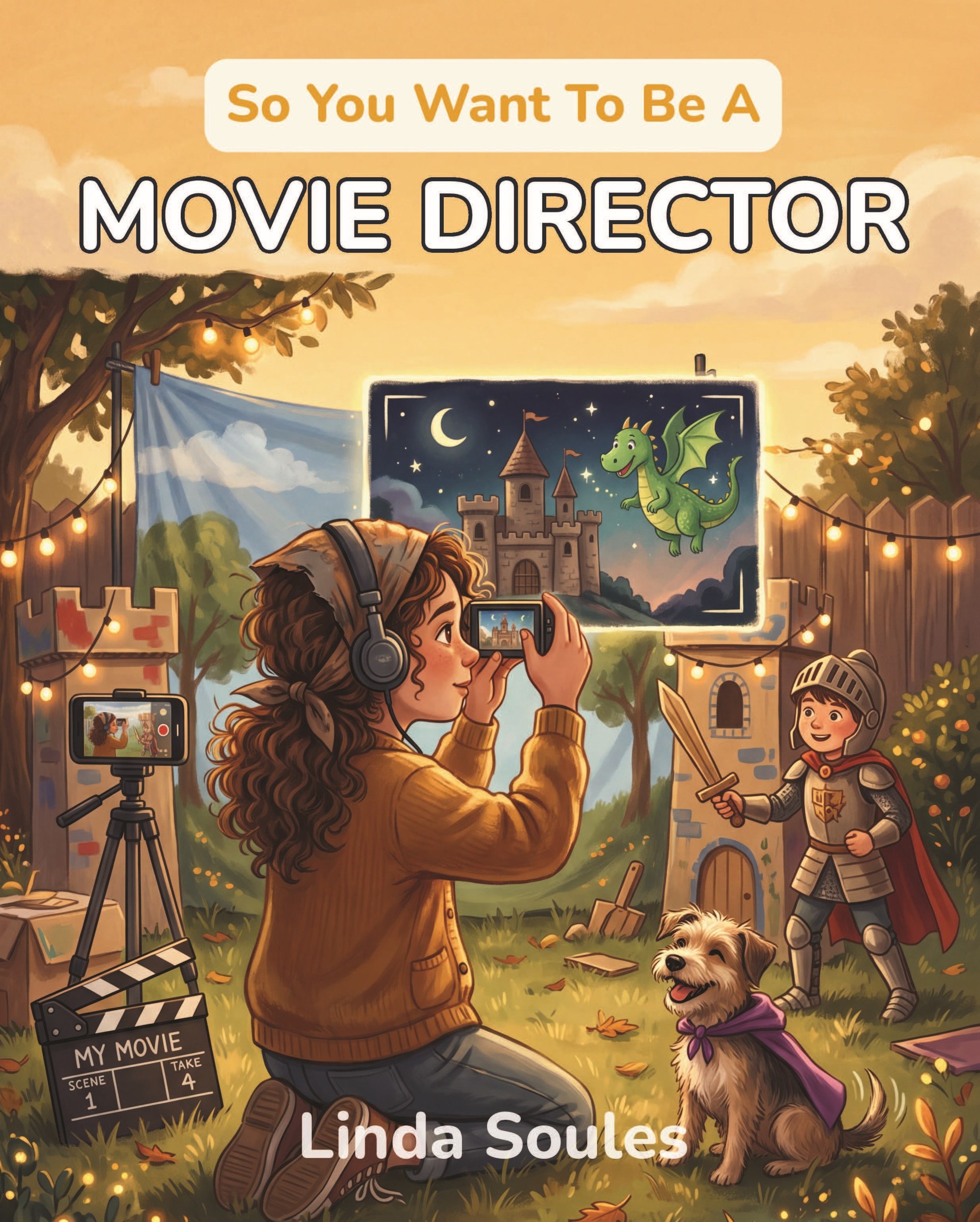
Author Linda Soules has released So You Want To Be A Movie Director: A Kids' Guide to Moviemaking, Storytelling, Behind-the-Scenes Magic, and the Visionary Leaders Who See a Film Before It Exists and Bring It to Life, a 45-page children's nonfiction book for readers ages 10 to 14. The book, listed at https://www.amazon.com/dp/B0HPZGC5XV (ISBN 979-8-951756-45-9), follows a movie through every stage of production, from the first storyboard sketch to opening night in a dark theater. It is the latest title in Soules's So You Want To Be A... career-exploration series. The book's description cites a Grand Prize in the 2026 Purple Dragonfly Book Awards and a Silver Award in Children's Nonfiction from the 2026 CIPA EVVY Book Awards. It pairs behind-the-scenes stories with profiles of six directors and hands-on activities, and is aimed at classrooms, homeschool career units, libraries, and young movie fans.
Children grow up surrounded by film and video, and many already make their own, whether with a phone and a shelf of toys or a school project. Few get a clear picture of the job behind the finished product. Every movie begins as words on a page, and someone has to imagine each scene before it exists, then lead hundreds of actors, artists, and crew members to build it. That person is the director. Career books for middle-grade readers often skip the craft or gloss over the difficulties. Soules's book is written for the age group that is starting to ask what adults actually do all day, and it aims to answer that question with specifics rather than slogans about following a dream.
The book is organized around the life of a single movie. Readers learn how directors plan shots with storyboards and shot lists, scout real locations, and rehearse with actors. They learn what happens when the director calls "Action!" and "Cut!" and why so much of the work happens afterward in the editing room, where trimming a few seconds can make a joke funnier or a chase more thrilling. Because the structure follows the order in which a film is actually made, a young reader can see how early decisions, such as where to put the camera or how to block a scene, shape what finally appears on screen months or years later.
A central chapter puts readers in the director's chair for a day on the set of a family adventure film. They race the setting sun, work with young actors, and decide what to do when a hungry goat takes a bite out of the treasure map. The scenario turns abstract advice into a series of choices with trade-offs, which is the closest a reader can get to directing without a camera. The book also covers the crew around the director, introducing gaffers, key grips, cinematographers, and assistant directors, and explaining why the best directors listen more than they yell. A kid-friendly glossary defines the vocabulary used throughout.
Soules also includes film history stories that explain why movies look and feel the way they do. Readers learn why Jaws became scarier because its mechanical shark kept breaking down, how Babe used forty-eight piglets to play one pig, and why Charlie Chaplin filmed a single scene 342 times. Each story illustrates a working problem that directors face: limited tools, practical constraints, and the pursuit of one precise moment. The anecdotes are brief and specific, which suits the target age range and gives teachers and librarians concrete examples to use in discussion.
The book introduces six directors who began in unexpected places: Alice Guy-Blaché, Satyajit Ray, Steven Spielberg, Hayao Miyazaki, Jennifer Yuh Nelson, and Ava DuVernay. The group spans the earliest days of cinema to the present and includes filmmakers from several countries and working traditions. The profiles show that there is no single route into directing, a point the book reinforces in a section on the many paths into the profession. Readers see that talent, persistence, and curiosity have taken people into the director's chair from very different starting points.
Many career guides for young readers present only the appealing parts of a job. This book includes the difficult parts as well: long days, big budgets, flops, and years of waiting for a movie to get made. The approach reflects the philosophy behind the whole series, which holds that young readers are capable thinkers who deserve an honest, eye-to-eye look at the work. The book also moves beyond reading. Its activities let children make a toy vanish on camera using a trick from the earliest days of film, test how audiences read emotions on a face, sketch their own storyboards, and shoot one moment from three different angles.
"Kids are smarter than publishing often assumes. A director's job is a great way to show them how ideas become work, one decision at a time," said Linda Soules, author of the So You Want To Be A... series.
The book is written for several audiences. Teachers and homeschool parents can use it as part of a career unit, with the storyboard and camera-angle activities serving as short, practical projects that require little more than paper, a pencil, and a phone or camera. Librarians gain a nonfiction title that connects to media literacy, storytelling, and the arts. Individual readers who already experiment with video can use the book's practical steps for young filmmakers to start now rather than wait. The recommended books and websites at the back point curious readers toward further study, and the clear, plain language suits readers at the younger end of the 10-to-14 range while still holding the interest of older ones.
So You Want To Be A Movie Director is available now through the listing at https://www.amazon.com/dp/B0HPZGC5XV. The book is 45 pages, categorized as children's nonfiction, and carries the ISBN 979-8-951756-45-9. Readers, educators, and librarians can find purchasing options and current pricing on the listing page. Soules's other titles in the So You Want To Be A... series are also available, so schools and libraries building a career-exploration shelf can pair the movie director volume with books on other professions. Review copies and interview requests can be directed to the author.
The movie director title sits within a larger publishing project. According to the author, the So You Want To Be A... series is envisioned to span more than 180 titles, with over 60 published to date and new releases arriving on a steady cadence. Existing and planned subjects range from astronauts and marine biologists to magicians, stunt performers, and roller coaster designers. The goal is the same across the list: pull back the curtain on a real career, covering its joys, its challenges, and the path to get there, and leave readers with the sense that the world is wider and more reachable than they imagined.
About Linda Soules and the So You Want To Be A... series: Linda Soules is the author and creator of the So You Want To Be A... series, a growing collection of career-exploration books for readers ages 10 to 14 and beyond. Her guiding principle is never to talk down to kids. Before turning to children's publishing, she spent 25 years in law and finance, advising hedge funds and sophisticated financial institutions on legal and regulatory matters. Her new book, So You Want To Be A Movie Director, can be found at https://www.amazon.com/dp/B0HPZGC5XV.
