Seattle, Washington — 2026-11-29
Linda Soules Releases 'So You Want To Be A Meteorologist,' a 44-Page Weather Science Guide for Ages 10 to 14
The children's nonfiction title adds a weather career to the award-winning So You Want To Be A… series, which now has 69 published books
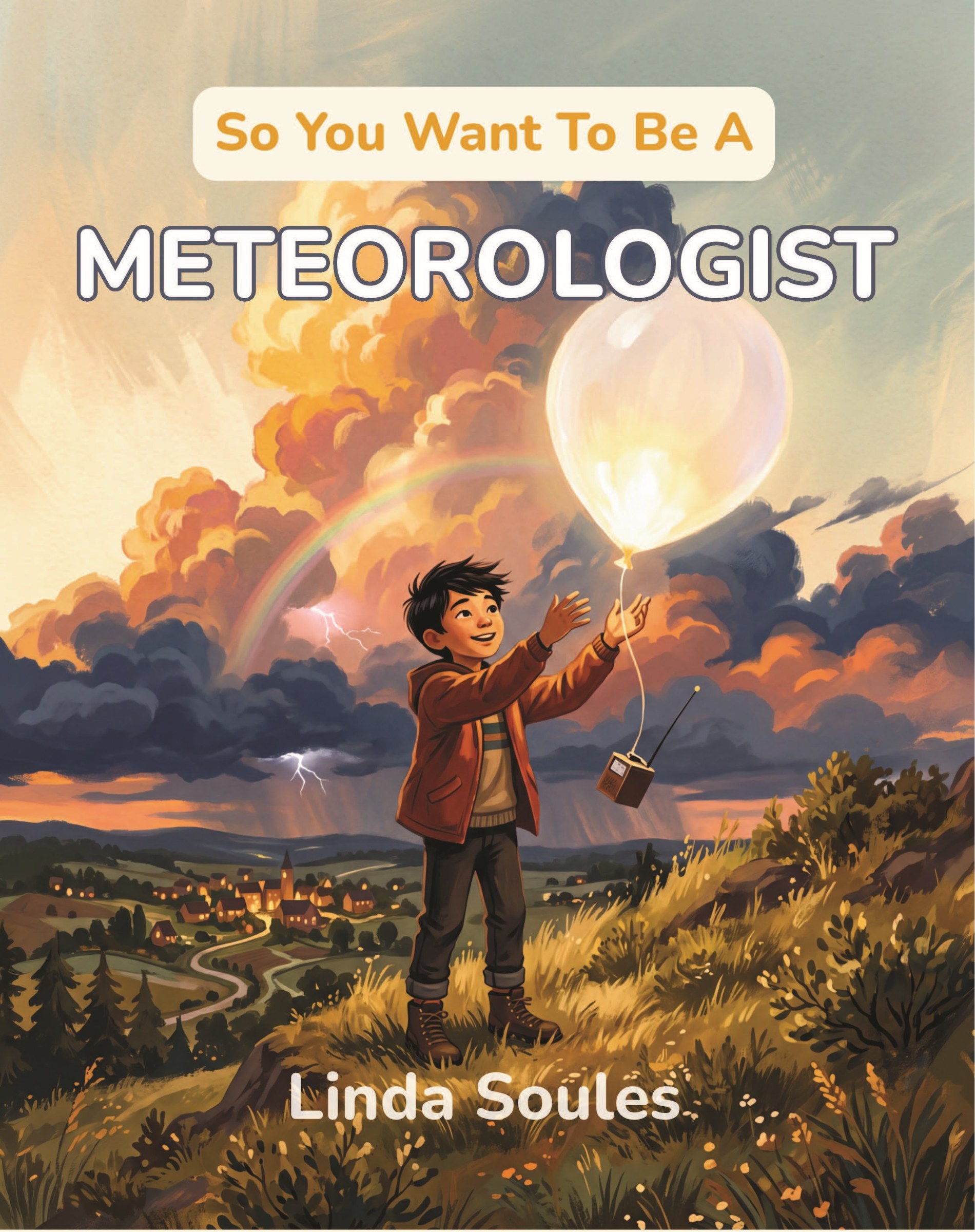
Author Linda Soules has released So You Want To Be A Meteorologist: A Kids' Guide to Clouds, Storms, and Weather Science, and the Forecasters Who Predict Tomorrow's Sky, a 44-page children's nonfiction book for readers ages 10 to 14. The book is listed at https://www.amazon.com/dp/B0HT7MVQFT (ISBN 979-8-951756-57-2). It explains how weather forecasts are produced and what the people who make them do all day. Readers follow a forecast office through a tornado outbreak, ride along with the Hurricane Hunters, and learn how artificial intelligence is beginning to change prediction. The title belongs to the So You Want To Be A… career-exploration series, which Soules created and which now has 69 published volumes.
Most people check a forecast every day, whether to choose clothes, plan a soccer game, or decide on an umbrella. Few know how the forecast is built. Weather is also one of the most visible applications of science in daily life. It is a natural entry point for young readers who are starting to ask how scientific knowledge becomes a job. The book targets that gap for the 10-to-14 age group, which is old enough to handle technical detail and young enough that career ideas are still forming. It fits earth science units, STEM classrooms, and homeschool weather lessons. It is also written for any child who has watched a thunderstorm from a window and wanted to know what was happening overhead.
The book opens with the practical questions readers tend to carry into a weather unit. It explains what a 40 percent chance of rain actually means and why TV meteorologists avoid wearing green in front of the weather map. It then shows how the main forecasting tools fit together: weather balloons, Doppler radar, satellites, and powerful computer models. A section on artificial intelligence describes how forecasters are starting to use it in making predictions. The goal is to show forecasting as a system in which each instrument supplies a different piece of the picture, not as a single screen of colored shapes.
Two narrative sequences move the reader from concepts to the job itself. In the first, readers spend a full day inside a forecast office while a tornado outbreak unfolds, which shows how data turns into decisions and warnings. In the second, they ride along with the Hurricane Hunters, who fly directly into the eye of a storm. The book also describes the less glamorous parts of the profession, including missed forecasts, long overnight shifts, and the weight of deciding when to sound a warning. Real accounts from Galveston, Texas, to the coast of eastern India show how accurate forecasts save lives.
The book also introduces the people behind the science. Wilson "Snowflake" Bentley, a farmer, took the first known photograph of a snowflake. Joanne Simpson was told that women did not belong in meteorology and went on to become a world expert on clouds. Ted Fujita, known as "Mr. Tornado," appears alongside Anna Mani of India and June Bacon-Bercey, the first African American woman to earn a degree in meteorology. The lineup spans several countries and backgrounds. It shows readers that the field has been shaped by people who entered it from many directions, often against resistance.
Humor is a deliberate part of the book's method. Forecasters in San Diego once spotted an 80-mile-wide blob on their radar that turned out to be a swarm of ladybugs. One of NOAA's hurricane planes is nicknamed Miss Piggy. Meteorologists measure snow on a flat board that is officially called a snow board. One Texas city once had to tell residents that the fish falling from the sky were not a joke. These details are meant to hold the attention of a reader who might skip a dry textbook chapter, and each one is tied back to how observation and measurement work in practice.
The book's central difference is its tone toward readers. It does not simplify the work into a list of exciting moments. It presents the profession with its routines, pressures, and tradeoffs, along with the path to get there. Warm, detailed illustrations appear on every page. Back matter includes fun facts, a glossary of weather words, hands-on activities to try at home, and a list of trusted books, websites, and organizations for further reading. That combination of narrative, reference, and activity material lets one title serve as a classroom text, a take-home project guide, and a starting point for independent research.
"Kids ask great questions about the sky, and they can tell when a book is simplifying too much. I wanted them to see the real work, including the misses," said Linda Soules, author of the So You Want To Be A… series.
The book is written for several kinds of readers. A middle-grade student preparing for a weather unit can use the glossary and the explanation of precipitation probability to make sense of forecasts they see at home. A homeschool parent can use the hands-on activities as the practical component of an earth science lesson. Teachers can pair the forecast office and Hurricane Hunter sequences with discussion of how instruments and models support public safety decisions. Librarians building STEM and career-exploration shelves will find a title that covers science concepts, biography, and the realities of shift work in one volume. The resource list at the back points interested readers toward further study.
The book is available through its listing at https://www.amazon.com/dp/B0HT7MVQFT. The listing carries current format and pricing information. It identifies the title as a 44-page children's nonfiction book with the ISBN 979-8-951756-57-2. The book is aimed at readers ages 10 to 14, though the author notes that the series is meant for readers "and beyond." Educators, librarians, and parents can use the same listing to review the description and purchase the book. Soules's other titles in the series are also available, and each volume stands alone, so readers can start with weather or with any other career that interests them.
The meteorology volume adds to a series that Soules envisions spanning more than 216 titles, with 69 published so far and new releases arriving on a steady cadence. Published subjects include astronauts, marine biologists, magicians, stunt performers, and roller coaster designers. Each book follows the same approach: pull back the curtain on a real career, covering its joys, its challenges, and the path to get there. The series has received recognition from two 2026 programs, the Purple Dragonfly Book Awards, where it earned a Grand Prize, and the CIPA EVVY Book Awards, where it earned a Silver Award in Children's Nonfiction.
About Linda Soules and the So You Want To Be A… series: Linda Soules is the author and creator of the series, a collection of career-exploration books for readers ages 10 to 14 and beyond, available at https://www.amazon.com/dp/B0HT7MVQFT for this title. Before turning to children's publishing, she spent 25 years in law and finance, advising hedge funds and sophisticated financial institutions on legal and regulatory matters. Her stated philosophy is never to talk down to kids, and each title is written to respect young readers' intelligence while sparking their curiosity. The series covers a wide range of professions, with 69 titles published to date and a planned total of more than 216.
