Seattle, Washington — 2026-11-01
Linda Soules Releases 'So You Want To Be A Marine Biologist,' a Career Guide for Ages 10–14
The 38-page illustrated nonfiction book covers research vessels, coral reef loss and grant writing, and has won multiple 2026 awards
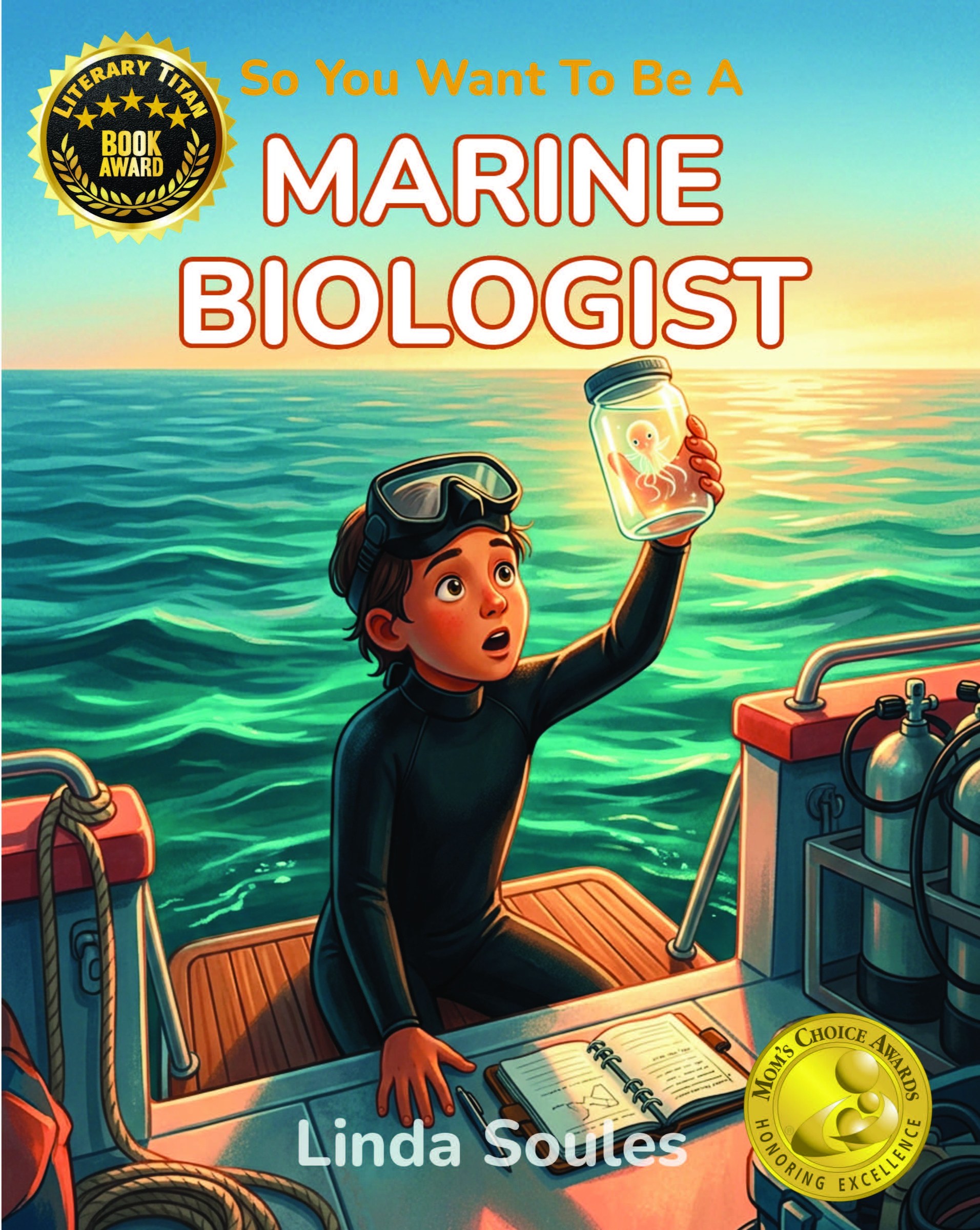
Author Linda Soules has released So You Want To Be A Marine Biologist: A Kids' Guide to Ocean Science, Sea Creatures, Coral Reefs, and the Curious Scientists Who Explore the Deep Blue, a 38-page illustrated nonfiction guide for readers ages 10 to 14. The book, listed at https://www.amazon.com/dp/1972766066 (ISBN 978-1-972766-06-4), describes what a career in marine science involves day to day, from open-water fieldwork to the grant applications that pay for expeditions. It is the latest title in Soules's So You Want To Be A… career-exploration series. The book has received the Mom's Choice Award Gold, first place in three categories at the 2026 Purple Dragonfly Book Awards, and honors from the NYC Big Book Awards, the PenCraft Book Awards and Literary Titan.
The book opens with two figures. Seventy-one percent of the planet is ocean, and humans have seen only about one thousandth of one percent of its deep floor. For a young reader, that gap makes marine science look like a field where discoveries are still waiting to be made. Soules's book is built around that premise, and it is aimed at children who have stood at the water's edge and wondered what lives below the surface, and whether they could be the person who finds out.
Career books for young readers often present a polished version of the job, and marine biology is a frequent subject of that treatment because documentaries tend to show the animals and skip the logistics. Soules takes the opposite approach. The book is written for readers who are ready to learn what the work looks like, including the parts that rarely appear on screen. It addresses the physical demands and intellectual rigor of the profession directly. It treats ten-to-fourteen-year-olds as capable of weighing those trade-offs, which is consistent with the stated philosophy behind the series: never talk down to kids.
The first half of the book's content follows the working life of a marine scientist. Sections cover mapping coral reefs, monitoring ocean ecosystems, and cataloging sea creatures. They also cover studying the connections between species that researchers are still working to understand. Readers learn how marine biologists conduct laboratory research and open-water fieldwork, and what it means to live and work aboard a research vessel for weeks at a time. The book also describes the less visible parts of the job: the grant applications that fund expeditions and the patience needed to observe animals in an environment that was never built for human bodies.
The second half turns to conservation. The book explains why coral reefs are disappearing, how pollution threatens sea life, and what marine scientists are doing now to protect the ecosystems the planet depends on. It stresses teamwork among marine biologists, lab technicians, ship crews, and conservationists, and it argues that patient observation is a skill no equipment can replace. Back matter includes a glossary of marine science terms, fun facts, and a curated page of books, websites, and citizen-science projects for readers who want to go further than the book itself.
A third element is practical. Soules includes action steps that a young reader can take now, before any lab or wetsuit is involved. These cover the habits and forms of curiosity that help a child who loves the ocean decide whether the calling is really theirs. The book frames the question as a test of fit rather than a promise of a career. That gives families and educators a concrete starting point for conversations about science pathways, and it gives readers a way to try the work before committing to years of study.
What separates the book from many titles on the same shelf is its candor about the job. It does not rely on the standard picture of a scientist swimming with whales. It puts grant writing, long shifts at sea, and slow observation next to the discoveries, so readers see how the two connect. It also pairs career information with environmental science, so a child can learn about coral loss and pollution as part of the working context of the profession. The format is consistent with the rest of the series: illustrated, short, and written for readers who are older than picture-book age but not yet in adult nonfiction.
"Kids can handle the truth about science careers, including the grant writing and the patience. They deserve a guide that doesn't talk down to them," said Linda Soules, author of the So You Want To Be A… series.
The book is written for several audiences. Children ages 10 to 14 who are curious about biology and drawn to the ocean are the primary readers. Parents looking for books that go beyond animal facts can use it to start discussions about what scientific work involves. Teachers and librarians may find it useful for STEM and environmental-science collections, since the book combines career information, conservation topics, a glossary, and pointers to citizen-science projects. The citizen-science page gives readers a way to take part in real research without special equipment, which suits families who live far from the coast.
The title arrives with a set of 2026 recognitions. Beyond the Mom's Choice Award Gold, it won first place at the Purple Dragonfly Book Awards in the Animals/Pets, Green Books/Environmental, and STEM categories. It also won in the Educational Series (Pre-Teen Nonfiction) category at the NYC Big Book Awards, Best Children's Book (Preteen) at the PenCraft Seasonal Book Award, and the Literary Titan Gold Book Award. The series as a whole has been recognized as well, with a 2026 Purple Dragonfly Grand Prize and a Silver Award in Children's Nonfiction at the CIPA EVVY Book Awards.
So You Want To Be A Marine Biologist is available through Amazon at https://www.amazon.com/dp/1972766066. The listing includes the full book description, the ISBN, and current pricing and format options. Readers who want to check availability, compare formats, or order can use that page directly. Libraries, schools, and booksellers can also reference the ISBN, 978-1-972766-06-4, when searching catalogs or placing orders through their usual channels.
The marine biology title belongs to a series that is still expanding. Soules has said she envisions the So You Want To Be A… series reaching more than 180 titles, and more than 60 have been published so far, with new releases arriving on a steady cadence. The subjects range widely, from astronauts and marine biologists to magicians, stunt performers, and roller coaster designers. The stated goal is to introduce young readers to the full range of human work, so that a child's first look at a profession comes from a source that describes it honestly.
About Linda Soules and the So You Want To Be A… series: Linda Soules is the author and creator of the So You Want To Be A… series, a growing collection of career-exploration books for readers ages 10 to 14 and beyond. The series is envisioned to span more than 180 titles, with more than 60 published to date. Her approach is that young readers are smarter, more curious, and more capable than the publishing world often gives them credit for, and that they deserve accurate information about the work people do. So You Want To Be A Marine Biologist is available at https://www.amazon.com/dp/1972766066.
