Seattle, Washington — 2026-11-02
Linda Soules Releases 'So You Want To Be A Magician,' a Kids' Guide to the Craft Behind Stage Illusion
The 38-page illustrated book for ages 10 to 14 has won awards from Literary Titan, Purple Dragonfly and CIPA EVVY
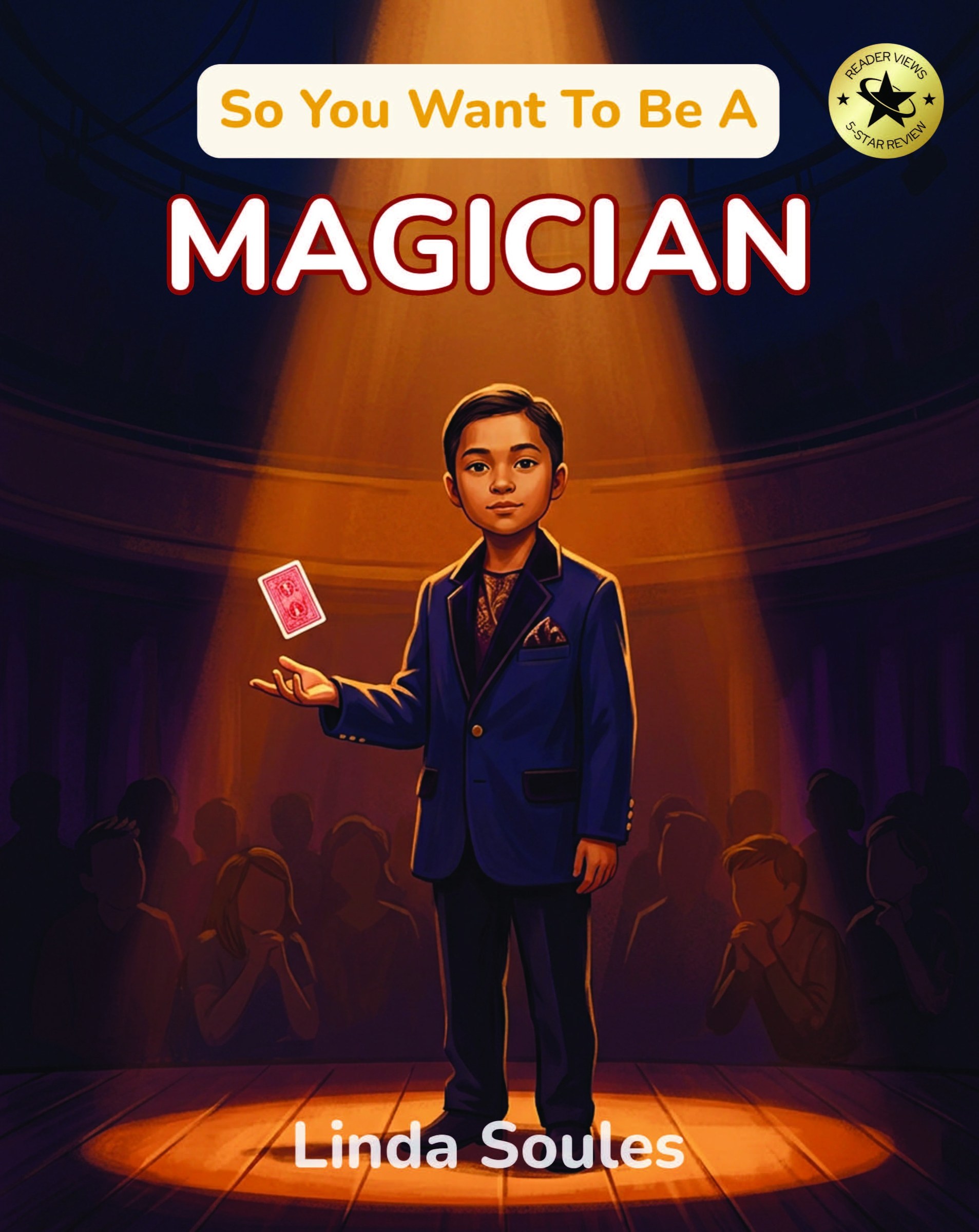
Author Linda Soules has released So You Want To Be A Magician: A Kids' Guide to Magic, Illusion, Sleight of Hand, and the Performers Who Amaze Audiences with Mystery and Wonder, a 38-page illustrated nonfiction book for readers ages 10 to 14. The book is available now at https://www.amazon.com/dp/1972766139 (ISBN 978-1-972766-13-2). It explains how professional magicians train and work, and it focuses on the craft behind the performance rather than on revealing individual tricks. The title belongs to Soules's So You Want To Be A... career-exploration series. It has already won the Literary Titan Gold Book Award, the Grand Prize in the 2026 Purple Dragonfly Book Awards, and a Silver Award in Children's Nonfiction at the 2026 CIPA EVVY Book Awards.
Children's books about magic usually fall into one of two groups: trick manuals that teach a handful of effects, or biographies of famous illusionists. Few address the question many young audience members ask after a good performance: what does it take to do this for a living? Career-exploration titles for the 10-to-14 age group are also relatively uncommon, even though that is when many students begin forming ideas about what they might pursue. Readers in this range are often old enough to want specifics about training, discipline and tradeoffs, and they notice when a book simplifies too much. Magic is a useful subject for this kind of treatment because it combines physical skill, psychology, theater and storytelling in a single career. So You Want To Be A Magician is written for young people who see an illusion, feel the wonder, and want to know how it was done.
The book describes a magician's training as a long progression, from a first flourish to a standing ovation. A central theme is the thousands of hours of practice that come before a trick is ever shown to an audience. Soules explains how sleight of hand is developed through repetition until a move is held in the muscles, and how a performer trains hands, eyes, timing and psychology at the same time. The book argues that a strong illusion is never only a technique. It is a story told well enough that the audience chooses to believe it. That framing gives young readers a way to see why two performers with similar skills can produce very different results on stage.
A second section covers the psychology of misdirection, which the book presents as the use of the human mind as a performer's primary instrument. Readers learn how magicians guide attention and shape perception, and why the hand that draws the eye is not the hand that matters. The book also covers stagecraft and performance skills, the abilities that let one person hold a room, and the physical demands that make difficulty disappear in front of an audience. Readers meet the historical figures who turned street corners and parlors into what the book calls theaters of the impossible. Illustrations appear throughout, and the publisher description says they are meant to make technical ideas accessible and engaging.
The book is also direct about the costs of the work. It describes solitary rehearsal sessions and the trick that falls apart and teaches a lesson no set of instructions could. It also describes the moment a spectator's expression changes to genuine astonishment, which performers say is unlike anything else. This candor reflects the series' approach, which assumes young readers can handle an accurate picture of a career, including the difficult parts. Rather than promising that magic is easy or glamorous, the book lays out the patience and repetition the craft demands and leaves readers to decide whether that work appeals to them. It treats them as equals, with step-by-step insight into pursuing magic as a calling.
"Kids who love magic are not satisfied with being fooled. They want to understand how the work gets done, and they can handle the real answer," said Linda Soules, author of the So You Want To Be A... series.
The book is aimed first at readers ages 10 to 14 who are curious about performing arts, and particularly those who have already tried a card trick or a coin vanish and want to know what comes next. It also suits students who respond to practical explanations of how a career is built, since the book emphasizes practice habits, the value of failure in rehearsal, and the discipline behind work that looks effortless. Parents, teachers and librarians may find it useful for units on careers, psychology or the performing arts, and as a reading option for young people who prefer nonfiction. Because the content centers on craft and psychology rather than a catalog of tricks, it can interest readers who have no plans to perform but are curious about attention and perception.
The book's recognition comes from three separate programs. The Literary Titan Gold Book Award is listed in the book's description, as is the Grand Prize in the 2026 Purple Dragonfly Book Awards. The title also received a Silver Award in the Children's Nonfiction category at the 2026 CIPA EVVY Book Awards. The recognition follows earlier awards for the series, which the book's description identifies as award-winning. For librarians, educators and booksellers who rely on third-party recognition to evaluate children's nonfiction, the awards offer an outside signal about quality, though the book's content, not its honors, is what will determine whether it holds the attention of its intended readers.
So You Want To Be A Magician is available through Amazon at https://www.amazon.com/dp/1972766139. The book is 38 pages, is categorized as children's nonfiction, and carries ISBN 978-1-972766-13-2. Readers should consult the Amazon listing for current formats, pricing and availability, as those details can change. Educators, librarians and booksellers interested in the title can find ordering information through the same listing, and the ISBN can be used to locate the book through other channels that carry it. Soules is available to discuss the book, the series and her approach to writing career guides for young readers.
The magician title is one entry in a series that Soules envisions as spanning more than 180 books in total. More than 60 have been published so far, with new releases arriving on a steady cadence. Subjects range from astronauts and marine biologists to magicians, stunt performers and roller coaster designers. Each book follows the same basic approach: pull back the curtain on a real career, describe its joys and challenges, outline the path to get there, and leave readers with the sense that the world is wider, more interesting and more reachable than they imagined. The series is designed for readers ages 10 to 14, and the author notes that older readers can enjoy the books as well.
About Linda Soules and the So You Want To Be A... series: Linda Soules is the author and creator of the series, a growing collection of career-exploration books for readers ages 10 to 14 and beyond. Her stated philosophy is never to talk down to kids, and each title is written to respect young readers' intelligence while sparking their enthusiasm. Before turning to children's publishing, she spent 25 years in law and finance, advising hedge funds and sophisticated financial institutions on legal and regulatory matters. She says that career taught her precision, discipline, and how to translate intricate subjects into language anyone can use. So You Want To Be A Magician is available at https://www.amazon.com/dp/1972766139.
