Seattle, Washington — 2026-11-04
Linda Soules Releases 'So You Want To Be A Geologist,' a Kids' Guide to Rocks, Earth Science and Careers
The 43-page children's nonfiction book, a multiple award winner, follows working geologists from pre-dawn field days to the scale of deep time
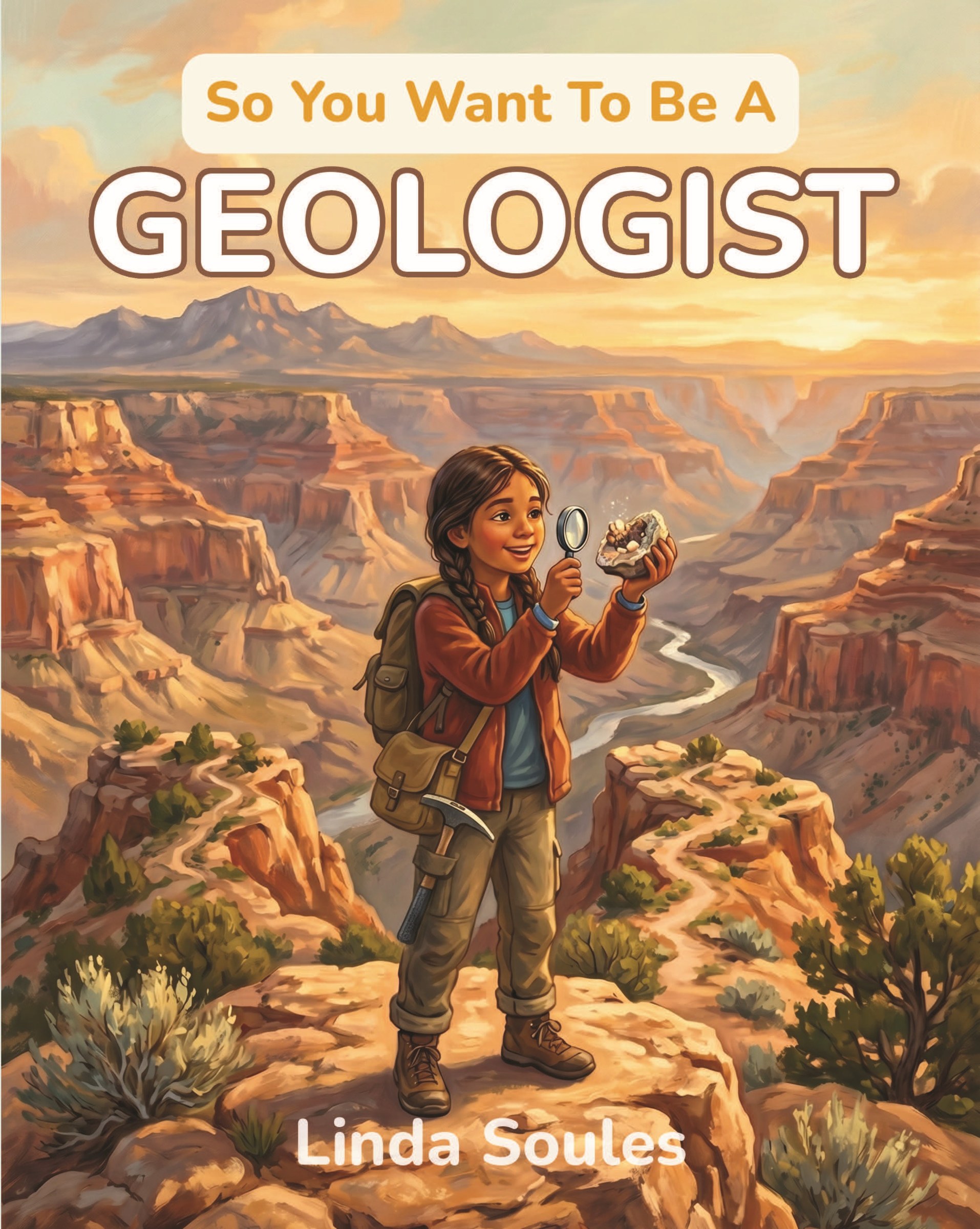
Author Linda Soules has released So You Want To Be A Geologist, a 43-page children's nonfiction book that introduces readers ages 10 to 14 to rocks, minerals, deep time and the careers of the people who study the Earth. The book is available at https://www.amazon.com/dp/B0HB8HS1B2 and belongs to the So You Want To Be A… series of STEM career-exploration books for young readers. Its full title is So You Want To Be A Geologist: A Kids' Guide to Geology, Rocks and Minerals, Earth Science, and the Curious Scientists Who Read the Stories Written in Stone Beneath Our Feet. The book has won the Literary Titan Gold Book Award, the Grand Prize in the 2026 Purple Dragonfly Book Awards, and a Silver Award in Children's Nonfiction at the 2026 CIPA EVVY Book Awards. Its ISBN is 979-8-951756-14-5.
Earth science is a common part of upper-elementary and middle-school curricula, but the working lives of the people who practice it are rarely shown to young readers. Children who pick up rocks on every walk, or who stare at a canyon wall and wonder how long it took to form, often have few books that connect that curiosity to an actual profession. Soules wrote the book for those readers. It targets ages 10 to 14 and is also suited to curious 8- and 9-year-olds who read alongside a parent. The premise is that geology is not a dusty subject. The ground underfoot is moving now, and a geologist is the person trained to read what it is doing. The book treats young readers as capable of handling real scientific ideas and an honest account of the job.
The book opens with a reframing: a cliff is a clock. Readers learn to see layered rock as a record of time and are walked through the scale of deep time. They then work through the three kinds of rock, igneous, sedimentary and metamorphic, and travel in text and illustration to the molten core of the Earth. A section on the tools of the trade introduces the rock hammer, the hand lens and the geologic map, the basic kit a field geologist carries. Another section follows a working geologist through a full day in the field, from pre-dawn coffee to a puzzling rock that changes everything. The day-in-the-life structure gives readers a sense of the routine, the decisions and the surprises involved in the work.
A second thread of the book covers the many careers inside one word. Readers meet the volcanologist, paleontologist, seismologist, hydrogeologist and planetary geologist, and learn how geologists keep people safe from earthquakes and eruptions, locate the clean water and minerals a civilization depends on, and read the planet's climate record. Three real scientists anchor the history: James Hutton, Mary Anning and Inge Lehmann. Their stories show how observation, persistence and sometimes an overlooked fossil or seismic wave changed what people understood about the planet. The book also collects facts meant to hold a young reader's attention, among them floating rocks, petrified lightning and crystals the length of a school bus. It closes with a kid-friendly glossary, guidance on what the job takes, and resources for further exploration.
The book's main distinction from many children's science titles is its candor about the profession. Rather than presenting only the wonder and the spectacular field days, it includes what the description calls the honest hard parts of a geologist's life, and it offers frank guidance on what the work demands. It pairs that approach with a career-exploration frame, so a reader learns the science and sees how it becomes a job. The tone follows the series philosophy of never talking down to kids. The book speaks to readers eye to eye and encourages them to look closely and stay curious. It also defends a habit many children are teased for, arguing that a pocket full of rocks is not a childish thing.
"Kids who can't walk past an interesting rock deserve a book that takes them seriously, including the hard parts of the job, not just the highlights," said Linda Soules, author and creator of the So You Want To Be A… series.
The book is written for several kinds of readers. Young rockhounds who collect specimens will find the vocabulary and tools to describe what they have gathered. Students who like earth science may use it to see where the subject leads after school, from hazard monitoring to water resources to planetary exploration. Parents of 8- and 9-year-olds can read it aloud as a shared project. Homeschool families and classroom teachers can place it on an Earth science shelf alongside textbooks, using the glossary and the profiles of Hutton, Anning and Lehmann as discussion starters. The publisher's description also positions it as a gift for future scientists and curious minds, particularly for children who ask how landscapes formed or how scientists know the age of a rock.
Recognition for the title came from three separate programs. The Literary Titan Gold Book Award honors it as a winner. The 2026 Purple Dragonfly Book Awards named it a Grand Prize recipient. The 2026 CIPA EVVY Book Awards gave it a Silver Award in the Children's Nonfiction category. The series itself is described as acclaimed, and this title carries those honors on its book description. For librarians, educators and parents evaluating a title, the awards come from different judging bodies with different criteria. Together they indicate that the book has been reviewed outside the author's own circle and has drawn favorable notice for both its writing and its treatment of a scientific subject for young readers.
So You Want To Be A Geologist is available through Amazon at https://www.amazon.com/dp/B0HB8HS1B2. The listing carries the full book description, the award information and purchasing options. The book runs 43 pages and is categorized as children's nonfiction, with the ISBN 979-8-951756-14-5. Readers should consult the listing for current pricing and available formats, since those details can change. Educators, librarians and homeschool families looking for a title to add to an Earth science collection can find it by searching the title or the author's name on the site. Because the book is part of a series, the listing is also a starting point for readers who want to explore other careers covered in the same format.
So You Want To Be A Geologist is one title in a series that Soules envisions at more than 180 books in total. More than 60 have been published to date, with new releases arriving on a steady cadence. The existing titles cover a wide range of careers, from astronauts and marine biologists to magicians, stunt performers and roller coaster designers. Each book is built to pull back the curtain on a real career: its joys, its challenges and the path to get there. The geology volume shows the approach applied to a field-based science, where the work happens outdoors, in laboratories and on maps. The long-term plan is a broad library that lets young readers sample many professions before they have to choose one.
Linda Soules is the author and creator of the So You Want To Be A… series, a growing collection of career-exploration books for readers ages 10 to 14 and beyond. Before turning to children's publishing, she spent 25 years in law and finance, advising hedge funds and sophisticated financial institutions on legal and regulatory matters, a career she credits with teaching her precision and how to translate intricate subjects into plain language. Her guiding belief is that young readers are smarter, more curious and more capable than the publishing world often assumes. She lives in Seattle with her husband and two children. More about So You Want To Be A Geologist is available at https://www.amazon.com/dp/B0HB8HS1B2.
