Seattle, Washington — 2026-11-01
Linda Soules Releases 'So You Want To Be A Doctor,' an Honest Career Guide to Medicine for Ages 10 to 14
The 38-page illustrated nonfiction title has won Gold honors from Readers' Favorite, Mom's Choice and Literary Titan award programs
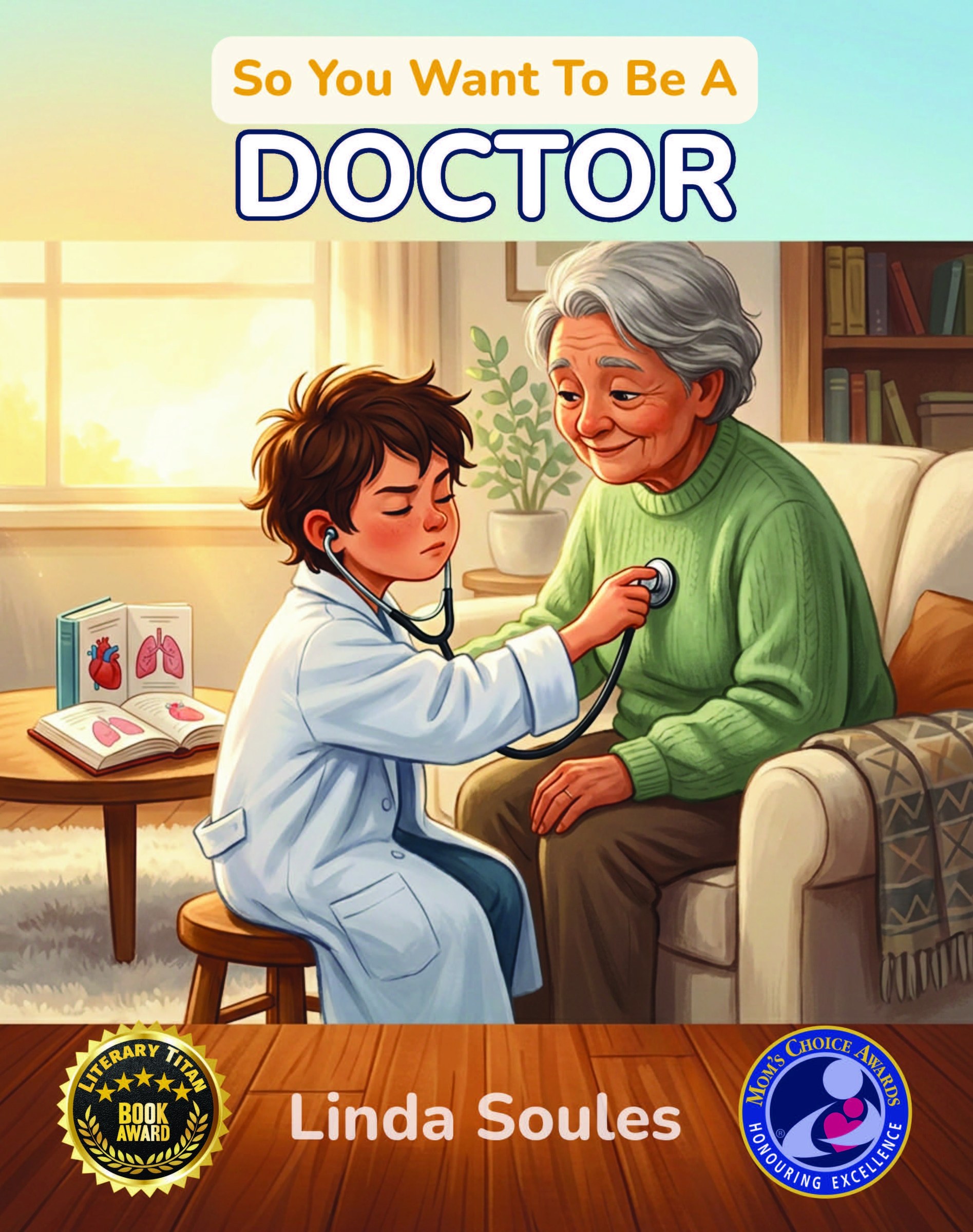
Author Linda Soules has released So You Want To Be A Doctor: A Kids' Guide to Medicine, Human Anatomy, Hospital Life, and the Caring Professionals Who Help People Heal, a 38-page illustrated nonfiction book for readers ages 10 to 14. The title, available now at https://www.amazon.com/dp/1972766082, walks young readers through the science of the human body, the structure of a medical career, and the demands of training. It is the latest entry in Soules's So You Want To Be A… career-exploration series. The book has already won the Gold Medal in the Children – Nonfiction category of the 2026 Readers' Favorite International Book Awards, along with a Mom's Choice Award Gold and a Literary Titan Gold Book Award.
Children who say they want to be doctors often have little way to test that idea against reality. Most career material for this age group leans on a single image: a white coat, a stethoscope, a happy ending. It says little about the years of study, the long hospital shifts, or the range of specialties a physician can choose. Meanwhile, readers between 10 and 14 are at an age when interests in science begin to harden into academic choices, from the courses they pick to the extracurricular activities they pursue.
So You Want To Be A Doctor is written for that audience. The book is aimed at the child who asks questions without simple answers, and it treats the decision to pursue medicine as a serious one. It describes the education required, the emotional weight of responsibility for another person's health, and the satisfaction that keeps many physicians in the profession. Parents, teachers and librarians looking for nonfiction that connects classroom science to a real occupation are the secondary audience. The book does not promise that medicine is easy. It tries to give readers enough information to decide for themselves whether the work suits them.
The first half of the book focuses on how the body works. Young readers learn how organ systems cooperate, how bones heal after a fracture, and how the brain sends signals through the nervous system. The text also introduces diagnosis as a form of problem-solving, comparing the way doctors read symptoms to the way a detective reads clues. The book does not simplify the subject to the point of distortion. Its stated approach is to acknowledge that the human body is complex and then make that complexity accessible, with illustrations designed to carry difficult concepts so that each page invites exploration.
The second half moves from biology to daily professional life. Chapters cover what happens during hospital rounds, how surgeons prepare for an operation, and how the work of a pediatrician differs from that of an emergency room doctor or a medical researcher. The aim is to show the range of paths within medicine so readers can begin to picture where they might fit. The book also describes the training itself, including medical school and residency, the sacrifices involved, and the sleepless nights. According to the book's description, every chapter is built on real science and real scenarios, and explains how doctors think, decide and care for patients.
Several features distinguish the book from typical career guides for young readers. It is explicit about hardship rather than leaving the difficult parts of medical training to be discovered later. It addresses the full spectrum of medical work, not only the surgeon or family physician most children already recognize. And it pairs anatomy and physiology with the human side of the job, including the emotional responsibility of caring for patients. The author's stated philosophy throughout the series is never to talk down to young readers, and the book is written to respect their intelligence while still sparking enthusiasm for the field.
"Kids who dream about medicine deserve to know what the road really looks like, including the sleepless nights, and why so many doctors say it is worth it," said Linda Soules, author of the So You Want To Be A… series.
The book's primary readers are students ages 10 to 14 who are drawn to science and curious about healthcare. A child who has just finished a unit on the nervous system, for example, can use it to see how that knowledge applies in an emergency room. A student weighing whether to pursue advanced science courses can get a realistic picture of the years of study that medicine requires. Parents who want to support a child's interest without overselling or discouraging it can read the book alongside them. Teachers and school librarians can place it in career-exploration units, STEM collections or classroom libraries, where its focus on specific specialties and hospital roles may help students talk about the many jobs that make up a healthcare team.
The book carries several recognitions. In addition to the Readers' Favorite Gold Medal, the Mom's Choice Award Gold and the Literary Titan Gold Book Award, the book's description lists series-level honors for So You Want To Be A…: a Grand Prize in the 2026 Purple Dragonfly Book Awards and a Silver Award in Children's Nonfiction at the 2026 CIPA EVVY Book Awards. These programs evaluate books independently of one another, and they differ in how they judge entries and which audiences they serve. Together, they indicate that the series has drawn attention from reviewers who focus on children's nonfiction and on family-oriented reading.
So You Want To Be A Doctor is available through Amazon at https://www.amazon.com/dp/1972766082. The book is listed as children's nonfiction, runs 38 pages, and carries the ISBN 978-1972766088. Readers can find current formats and pricing on the product page, where purchase options are displayed at checkout. Because the book is sold through a major online retailer, families, schools and libraries can order it without a separate account or membership. Interested readers can also look up the title by its ISBN through other booksellers and library catalogs.
The book belongs to a long-running project. According to the author, the So You Want To Be A… series is envisioned to span more than 180 titles, with more than 60 published to date and new releases arriving on a steady cadence. Subjects range from astronauts and marine biologists to magicians, stunt performers and roller coaster designers. Each volume is written to pull back the curtain on a real career: its joys, its challenges and the path to get there. The medicine title extends the series into one of the most commonly cited childhood career ambitions, and sits alongside books that cover less familiar occupations.
Before turning to children's publishing, Soules spent 25 years in law and finance, advising hedge funds and sophisticated financial institutions on legal and regulatory matters. Her author biography describes that career as one that taught her precision and discipline. Her approach to the series rests on a straightforward premise: young readers are smarter, more curious and more capable than the publishing world often gives them credit for. That premise shapes the tone of So You Want To Be A Doctor, which presents difficult subject matter directly and leaves readers with the sense that the world is wider, more interesting and more reachable than they imagined.
About Linda Soules and the So You Want To Be A… series: Linda Soules is the author and creator of the So You Want To Be A… series, a growing collection of career-exploration books for readers ages 10 to 14 and beyond. The series is envisioned to include more than 180 titles, with more than 60 published to date. Each book examines a real profession, including the path to entering it and the realities of the work. Soules worked for 25 years in law and finance before becoming a children's author. So You Want To Be A Doctor is available at https://www.amazon.com/dp/1972766082.
