Seattle, Washington — 2026-11-08
Linda Soules Releases 'So You Want To Be A Baker,' a Kids' Guide to Bread, Pastry and Kitchen Chemistry
The 44-page illustrated book for ages 10 to 14 follows a 3:30 AM bakery shift and includes hands-on experiments and a 24-term glossary
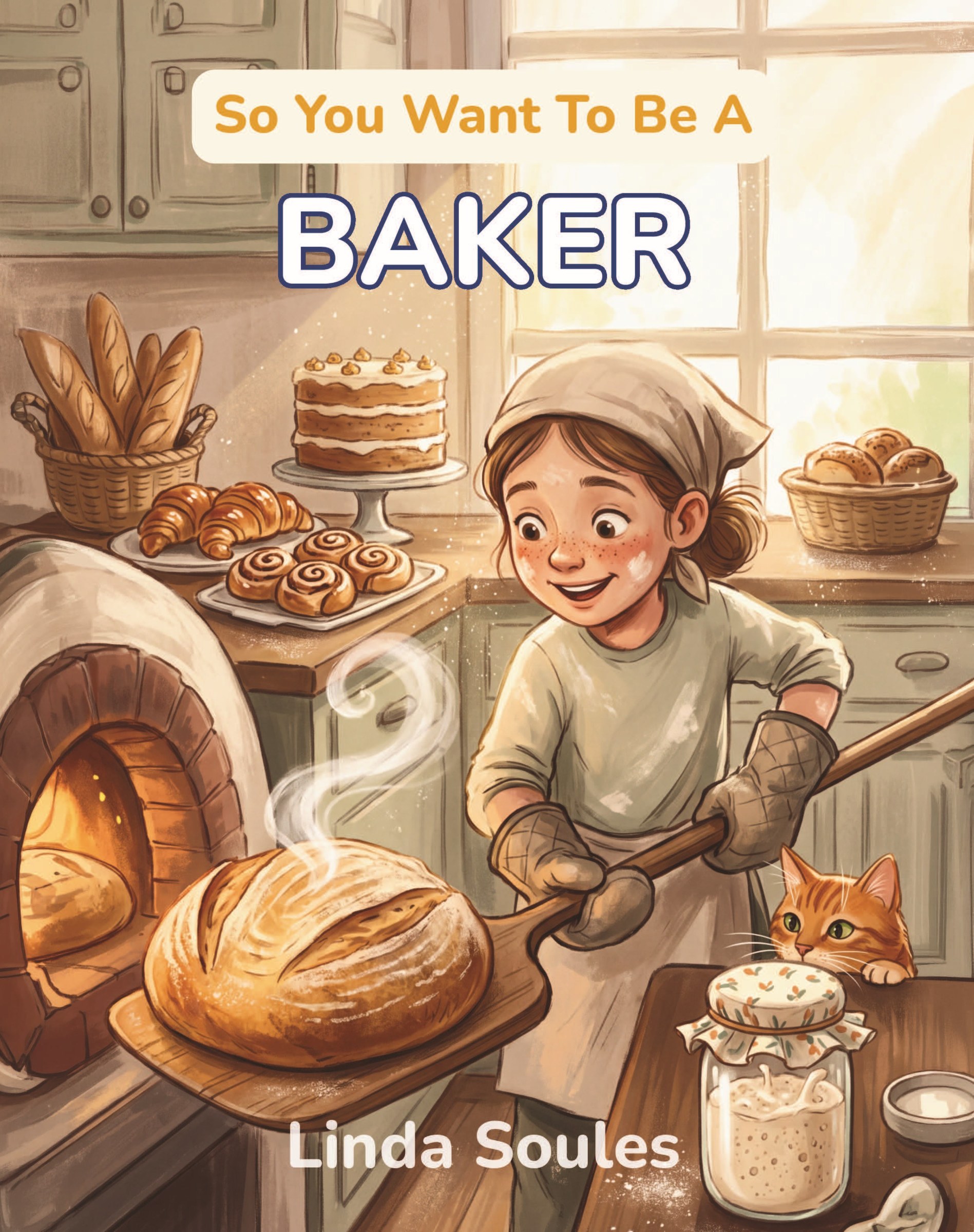
Author Linda Soules has released So You Want To Be A Baker, a 44-page illustrated children's nonfiction book that teaches readers ages 10 to 14 how bread, pastry and cake work as chemistry, and what a baker's working life involves. The book is available at https://www.amazon.com/dp/B0HQVVH3S1 (ISBN 979-8-951756-47-3). Its subtitle describes the scope: A Kids' Guide to Bread, Pastry, Kitchen Chemistry, and the Early-Rising Bakers Who Turn Flour, Water, and Time into Something Worth Sharing. The text opens with a simple claim, that bread rises because of yeast burps, and builds from there into gluten, leavening, laminated dough, bakery vocabulary, baking history, profiles of working bakers and home experiments. It is the latest title in the So You Want To Be A... career-exploration series.
Children's books about baking tend to be recipe collections. They tell young readers what to mix and for how long, but rarely explain why the dough behaves as it does. They also say little about the people who bake for a living. Career-exploration titles for middle-grade readers face a similar gap. Many stay on the surface of a profession and skip the unglamorous parts, such as early hours, burns, thin margins and allergy risks. So You Want To Be A Baker targets both gaps. It treats baking as a science that a ten-year-old can follow, and it treats the bakery as a workplace with real schedules, real tradeoffs and a real path into the trade. The book is written for ages 10 to 14 and is meant to be accessible to younger children reading with an adult.
The chemistry sections are the core of the book. Readers learn how yeast and gluten trap millions of tiny bubbles in dough, which is what lets bread rise and gives it structure. The book explains why baking soda needs an acid to fizz, a distinction that separates many quick breads and cakes from yeast-leavened loaves. It also describes how bakers fold butter into dough to build the flaky layers of a croissant. Along the way, readers pick up the working vocabulary of a bakery, including proof, crumb, oven spring and lame. The book's premise is that baking is closer to chemistry than to cooking, and it uses concrete, kid-sized examples to show why precision matters at the bench.
A section titled A Day in the Life starts at 3:30 AM, when the head baker unlocks the door in the dark. It follows the team through a shift that includes singing loaves, flat cinnamon rolls and a birthday cake shaped like a dragon. The book is direct about the hard parts of the job, from early hours and burns to thin profit margins and food allergies, and it explains how people become bakers. Hands-on activities let readers blow up a balloon with yeast, test kneaded dough and grow a sourdough starter with an adult. The back matter includes a 24-term glossary, recommended books and websites, and baking organizations for readers who want to explore further.
The book also places baking in a long human story. It cites 14,400-year-old bread crumbs found in Jordan, 81 loaves preserved at Pompeii and the Great Fire of London, which started in a bakery. Profiles introduce Malinda Russell, Kimura Yasubei, Ruth Wakefield, Dominique Ansel, Nadiya Hussain and Bryan Ford, a group that spans centuries, continents and specialties. Readers also meet bakeries with big hearts and visit the Bread Lab, where scientists grow purple and black wheat. Together, these sections show young readers that baking draws on history, agriculture, entrepreneurship and community work as well as technique, and that people from many backgrounds have shaped the craft.
Several choices set the book apart from other baking titles for young readers. It leads with mechanisms rather than recipes, so a child who finishes it can explain why dough rises, why croissants flake and why a sourdough starter is alive. It names the occupational downsides alongside the rewards, including burns, long hours and thin margins, which is information that career guides for young readers often omit. It also pairs its science with a profiles section that is broad in era and background, from Malinda Russell to Bryan Ford. And its activities are designed to be completed with ordinary kitchen materials, with adult supervision flagged where a sourdough starter is involved. The result is a short nonfiction book that functions as a science primer, a career guide and a history lesson.
"Kids can handle real science and real work. Baking is chemistry you can eat, and bakers deserve to be shown honestly, early hours and burns included," said Linda Soules, author of the So You Want To Be A... series.
The book's most direct audience is the child who already likes to bake or is curious about kitchen science. A reader who has pulled a loaf from the oven at home can use the book to understand why it turned out the way it did, and what a professional would do differently. The yeast-and-balloon experiment and the dough-kneading test give that reader something to try at the counter. The sourdough starter activity offers a longer project to share with a parent or grandparent. For readers who are only beginning to think about careers, the 3:30 AM shift, the allergy discussion and the explanation of how people become bakers offer a realistic picture of the work before they decide whether it appeals to them.
The book is also positioned for adults who choose materials for young readers. The publisher description identifies it as a fit for STEM lessons, homeschool families and school libraries. A teacher can use the leavening and gluten sections to ground a unit on chemical reactions in something students have eaten. A homeschool parent can pair the glossary with the hands-on activities for a short, self-contained lesson. Librarians building career-exploration shelves get a title that covers a skilled trade often missing from collections that lean toward medicine, law and technology. The recommended books, websites and baking organizations in the back matter give educators and families a way to extend the topic past the final page.
So You Want To Be A Baker is available through Amazon at https://www.amazon.com/dp/B0HQVVH3S1. The listing identifies the book as a 44-page illustrated work of children's nonfiction with ISBN 979-8-951756-47-3. Readers can find current pricing and format options on the product page. Because the book is written for ages 10 to 14 and is accessible to younger children when read with an adult, it can serve as a gift for young bakers, a classroom or library addition, or a family reading project. The book is part of the So You Want To Be A... series, and other titles can be explored from the same author and listing pages on the retailer's site.
The book extends a series that Soules has described as envisioned to span more than 180 titles, with over 60 published to date and new releases arriving on a steady cadence. Existing and planned subjects range from astronauts and marine biologists to magicians, stunt performers and roller coaster designers. The series is described as award-winning: the listing cites a Grand Prize at the 2026 Purple Dragonfly Book Awards and a Silver Award in Children's Nonfiction at the 2026 CIPA EVVY Book Awards. Adding a baking title brings a hands-on trade into a catalog that already covers science, entertainment and engineering careers. Each book follows the same approach, which is to show a real career's joys, challenges and path, without simplifying the subject beyond what readers can handle.
Linda Soules is the author and creator of the So You Want To Be A... series, a collection of career-exploration books for readers ages 10 to 14 and beyond. Her stated philosophy is never to talk down to kids, and to write books that respect young readers' intelligence while sparking their enthusiasm. Before turning to children's publishing, she spent 25 years in law and finance, advising hedge funds and sophisticated financial institutions on legal and regulatory matters. She lives in Seattle with her husband and two children, whose daily questions continue to inform her work. Her books are written to pull back the curtain on real careers and to leave readers with the sense that the world is wider and more reachable than they imagined.
About the So You Want To Be A... series. The So You Want To Be A... series is a career-exploration collection for readers ages 10 to 14, written by Linda Soules. With more than 60 titles published and a plan to reach more than 180, the series covers professions from astronauts and marine biologists to stunt performers and bakers. Each book describes the daily work, the difficulties and the route into a career in plain, respectful language. So You Want To Be A Baker is available at https://www.amazon.com/dp/B0HQVVH3S1.
