Seattle, Washington — 2026-11-01
Linda Soules Releases Kids' Guide to Video Game Design Careers for Readers Ages 10 to 14
"So You Want To Be A Video Game Designer" has won a 2026 Purple Dragonfly Grand Prize and a Literary Titan Gold Book Award
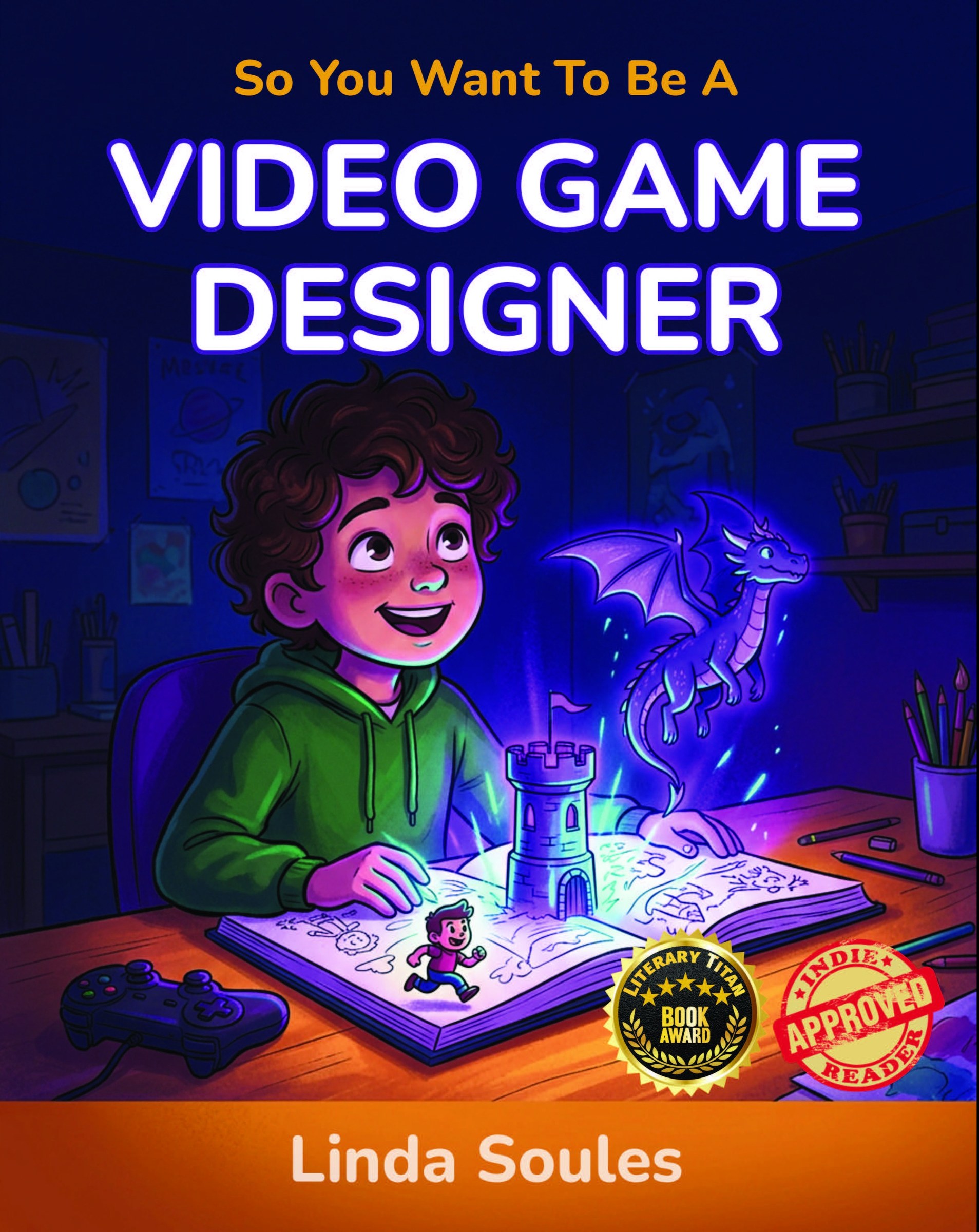
Author Linda Soules has released So You Want To Be A Video Game Designer: A Kids' Guide to Game Design, Coding, Storytelling, and the Creative Minds Who Build the Worlds We Love to Play, a 38-page illustrated nonfiction book for readers ages 10 to 14. The book is a career-exploration guide that explains what game designers do each day, how development teams are organized, and how young people can begin preparing now. It is listed at https://www.amazon.com/dp/197276604X (ISBN 978-1-972766-04-0). It belongs to Soules's So You Want To Be A... series and has already collected several 2026 awards, including a Purple Dragonfly Book Awards Grand Prize and a first-place STEM designation from the same program.
Many children who play video games eventually ask how the games are made. Few age-appropriate resources answer that question in any depth. Game development draws on programming, visual art, writing, music, sound design, and behavioral psychology, and it is rarely presented to young readers as a career with a clear structure. Children who finish a game and start imagining different levels, rules, or story endings often have no obvious next step. Parents and teachers who want to encourage that curiosity may not know where to point it.
Soules's book is written for that reader: the kid who sketches game worlds in notebooks and argues about mechanics with friends. It treats games as an art form, a science, and an engineering challenge at once. Instead of a simplified overview, it describes the real process of moving a rough concept toward a finished game, including the parts that are difficult. The book is categorized as Children's Nonfiction, Careers and Professions, and is part of a series built on a consistent premise: young readers can handle accurate information about real work.
The book has received recognition from several programs. It won first place in the STEM category of the 2026 Purple Dragonfly Book Awards and was also named a Grand Prize winner in that program. It received a Silver Award in Children's Nonfiction from the 2026 CIPA EVVY Book Awards and a Gold Book Award from Literary Titan. It was also selected for the Indie Author Project Select Collection. The awards were granted by their respective programs, and readers can review the listing at https://www.amazon.com/dp/197276604X for the publisher-supplied description of each honor.
The book's core chapters follow how a game takes shape. It explains how designers prototype mechanics and test them until they break, a process that shows readers why iteration is central to the job. It describes how writers build interactive stories that respond to a player's choices, a different task from writing a novel or screenplay. It also shows how artists, engineers, and sound designers work together to build game worlds that feel convincing. A section on the science and psychology of play examines why some games hold a player's attention and others do not, and presents that difference as the foundation of good design.
The book also covers history and industry structure. It traces the history of video games and the designers who developed the creative conventions the industry still uses. It describes what a development team looks like, what each role contributes, and what is required to take a project from first draft to finished product. It states plainly what the work demands. A practical section lists what young people can do now: sketching game ideas, learning basic coding concepts, and studying the games they already play from a designer's point of view. The book frames art, storytelling, programming, and the study of player behavior as separate paths into the field.
Two features set the book apart from general inspirational titles about technology careers. First, it focuses on process rather than celebrity. Readers learn how prototypes are built, how teams divide responsibilities, and how testing shapes a design, rather than a list of famous studios or products. Second, it does not present game design as a single skill. By separating the art, writing, engineering, sound, and psychology tracks, it lets a reader who prefers drawing or storytelling find a place in the field without needing to be a programmer. The book's stated position is that serious young readers deserve a real answer rather than a simplified one.
"Kids who take games seriously deserve a serious answer about how they are made, what the work demands, and how to start preparing now," said Linda Soules, author of the So You Want To Be A... series.
The book is aimed first at readers ages 10 to 14 who already spend time with games and want to understand them from the inside. A child interested in art can see where illustrators fit on a development team. A reader who likes to write can learn how interactive narrative differs from linear storytelling. A student drawn to math and logic can see where coding and systems thinking apply. Parents, teachers, and librarians may find it useful as a starting point for conversations about STEM and creative careers, or as a supplement to classroom discussions of technology, design, and storytelling. Its illustrated format and short length make it suited to independent reading.
The book is available through Amazon at https://www.amazon.com/dp/197276604X. The listing identifies the work as So You Want To Be A Video Game Designer by Linda Soules, 38 pages, ISBN 978-1-972766-04-0, in the Children's Nonfiction genre. Interested readers, parents, educators, and librarians can find current format and pricing details on the listing page. Review copies and interview requests can be directed to the author through the spokesperson contact supplied with this release. Because the book is part of an ongoing series, readers who enjoy it can also look for other career guides in the So You Want To Be A... collection.
The video game title is one entry in a series that Soules envisions reaching more than 180 titles. More than 60 have been published so far, and new releases continue on a steady schedule. Existing and planned subjects span careers from astronauts and marine biologists to magicians, stunt performers, and roller coaster designers. The series applies one editorial approach to each profession: describe the work's rewards, its difficulties, and the path to get there, and leave readers with the sense that the world is wider and more reachable than they assumed. The video game volume extends that approach into one of the most popular creative fields among young people.
Linda Soules is the author and creator of the So You Want To Be A... series, a collection of career-exploration books for readers ages 10 to 14 and older. Her stated philosophy is to never talk down to kids, and to write books that respect young readers' intelligence while sparking real enthusiasm. Before turning to children's publishing, she spent 25 years in law and finance, advising hedge funds and sophisticated financial institutions on legal and regulatory matters. More information about So You Want To Be A Video Game Designer is available at https://www.amazon.com/dp/197276604X.
