Seattle, Washington — 2026-11-03
Linda Soules Releases Kids' Guide to Crime Scene Investigation Careers for Ages 10 to 14
The 38-page nonfiction book, which has won three awards, covers evidence collection, crime labs and the mindset the work demands
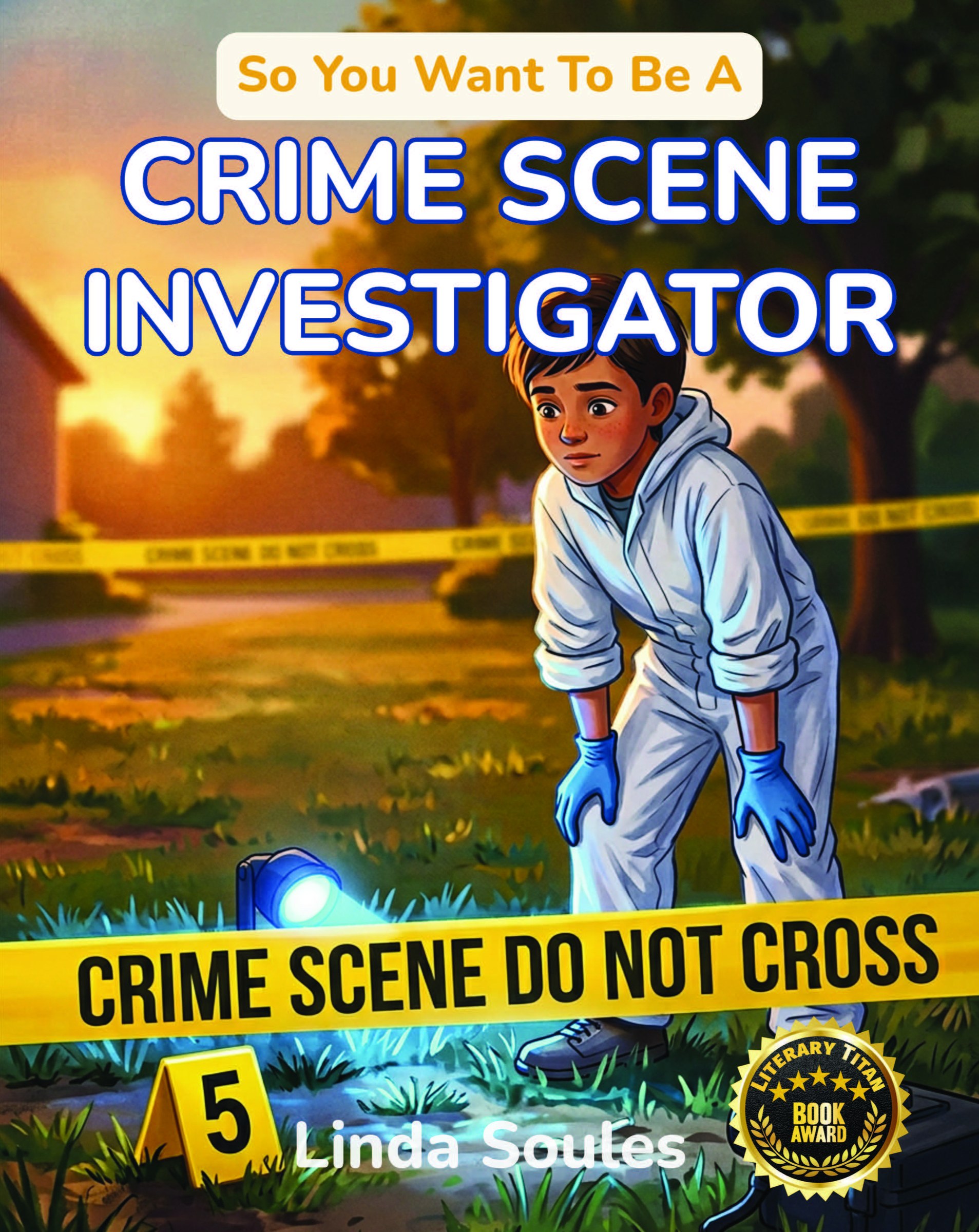
Author Linda Soules has released So You Want To Be A Crime Scene Investigator: A Kids' Guide to Forensic Science, Evidence Collection, Crime Labs, and the Detail-Minded Detectives Who Solve Mysteries Using Clues and Science, a 38-page children's nonfiction book now listed at https://www.amazon.com/dp/1972766295. The book is written for readers ages 10 to 14, or grades five through eight, and describes the actual work of crime scene investigators rather than the television version. It has won the Literary Titan Gold Book Award, the Grand Prize in the 2026 Purple Dragonfly Book Awards, and the Silver Award in Children's Nonfiction at the 2026 CIPA EVVY Book Awards. The ISBN is 978-1-972766-29-3.
Forensic science is a common subject in young readers' media, but most of what children see comes from dramatized crime shows that compress years of training into a single episode. Those portrayals tend to skip the slow, procedural parts of the job: securing a scene, documenting it, and preserving evidence so it can withstand scrutiny in court. For a student curious about the field, it can be hard to find an accurate account of what the career involves, what it demands and what it offers in return.
Soules's book addresses that gap directly. It is aimed at middle-grade readers who are starting to think about what they might do as adults, and at the parents, teachers and librarians who help them look into careers. The text does not simplify the profession into a list of gadgets. It presents crime scene investigation as a discipline built on methodical fieldwork, scientific skill developed over years, and the mental steadiness needed long before an investigator works a case that reaches trial.
The book follows the full arc of an investigation, beginning the moment the tape goes up. Readers learn how evidence collection techniques are performed with practiced precision, and why documentation discipline matters: a strong chain of custody is what allows evidence to stand up to challenge in a courtroom. The text explains how the physical world records human actions, including fingerprints left on a surface, DNA transferred in a split second, and trace evidence that can tell a story no witness could. It also covers the investigative reasoning involved in reading a scene before anyone else has thought to ask the right questions.
Beyond the scene itself, the book places forensic work in a wider context. It explains how forensic science moved criminal justice away from reliance on witness testimony and toward evidence-based findings, and it describes the pioneering investigations that drove that change. Readers are introduced to specialized areas, including forensic linguistics and odontology, and to the laboratories where fingerprint examination and DNA analysis are done under exacting standards. The book also profiles the team that makes the system function: scene investigators, forensic specialists, medical examiners, detectives and prosecutors working in coordination.
A distinguishing feature is the attention paid to the mind behind the work. The book discusses how investigators develop focus, objectivity and analytical thinking, and how they stay calm when the pressure to get it right is absolute. It addresses what the career costs and what it gives back, including why unsolved or difficult cases tend to be the ones that make the work meaningful. That emphasis on temperament, not only technique, gives young readers a more complete picture of the job than a survey of tools and procedures would.
The book is designed to be used, not only read. It outlines what curious readers can do now to test their interest in forensic investigation, including hands-on activities to try at home, school subjects worth studying, and ways to build habits of observation and critical thinking. The premise is that skilled investigators start by noticing what others walk past. For classrooms and home-school settings, these activities offer a starting point for discussions about evidence, reasoning and how scientific conclusions are supported.
Many career-oriented books for young readers either lean on glossy overviews or assume adult-level background knowledge. Soules positions this title between the two. According to the book's description, it "does not talk down to its readers" and aims to bring them fully into the subject, from the first moments at a scene to the laboratory and the courtroom. Its focus on chain of custody, team coordination and the psychological demands of the job sets it apart from titles that concentrate mainly on dramatic cases or on the equipment investigators carry.
"Kids who ask what this job is really like deserve a true answer, not a watered-down version of a career that demands everything," said Linda Soules, author and creator of the So You Want To Be A... series.
The book is relevant to several audiences. Students in grades five through eight who show an early interest in science, law enforcement or the justice system can use it to learn what the field requires before they choose electives or activities. Teachers and school librarians can draw on it for career-exploration units or STEM-adjacent reading lists. Parents looking for nonfiction that engages a detail-oriented child can use the at-home activities as a shared project. Readers who find the work is not for them still come away with a clearer understanding of how evidence supports the justice system.
So You Want To Be A Crime Scene Investigator is available through Amazon at https://www.amazon.com/dp/1972766295. The listing identifies the book as children's nonfiction running 38 pages, with the ISBN 978-1-972766-29-3. Readers and institutional buyers should consult the Amazon listing for current format options and pricing, as these details can change. Librarians, educators and parents who want to evaluate the title can reach the same page to review the description and the awards information. Media seeking review information or an interview with the author can contact Linda Soules through the channels associated with the book listing.
The title is part of the So You Want To Be A... series, a growing collection of career-exploration books for readers ages 10 to 14 and beyond. Soules has said the series is envisioned to span more than 180 titles in total, covering a broad range of professions that young readers might want to explore. Each book is intended to give an honest, specific account of a real career, so that children can make early decisions about what to study and where to direct their curiosity. The crime scene investigation volume adds a forensic science entry to that planned catalog.
About Linda Soules and the So You Want To Be A... series: Linda Soules is the author and creator of the So You Want To Be A... series, a growing collection of career-exploration books for readers ages 10 to 14 and beyond. The series is envisioned to span more than 180 titles. So You Want To Be A Crime Scene Investigator, the latest title, is a 38-page children's nonfiction book that has received the Literary Titan Gold Book Award, the 2026 Purple Dragonfly Book Awards Grand Prize, and the Silver Award in Children's Nonfiction at the 2026 CIPA EVVY Book Awards. More information and purchase details are available at https://www.amazon.com/dp/1972766295.
