Seattle, Washington — 2026-11-04
Linda Soules Releases Kids' Guide to Coding for Ages 10–14 in Award-Winning Career Series
The 38-page illustrated book profiles Ada Lovelace, Grace Hopper and Margaret Hamilton alongside Git, debugging and a developer's daily work
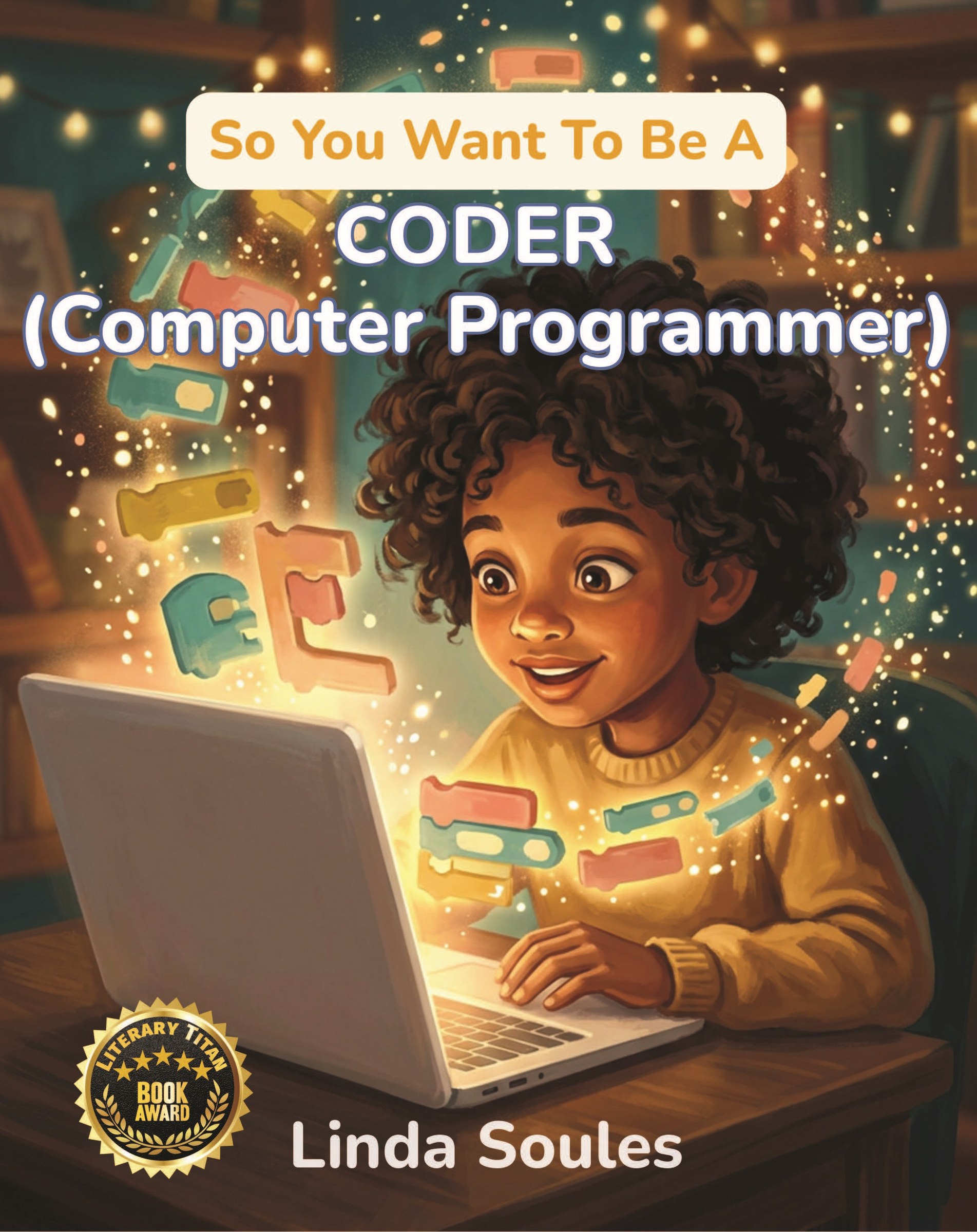
Author Linda Soules has released So You Want To Be A Coder (Computer Programmer): A Kids' Guide to Coding, Programming Languages, Software Development, and the Problem-Solvers Who Build the Technology We Use Every Day, a 38-page illustrated children's nonfiction title for readers ages 10 to 14. The book is available now at https://www.amazon.com/dp/1972766422 (ISBN 978-1-972766-42-2). It is the latest entry in Soules's So You Want To Be A... series of career-exploration books. It walks young readers through what software developers actually do each day, the tools they use, and the historical figures who shaped the field. It also gives beginners activities they can start without prior experience. The book's listing cites three honors: the Literary Titan Gold Book Award, the Grand Prize in the 2026 Purple Dragonfly Book Awards, and a Silver Award in Children's Nonfiction from the 2026 CIPA EVVY Book Awards.
Most children meet software as a finished product: a game, an app, a website. Few see the work behind it. Programming is often presented to young people either as an abstract school subject or as a glamorous job title, and neither framing explains what a developer does between nine and five. Parents and teachers who want to introduce coding often find tutorials aimed at people who have already decided to learn, not at children still deciding whether the field is for them.
Soules's book is written for that earlier stage of curiosity. It addresses basic questions. What does a typical day look like for a software developer? What does it feel like to write a first line of code, watch it fail, fix it and see it work? The book treats failure as a normal part of the process rather than a sign a reader does not belong. It also describes coding as one of the few kinds of work with no formal gatekeeper: no license, no required degree and no permission needed to begin. That framing is aimed at a reader who may have assumed programming is reserved for adults with specialized training.
The book's first section covers what coders do all day. It describes the repeated loop of writing code, testing it, debugging it and trying again. A second section introduces the tools of the trade, naming code editors, terminals, debuggers and Git version control in language intended for a middle-grade reader. Readers then follow a programmer's typical day, from the morning standup meeting to evening side projects started purely out of curiosity. The sequence is meant to give children a realistic picture of professional software work, including the routine and collaborative parts that rarely appear in popular depictions of programming.
Beyond the workday, the book introduces four people whose work shaped modern computing: Ada Lovelace, Grace Hopper, Margaret Hamilton and Tim Berners-Lee. Each is presented through the logic, courage and creativity that Soules says carried their work forward. The book also includes fun facts, a glossary of essential programming terms and concrete activities readers can try immediately. It references languages and environments children may already have encountered, including Python and Scratch, and connects coding to the games, apps, websites and interactive projects they use every day. The glossary gives families a shared vocabulary for conversations about software, whether at home or in a classroom.
The book also presents personal qualities as part of the craft, not only technical knowledge. It names patience with failure, curiosity about how things work, logical precision and the comfort of saying "I don't know yet, but I'll find out." Soules positions these habits of mind as transferable. The book argues that the logic, problem-solving, creativity and persistence a child practices through coding apply whether that child becomes a software developer, a designer, a scientist or works in a field that does not yet exist. That makes the book a career-exploration title and also a primer on approaching problems step by step.
The title differs from many children's coding resources in its emphasis. It is not a language tutorial or a set of programming exercises tied to one platform. It is a profession-focused guide, built on the same model as the other books in the So You Want To Be A... series, which introduce young readers to a specific line of work rather than to a specific skill. Within that model, this volume combines a day-in-the-life narrative, a short history of the field, a tool overview and starter activities in a single 38-page book. It is written to be read by children independently while remaining useful to adults reading alongside them.
"Nobody has to grant a child permission to start coding. This book shows them that the first line is the hardest, and they can type it today," said Linda Soules, author of the So You Want To Be A... series.
The book is aimed first at curious readers ages 10 to 14, including those who already use apps and games and want to understand how they are made. A child who has tried Scratch, for example, can see where that kind of block-based experimentation sits in a wider profession. A child who has never written code can use the book's no-experience-needed activities as a starting point. The glossary and clear language are intended to keep the material accessible to readers who encounter terms like debugging or version control for the first time. The tone is encouraging, with the stated goal of helping beginners feel they belong in the field.
Parents and teachers are a second audience. The publisher-neutral format of a short illustrated guide suits classroom libraries, homeschool reading lists, after-school coding clubs and family reading time. Educators can use the profiles of Lovelace, Hopper, Hamilton and Berners-Lee to connect computing to history, and the day-in-the-life chapters to open career-awareness discussions. Soules describes the book as written for kids but with plenty for adults, and its plain explanations of terms such as Git and debuggers can help non-technical caregivers follow a child's questions about what programmers actually do.
So You Want To Be A Coder (Computer Programmer) is available through Amazon at https://www.amazon.com/dp/1972766422. The book is 38 pages, classified as children's nonfiction, and carries ISBN 978-1-972766-42-2. Current formats, pricing and shipping options are listed on the Amazon product page and may vary by region. Readers who want to learn about the author's other titles can find them through the same Amazon listing, which identifies the book as part of the So You Want To Be A... series. Parents, teachers and librarians seeking review information, award details or interview access with the author can reach Linda Soules through the contact channels associated with her series.
The coding title is one of more than 60 books published so far in the So You Want To Be A... series, which Soules envisions growing to more than 180 titles in total. New releases arrive on a steady cadence, extending the series across a widening range of professions for readers ages 10 to 14 and beyond. The plan reflects a belief that young people benefit from seeing many possible careers described honestly and warmly before they have to choose among them. With this release, the series adds one of the most widely relevant fields of the current economy, a profession whose products children already use daily but whose daily practice is far less visible to them.
About the So You Want To Be A... series and Linda Soules. Linda Soules is the author and creator of the So You Want To Be A... series, a growing collection of career-exploration books for readers ages 10 to 14 and beyond. The series is envisioned to span more than 180 titles, with more than 60 published to date and new releases appearing on a steady cadence. The books introduce young readers to real professions through warm, accessible language and illustrations. So You Want To Be A Coder (Computer Programmer) is available at https://www.amazon.com/dp/1972766422.
