Seattle, Washington — 2026-11-22
Linda Soules Releases Kids' Guide to Board Game Design, Featuring Creators of Monopoly, Jenga and Catan
The 44-page illustrated book for ages 10 to 14 covers prototyping, playtesting, pitching and royalties, and joins a 67-title career series
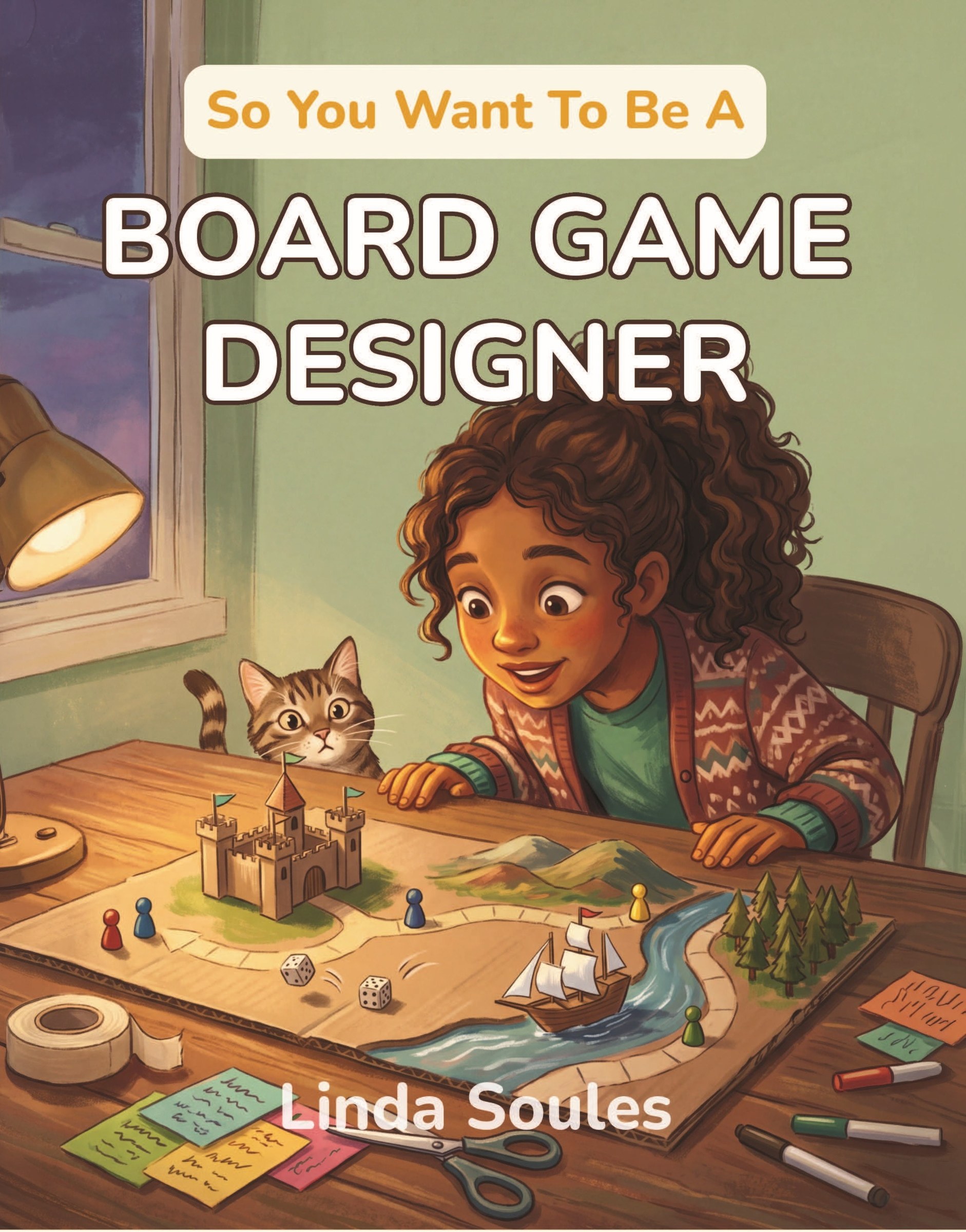
Author Linda Soules has released So You Want To Be A Board Game Designer: A Kids' Guide to Inventing Games, Playtesting, and the Designers Who Bring People Together Around the Table, a 44-page illustrated children's nonfiction book that presents game design as a real, reachable career. The book, listed at https://www.amazon.com/dp/B0HSLKHZRQ, is written for readers ages 10 to 14 and is accessible to curious children as young as 8. It follows a game from messy cardboard prototype to store shelf, covering theme, mechanics, balancing, playtesting, pitching to publishers, royalties and crowdfunding. The Amazon listing notes a 2026 Purple Dragonfly Book Awards Grand Prize and a 2026 CIPA EVVY Book Awards Silver Award in Children's Nonfiction. The ISBN is 979-8-951756-54-1.
Board games have become a fixture of family life, classrooms and libraries, yet the people who invent them rarely appear in the books young readers pick up. Children see the box, the board and the pieces. They seldom learn that every game began as someone's question, a stack of index cards and a pair of scissors. Career-exploration titles for middle-grade readers tend to focus on familiar jobs such as doctor, teacher or firefighter, which leaves creative and technical professions less visible. Soules's book targets that gap. It speaks to children who already tinker with rules, redraw boards or invent variations at the kitchen table, and it tells them that this habit has a professional counterpart. It also gives parents, teachers and librarians a concrete resource for STEM and career units that need something more hands-on than a list of job titles.
The core of the book is the design process, explained in plain language. Readers learn how designers choose a theme, invent game mechanics and balance the math so that no single strategy always wins. They then see why playtesting matters: a designer runs test after test, watches where players get confused or bored, and revises until the game finally clicks. The book follows a designer through a full working day, which shows that the job includes more than inspiration. It involves testing, note-taking, rule-writing and revision. Readers also get an introduction to the business side, including how pitching to publishers works, how royalties pay designers, and how crowdfunding lets creators raise money to produce a game on their own. Each concept is presented at a level suited to ages 10 to 14 without simplifying the underlying ideas.
The book is built to move readers from learning to making. A roll-the-dice activity called "Invent a Game in 60 Seconds" asks children to generate a game concept on the spot. Try-it-tonight challenges are designed for family game night or an afternoon at home, and a step-by-step list outlines ways to start designing right away with materials most households already own. A 24-word glossary defines terms children will encounter in the field, and a closing page points to books, websites, contests and organizations for those who want to go further. The practical sections make the title suitable for classrooms, libraries and homeschool STEM and career units, where a single activity can anchor a lesson. Readers who finish the book have a working vocabulary and a starting project.
Soules also introduces the people behind well-known games. Readers meet Lizzie Magie, whose invention became Monopoly; Leslie Scott, who turned sawmill scraps into Jenga; and Klaus Teuber, creator of Catan. Modern designers Seiji Kanai, Elizabeth Hargrave and Omari Akil are profiled as well, which shows that the field continues to evolve. The book adds historical and surprising stories: a 4,500-year-old game whose rules were lost for centuries, secret escape maps hidden in wartime game sets, and a 7-year-old from Seattle whose card game sold more than a million copies. These stories show that game design stretches across thousands of years and that designers come from many backgrounds and ages. They also give young readers real names and examples to look up next.
The book does not present the profession as all fun and prizes. It includes an honest look at the difficult parts of the work, including rejection from publishers, slow progress on projects and the reality that most designers keep a second job. That candor reflects the philosophy Soules applies across her series: never talk down to kids. Young readers, she holds, are smarter and more capable than publishing often assumes, and they deserve accurate information about what a career involves. By pairing the creative appeal of inventing games with a realistic account of the effort, the book gives children and the adults who guide them a fuller picture. A reader who still wants to design games after learning about rejection and long hours is making an informed choice.
Several features distinguish the book from general guides to making games or from broader career books. It is aimed squarely at one profession, which allows more depth than a survey title can offer, and it treats playtesting, balancing and business models as core content instead of footnotes. It combines biography, history, process and activities in 44 pages, so a single book serves as a classroom read, a library resource and a family project guide. Its subjects span centuries and continents, from an ancient game with lost rules to contemporary designers working today. It also belongs to a series with a consistent format, so readers who enjoy it can move to other careers without relearning how the books work. That structure supports both curiosity-driven reading and structured teaching.
"Any kid who has changed a rule to make a game better is already thinking like a designer. This book shows them where that instinct can lead," said Linda Soules, author of the So You Want To Be A… series.
The book is written for several overlapping audiences. Children ages 10 to 14 who love board games, card games, puzzles, strategy, math, art or making things with their hands can use it as both a read and a project starter. Younger, curious readers ages 8 and up can follow the stories and try the activities with an adult. Teachers and librarians can use it in STEM, career-exploration and makerspace programs, where the dice-based invention exercise and glossary support short lessons. Homeschool families can build a unit around it, pairing the reading with prototype building and playtesting sessions with siblings or friends. Parents looking for a gift for a child who tinkers with game rules will find a book that treats that habit as a skill worth developing.
So You Want To Be A Board Game Designer is available through Amazon at https://www.amazon.com/dp/B0HSLKHZRQ, where readers can find the current format options and pricing. The title is identified by ISBN 979-8-951756-54-1. Educators and librarians who want to add the book to a collection can use the ISBN and the Amazon listing to locate it. The book is a standalone read, so no prior knowledge of the So You Want To Be A… series is needed, though readers who enjoy it may want to explore other titles in the collection. Parents and teachers who want to preview the content can consult the book description on the listing, which outlines the topics, activities and designers covered in the book.
The board game title is part of a long-term publishing effort. Soules envisions the So You Want To Be A… series spanning more than 180 titles in total, with 67 published to date and new releases arriving on a steady cadence. Subjects already in the series range from astronauts and marine biologists to magicians, stunt performers and roller coaster designers. The common thread is pulling back the curtain on a real career, including its joys, its challenges and the path to get there. Adding board game design extends the series into a field that blends art, mathematics, psychology and small-business skills. The series has won the CIPA EVVY Silver Award (Series) and the Purple Dragonfly Grand Prize (Series), and more titles are planned as the catalog grows toward its target.
About Linda Soules and the So You Want To Be A… series: Linda Soules is the author and creator of the So You Want To Be A… series, a growing collection of career-exploration books for readers ages 10 to 14 and beyond. Sixty-seven titles are published to date, with a planned total of more than 180. Before turning to children's publishing, she spent 25 years in law and finance, advising hedge funds and sophisticated financial institutions on legal and regulatory matters, an experience she says taught her to translate intricate subjects into language anyone can use. She lives in Seattle with her husband and two children. So You Want To Be A Board Game Designer is available at https://www.amazon.com/dp/B0HSLKHZRQ.
