Seattle, Washington — 2026-11-15
Linda Soules Releases Kids' Cryptography Guide, 'So You Want To Be A Code Breaker (Cryptographer)'
The 43-page illustrated book for ages 10 to 14 covers Caesar ciphers, Enigma, public-key encryption and quantum threats
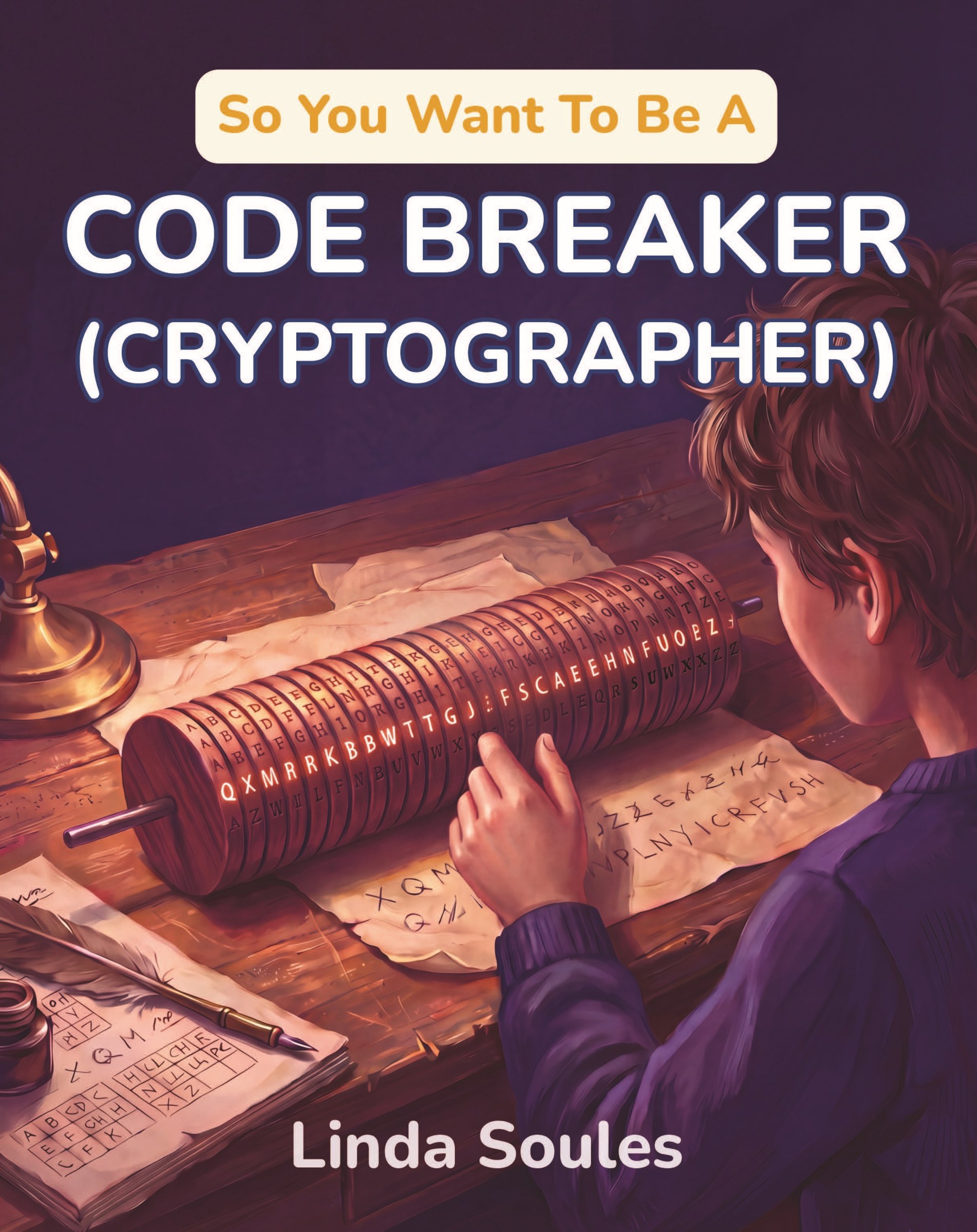
Author Linda Soules has released So You Want To Be A Code Breaker (Cryptographer), a 43-page children's nonfiction book that introduces readers ages 10 to 14 to the real work of cryptography. The title is the newest entry in her So You Want To Be A... career-exploration series and is listed at https://www.amazon.com/dp/B0HRR7GJW6. Its full subtitle is A Kids' Guide to Codes, Ciphers, Secret Messages, Encryption, and the Clever Puzzle Solvers Who Crack Hidden Messages and Keep the World's Secrets Safe. The book moves from Julius Caesar's letter shift to public-key encryption and the race to defend the internet against quantum computers. It also hides codes in its pages for readers to solve. The ISBN is 979-8-951756-48-0.
Encryption now sits behind nearly every routine thing a young person does on a screen. Text messages, game log-ins and family purchases made online all depend on codes that someone designed and someone else is trying to break. Most children never learn how that protection works, who built it, or that cryptographer is a profession that rewards math, language skills and patience. Books for this age group have tended to treat codes as a party trick, such as a decoder ring or a substitution puzzle, without connecting them to the digital systems kids use every day. Soules's book is built around that gap. It treats cryptography as both a history of clever people and a live career field with unsolved problems.
The book teaches the mechanics in steps. It starts with the Caesar shift, one of the simplest ciphers, and builds toward frequency analysis, the technique of counting how often letters appear to expose a hidden message. It then covers cribs, which are guessed fragments of plaintext that help an analyst crack a longer message, and explains how the Enigma machine mechanized the problem of secret writing. Later sections cover brute-force attacks, in which an attacker tries every possible key, and public-key encryption, the idea that makes secure online shopping and messaging possible. The text is written in what the listing describes as clear, friendly language, with no prior math background assumed.
History is delivered through people. Readers meet al-Kindi, the Baghdad scholar credited in the book with writing down the first known code-breaking trick. They meet Elizebeth Smith Friedman, who took on smugglers and Nazi spy rings, and the Bletchley Park team that helped break Enigma during World War II. The book also covers the Navajo Code Talkers, who built a code the enemy never cracked, and a message about a broken water supply that helped win the Battle of Midway. A section on current research explains why cryptographers are working now to protect the internet from quantum computers that do not yet fully exist. Together these profiles show that the field spans centuries, continents and very different kinds of people.
The book is meant to be used, not just read. Secret messages are tucked into the pages for readers to decode, and hands-on activities walk children through making a cipher wheel, building a Spartan scytale from a pencil and paper, writing in invisible ink and attempting frequency analysis on their own. The volume is full-color and illustrated. It includes a day-in-the-life story that follows a working cryptographer, a glossary of terms, and a resource list of books, websites, museums and contests for young cryptographers. The activities use materials found in most homes and classrooms, so a reader, parent or teacher can start without buying supplies.
The book is candid about the job. It describes the years of math training, the dead ends, and the fact that much cryptographic work cannot be discussed at home. That honesty runs through the whole So You Want To Be A... series, which Soules built on a rule of never talking down to young readers. The cryptography volume also leans into the odd corners of the subject. It includes a secret society with a peculiar initiation, a wartime pigeon whose final message remains unread, and an office mystery about stolen yogurt. Those details keep the technical material approachable without turning cryptography into a cartoon. The aim is for a reader to finish the book knowing what the work involves and whether it appeals to them.
"Kids already live inside encrypted systems every day. I wanted them to see the people and the puzzles behind that, and to try cracking a few codes themselves," said Linda Soules, author of the So You Want To Be A... series.
The book is aimed at readers ages 10 to 14 and is described as accessible to curious readers as young as 8 when an adult reads along. The listing positions it as a gift for children who like puzzles, spy stories, math, coding and STEM subjects. It is also pitched at classrooms, libraries and homeschool families. A teacher could use the cipher wheel and scytale projects as short hands-on lessons on pattern recognition and logical reasoning. A librarian could pair the resource list with a code-breaking club or display. A parent could use the hidden messages as a shared puzzle at home. The profiles of Friedman, the Bletchley Park team and the Code Talkers also tie into history units on World War II.
So You Want To Be A Code Breaker (Cryptographer) is available through Amazon at https://www.amazon.com/dp/B0HRR7GJW6. The book runs 43 pages and carries the ISBN 979-8-951756-48-0. Genre classification is children's nonfiction. Current pricing and available formats are shown on the product page. Educators, librarians and reviewers who want more information about the series can start from the same listing, which also carries the full book description and the author's biography. The listing credits the So You Want To Be A... series with a Grand Prize in the 2026 Purple Dragonfly Book Awards and a Silver Award in the 2026 CIPA EVVY Book Awards in the Children's Nonfiction category.
The code-breaking title belongs to a series that Soules envisions reaching more than 180 titles in total. According to her author biography, 65 have been published so far, with new releases arriving on a steady cadence. Existing subjects range from astronauts and marine biologists to magicians, stunt performers and roller coaster designers. Each book pulls back the curtain on a real career, covering its rewards, its difficulties and the path to enter it. Adding cryptography extends the series into a technical field that sits close to the daily lives of its readers. The approach is consistent across volumes: treat young readers as the future professionals they might become and leave them with the sense that the world is wider and more reachable than they imagined.
About Linda Soules: Soules is the author and creator of the So You Want To Be A... series, a growing collection of career-exploration books for readers ages 10 to 14 and beyond. Before turning to children's publishing, she spent 25 years in law and finance, advising hedge funds and sophisticated financial institutions on legal and regulatory matters. She says that career taught her precision and discipline, and how to translate intricate subjects into language anyone can use. Her guiding philosophy is that young readers are smarter, more curious and more capable than the publishing world often assumes. More information about So You Want To Be A Code Breaker (Cryptographer) is available at https://www.amazon.com/dp/B0HRR7GJW6.
