Seattle, Washington — 2026-11-03
Linda Soules Releases Kids' Career Guide to Astronomy and Exoplanet Hunting for Ages 10 to 14
The 38-page illustrated book covers transit, spectroscopy and radial velocity methods and shows readers how to use public telescope data
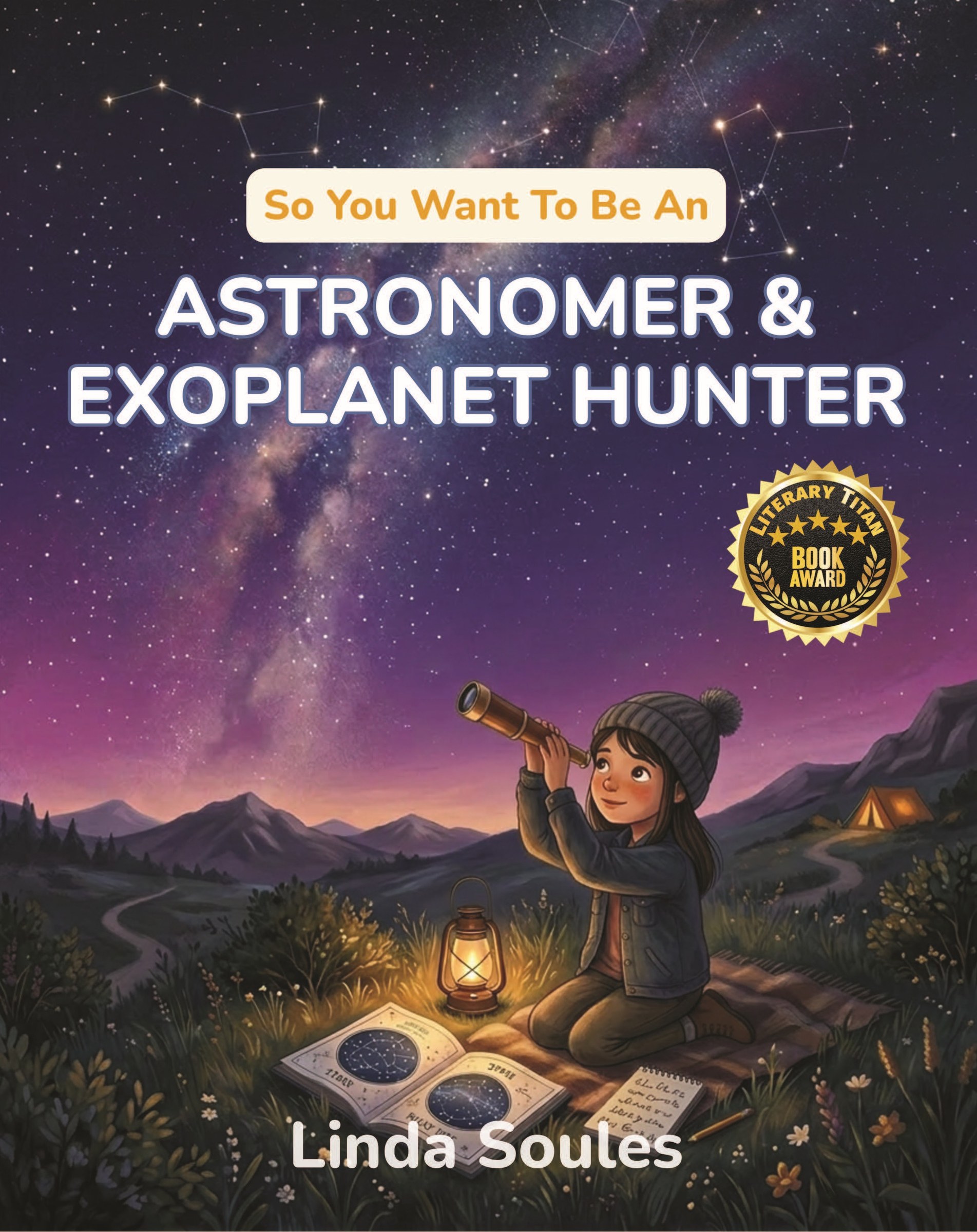
Author Linda Soules has released So You Want To Be An Astronomer & Exoplanet Hunter: A Kids' Guide to Astronomy, Telescopes, Stars and Galaxies, and the Curious Scientists Who Search the Universe for New Worlds, a 38-page illustrated children's nonfiction book for ages 10 to 14. The book, listed at https://www.amazon.com/dp/1972766406 (ISBN 978-1-972766-40-8), explains how professional astronomers detect planets around other stars and what the job involves day to day. It also lays out steps young readers can take now, including working with real, publicly available telescope data. The listing identifies the title as a 2026 Best Book Awards (American Book Fest) winner in Children's Educational and a finalist in Science.
Exoplanet science has become one of the most active areas of space research, and it relies on measurements far smaller than anything the human eye can register. According to the book, a space telescope tracking thousands of stars at once may treat a dimming of one part in ten thousand as a possible signal. That flicker might be noise, or it might be the shadow of a planet hundreds of light-years away crossing in front of its star. Soules builds the book around that tension between ambiguous data and real discovery.
The intended readers are middle-grade students who already show curiosity about the night sky and want to know what a career in astronomy involves. Parents, teachers and librarians looking for science titles that go beyond a general tour of the planets are a second audience. The book frames itself as a career guide rather than a catalog of space facts. It covers the years of physics, math and patience that come before an astronomer ever points a telescope at the sky, and it says plainly that this is the real profession, not the Hollywood version.
The science chapters focus on three detection methods. The transit method catches a planet's shadow as it crosses a distant star. Spectroscopy reads the chemical fingerprints of alien atmospheres. Radial velocity captures the faint stellar wobble that revealed the first exoplanet. The book places each method in the context of the instruments that use it: space telescopes that scan entire sections of the sky, and mountaintop observatories above the clouds where astronomers work through the night collecting data on stars, planets and galaxies beyond the solar system. The text uses real scientific vocabulary and defines it for the reader.
A day-in-the-life section follows a single observing night from the opening of the dome at sunset through calibration, a twelve-target observing run and weather interruptions. It ends with the data analysis that happens the next morning. The section shows readers that observing runs are planned years in advance and that much of the work is procedural. Fun facts scattered through the book describe the strangeness of known exoplanets, including worlds where it rains molten iron, where glass flies sideways in screaming winds, and where double sunsets light up alien skies.
The book also profiles five astronomers who expanded human understanding of the universe. Three of the five are women who broke through institutional barriers to make discoveries about dark matter, comets and distant worlds. The profiles tie the history of the field to the career advice in the book: persistence is presented as a working requirement of the profession, not a motivational slogan. For young readers who do not often see scientists who look like them in popular science books, the selection offers a wider set of examples.
Several features distinguish the book from typical children's space titles. It is organized around a profession and a single scientific pursuit, exoplanet hunting, rather than a survey of the solar system. It names the methods astronomers use and explains how each works. It also treats its audience as capable of handling real terminology and real uncertainty. The book's description says it is written in a warm, direct voice that does not talk down to kids. Its most practical claim is that no degree is required to begin: real telescope data is public, and citizen science platforms have already helped people without astronomy training confirm real planets.
"Kids deserve the real version of this career: the math, the patience, and the discovery. You do not need a degree to start exploring real exoplanet data," said Linda Soules, author and creator of the So You Want To Be A... series.
The book gives readers a sequence of actions rather than general encouragement. A student can learn the constellations, use a small telescope to find Saturn's rings or Jupiter's moons, and explore real datasets online. The book also tells readers to start building the math and coding skills that professional astronomers use daily. A classroom teacher could use the observing-night section to show how scientific work is planned and documented. A librarian could place the title alongside STEM career collections. A parent of a child who has asked what is out there, and whether humans are alone, has a concrete starting point for that conversation.
The series carries its own recognition. The book's description credits the So You Want To Be A... series with a Grand Prize in the 2026 Purple Dragonfly Book Awards and a Silver Award in Children's Nonfiction from the 2026 CIPA EVVY Book Awards. The astronomy title's own Best Book Awards designations, a win in Children's Educational and a finalist placement in Science, apply to this volume specifically. Awards do not substitute for classroom or home testing, but they indicate that outside judges in children's and educational publishing have reviewed the work.
So You Want To Be An Astronomer & Exoplanet Hunter is available through Amazon at https://www.amazon.com/dp/1972766406. The book is 38 pages, carries ISBN 978-1-972766-40-8, and is categorized as illustrated children's nonfiction in science and nature for ages 10 to 14. Current format options and pricing appear on the product page and may change, so buyers should confirm them there. No account, subscription or software is needed to read the book. The online datasets and citizen science platforms it describes are separate public resources that readers can explore on their own after finishing it.
The astronomy guide extends the premise of the So You Want To Be A... series, which introduces young readers to a profession and the work behind it. In this volume, that approach is applied to a field where public participation is already possible. The book's closing emphasis is the question that drives much of exoplanet research: whether humans are alone in the universe. By pairing that question with practical steps, including stargazing, public data and early math and coding practice, Soules positions the book as an entry point to both a hobby and a possible career path.
Linda Soules is the author and creator of the So You Want To Be A... series of children's nonfiction career guides. Her latest title, So You Want To Be An Astronomer & Exoplanet Hunter, is a 38-page illustrated book for ages 10 to 14 that explains how astronomers search for planets beyond the solar system and how young readers can begin exploring real data. More information and purchasing details are available at https://www.amazon.com/dp/1972766406.
