Seattle, Washington — 2026-11-01
Linda Soules Releases Dinosaur Hunter Guide for Ages 10–14, Written as a Real Career Roadmap
The 38-page illustrated title in a 60-plus-book career series has earned five awards or selections, including a Purple Dragonfly Grand Prize
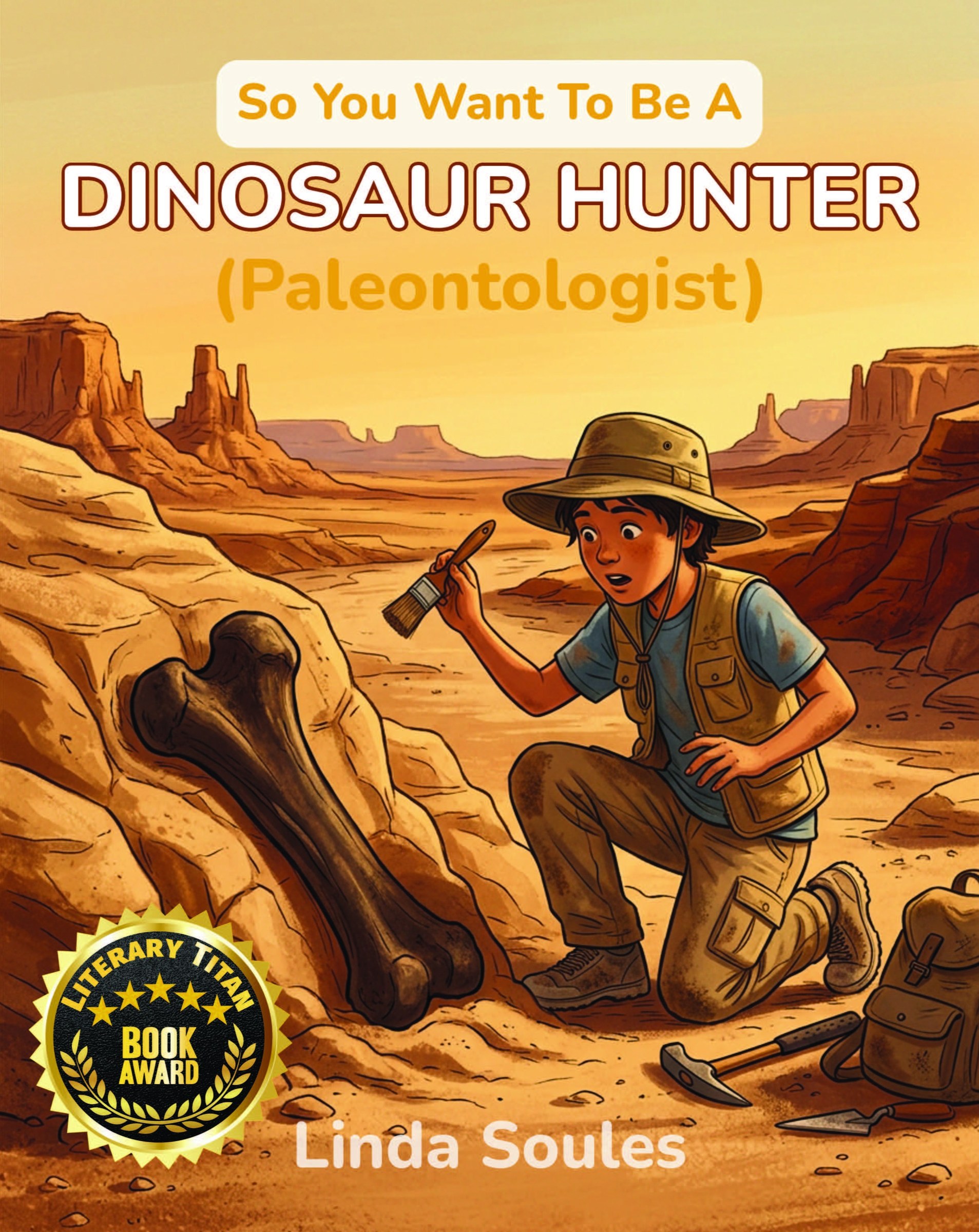
Author Linda Soules has released So You Want To Be A Dinosaur Hunter (Paleontologist): A Kids' Guide to Paleontology, Fossil Discovery, Prehistoric Life, and the Real Scientists Who Dig Up Dinosaurs, a 38-page illustrated children's nonfiction book for readers ages 10 to 14. The book, listed at https://www.amazon.com/dp/1972766031 (ISBN 978-1-972766-03-3), treats paleontology as a career rather than a trivia subject. It walks young readers through fieldwork, laboratory analysis, and the physical endurance and intellectual rigor the profession demands. It is the latest title in Soules's So You Want To Be A… series and has already collected several honors, including a 2026 Purple Dragonfly Book Awards Grand Prize and a Literary Titan Gold Book Award.
Dinosaur books for children are plentiful, and most are organized around species: size, diet, and a roster of famous names. Far fewer address the people who find the fossils, or the work required to become one of them. Readers in the 10-to-14 range are old enough to begin thinking seriously about what they might do as adults, yet they are often served by books written for much younger audiences. Soules's book is aimed at that gap. It assumes a reader who has outgrown the picture-book treatment of prehistoric life and wants to know how scientists actually reach their conclusions, what a typical dig involves, and what the job looks like beyond the discovery moment.
The book's science content is specific. Readers learn how paleontologists read geological layers the way most people read books, and how fossils form in the first place. They see how painstaking excavation techniques free a specimen from stone, and how laboratory analysis turns a chunk of rock into a scientific finding. Ancient teeth and tracks serve as case studies: the book explains what such evidence reveals about creatures including T. rex and Triceratops. It also explains why a single bone fragment can overturn assumptions about dinosaurs that scientists had held for years, giving readers a concrete sense of how knowledge in the field is revised.
A second thread follows the history of legendary fossil discoveries that changed how people understand prehistoric creatures, placing individual finds in the longer arc of the science. The book is equally direct about the less glamorous side of the work. It describes the endurance fieldwork requires and the discipline of careful, repetitive excavation. It also makes the case that a dig that yields nothing can matter as much as one that changes everything, because negative results narrow the search and refine the questions. The text is paired with illustrations and is organized as a guide to a real profession, not an encyclopedia of species profiles.
The book also includes practical guidance for readers who want to test their interest now. According to the book's description, it points young readers toward the skills to build, the questions to ask, and the places to explore if they want to find out whether paleontology could become their future. That forward-looking section is central to the series' design: each title is meant to leave readers with a next step as well as information. For a student, that might mean a more informed conversation with a teacher, a museum visit with sharper questions, or a clearer picture of what a science career demands.
The series approach distinguishes this title from conventional dinosaur reference books. Where a typical entry catalogs animals, So You Want To Be A Dinosaur Hunter centers on the working scientist and the process of discovery. It does not simplify the science into something unrecognizable, and it does not gloss over the hard parts of the job, according to the publisher description. The stated goal is to bring young people all the way inside the work, including the uncertainty, the labor, and the patience involved. That candor about what a career requires, aimed at readers who are old enough to weigh it, is the book's central editorial choice.
"Kids who dream of hunting dinosaurs deserve to know what that dream looks like as a life, including the hard parts, not a simplified version of it," said Linda Soules, Author, So You Want To Be A… series.
The book has drawn recognition from several independent awards programs. It won the Literary Titan Gold Book Award and took first place in the 2026 Annual PenCraft Book Award for Children's Mysteries & Wonders. It received the Grand Prize in the 2026 Purple Dragonfly Book Awards and a Silver Award in the 2026 CIPA EVVY Book Awards for Children's Nonfiction. It was also selected for the Indie Author Project Select Collection. The awards span categories from general children's literature to nonfiction specifically, suggesting the book is resonating with judges for both its subject matter and its approach to young readers.
The primary audience is readers ages 10 to 14 who are fascinated by fossils, rocks, and the prehistoric world, including the child who picks up every stone and wonders what might be inside. The book also fits several adult-mediated settings. Parents looking for science-forward gifts can use it as a bridge between a dinosaur phase and serious interest in earth science. Teachers and school librarians can place it in career-exploration or STEM displays. Homeschooling families can use its descriptions of excavation and lab analysis as a starting point for projects. Because it frames paleontology as a profession with entry requirements, it can also support early conversations about the education and training that science careers involve.
The book is available through Amazon at https://www.amazon.com/dp/1972766031. The listing identifies the title as a 38-page illustrated children's nonfiction work with ISBN 978-1-972766-03-3. Pricing and format options appear on the Amazon product page and may vary by format and region, so interested readers, parents, and educators should consult the listing for current details. Journalists, reviewers, and librarians seeking more information about the book or the author can use the same link as a starting point. No subscription or account beyond a standard Amazon purchase is required to obtain the book.
The dinosaur title sits within a much larger publishing effort. The So You Want To Be A… series is envisioned to span more than 180 titles, with more than 60 published to date and new releases arriving on a steady cadence. Subjects range from astronauts and marine biologists to magicians, stunt performers, and roller coaster designers. Each book follows the same premise: pull back the curtain on a real career, covering its joys, its challenges, and the path to get there. Paleontology joins a list that deliberately mixes traditional science professions with unconventional ones, reflecting the range of work young readers may not yet know exists.
About Linda Soules and the series: Linda Soules is the author and creator of the So You Want To Be A… series, a growing collection of career-exploration books for readers ages 10 to 14 and beyond. Before turning to children's publishing, she spent 25 years in law and finance, advising hedge funds and sophisticated financial institutions on legal and regulatory matters. Her philosophy is to never talk down to kids: young readers are smart, curious, and capable, and deserve books that respect their intelligence while sparking real enthusiasm. So You Want To Be A Dinosaur Hunter (Paleontologist) is available at https://www.amazon.com/dp/1972766031.
