Boston, MA — 2026-06-02
Critical Thinker Press Releases 'Reason Over Rhetoric' Amid Rising Demand for Civil Discourse Skills
The 100-page self-help guide teaches readers to identify logical fallacies, cognitive biases, and emotional manipulation in everyday conversation.
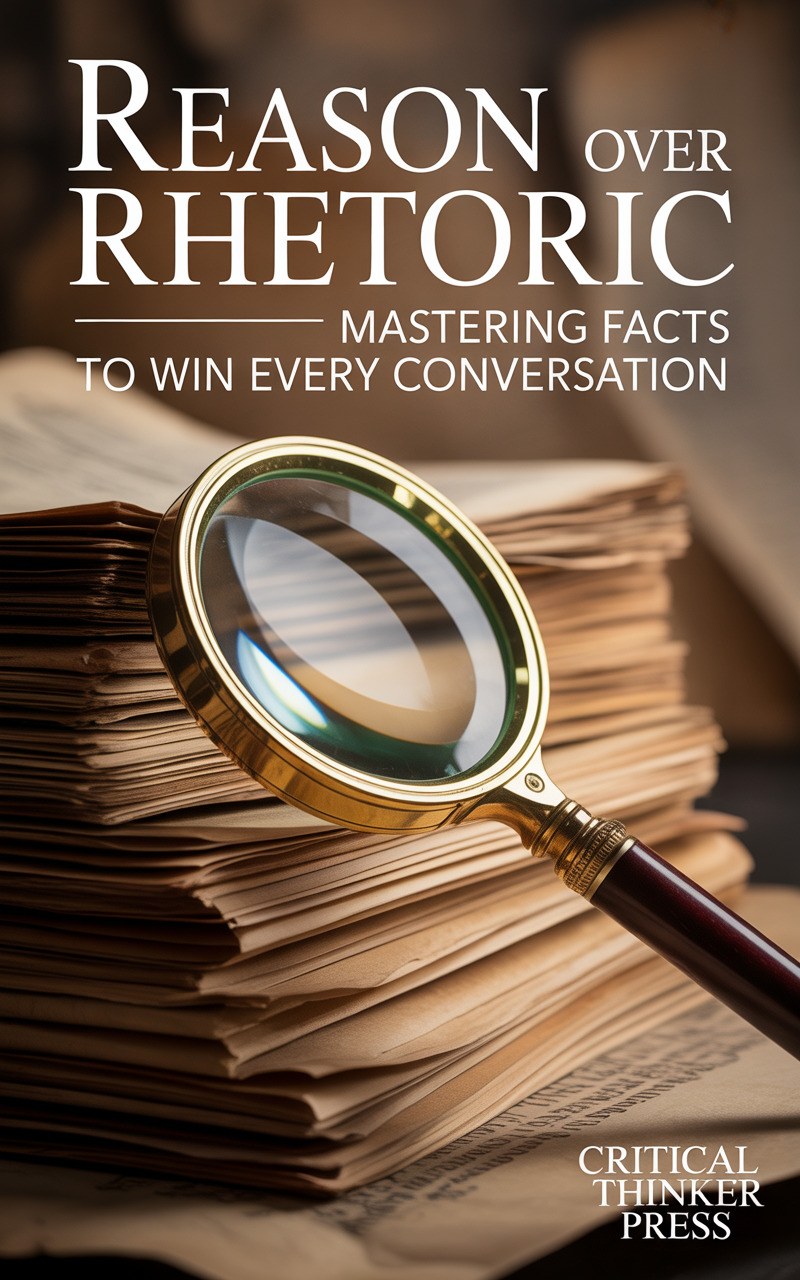
Critical Thinker Press has published Reason Over Rhetoric: Mastering Facts to Win Every Conversation, a 100-page self-help guide designed to equip readers with the analytical tools needed to hold their ground in fact-based dialogue. The book is available now in e-book format at https://www.amazon.com/Reason-Over-Rhetoric-Mastering-Conversation-ebook/dp/B0FY6NZZM2 (ISBN: 9781456673833), catalogued under the SELF-HELP / Communication & Social Skills category. Its release comes at a moment when misinformation, partisan framing, and rhetorical sleight-of-hand have made evidence-based conversation increasingly difficult to sustain in both public and private life.
The broader context for this release is a documented erosion of productive public discourse. Political polarization, algorithm-driven media, and the viral spread of emotionally charged content have made it harder for individuals to distinguish reasoned argument from sophisticated manipulation. Existing resources in the communication and self-help space tend to focus on negotiation tactics, charisma, or emotional intelligence — skills that, while useful, do not directly address the logical infrastructure of an argument. Reason Over Rhetoric fills a narrower and more specific gap: it trains readers to evaluate the structure of claims, not just the tone of the person making them. The book targets anyone who regularly engages in consequential conversation — professionals navigating workplace disagreements, students in debate or civic contexts, and citizens trying to parse political messaging with clear eyes.
The book opens with the science of critical thinking, walking readers through how cognitive biases — including confirmation bias, availability heuristic, and motivated reasoning — quietly shape judgment before a single word of argument is exchanged. Rather than presenting these concepts as abstract psychology, the text grounds each one in recognizable conversational scenarios. Readers learn to audit their own reasoning processes before engaging others, a sequencing choice that distinguishes the book from debate manuals that focus exclusively on attacking an opponent's position. This internal-first approach reflects the author's long-standing educational philosophy: that durable rationality requires changing how a person thinks, not just what they conclude.
The second structural pillar of the book is a taxonomy of logical fallacies — the rhetorical moves that make weak arguments appear strong. Drawing on the same intellectual tradition as the author's earlier reference work Logically Fallacious, described as the most comprehensive collection of logical fallacies in print, Reason Over Rhetoric translates that catalog into applied conversational technique. Readers are shown not only how to identify fallacies such as ad hominem, false equivalence, and appeal to emotion, but also how to address them calmly and without escalating the exchange. The book's final sections cover ethical reasoning, open-minded reflection across ideological divides, and what the author frames as bridge-building through evidence — the capacity to find shared factual ground even when values diverge sharply.
What separates Reason Over Rhetoric from comparable titles in the communication self-help genre is its explicit rejection of persuasion as performance. Most books in this space teach readers how to be more convincing; this one teaches them how to be more correct, and how to hold that standard under social pressure. The distinction matters in an environment where confident delivery and factual accuracy are frequently decoupled. At 100 pages, the book is also deliberately concise — a format decision that reflects the author's view that critical thinking instruction should be accessible, not academic.
"Expose an irrational belief, keep a person rational for a day. Expose irrational thinking, keep a person rational for a lifetime," said Critical Thinker Press, reflecting the guiding philosophy behind the book's approach to communication and education.
The primary audience for Reason Over Rhetoric includes professionals in fields where argumentation is consequential — law, policy, journalism, education, and management — as well as general readers who find themselves losing ground in conversations not because they lack information, but because they lack a framework for deploying it. A manager confronting a colleague who relies on anecdote over data, a parent discussing science with a family member who distrusts institutional sources, or a citizen trying to evaluate competing political claims during an election cycle all represent concrete use cases the book addresses directly. The text's emphasis on respectful, constructive exchange also makes it applicable in educational settings, particularly at the secondary and undergraduate level where civic reasoning skills are increasingly part of formal curricula.
Reason Over Rhetoric: Mastering Facts to Win Every Conversation is available now in e-book format. The book carries ISBN 9781456673833 and is listed under BISAC category SEL040000 (SELF-HELP / Communication & Social Skills). Readers can purchase or sample the title directly through its Amazon listing. No subscription or platform membership is required for access. Pricing follows standard Kindle e-book market rates as set at point of sale. Print availability has not been announced at this time.
This release is part of a broader body of work by the author focused on science, critical thinking, and secular humanism. Previous projects include The Concept: A Critical and Honest Look at God and Religion and Logically Fallacious, a reference compendium of logical fallacies that has been used in educational and professional contexts. From March 2014 through February 2016, the author produced and hosted The Humanist Hour, the official broadcast of the American Humanist Association, covering science, psychology, philosophy, and critical thinking on a weekly basis. Reason Over Rhetoric represents a practical distillation of that accumulated focus into a format designed for immediate, everyday application.
Critical Thinker Press publishes works at the intersection of science, philosophy, and rational inquiry, with a focus on making evidence-based thinking accessible to general audiences. The imprint's catalog includes reference works and applied guides built around the principle that how a person thinks matters more than any single conclusion they reach. Additional titles and the author's secular humanist philosophy are documented at PositiveHumanism.com. Reason Over Rhetoric is available at https://www.amazon.com/Reason-Over-Rhetoric-Mastering-Conversation-ebook/dp/B0FY6NZZM2.
