Boston, MA — 2026-05-28
BookyAwards Launches AI Book Award That is Selective By Design
Genre-specialist AI judges score manuscripts across ten craft axes; books earn category-specific awards or a full refund.
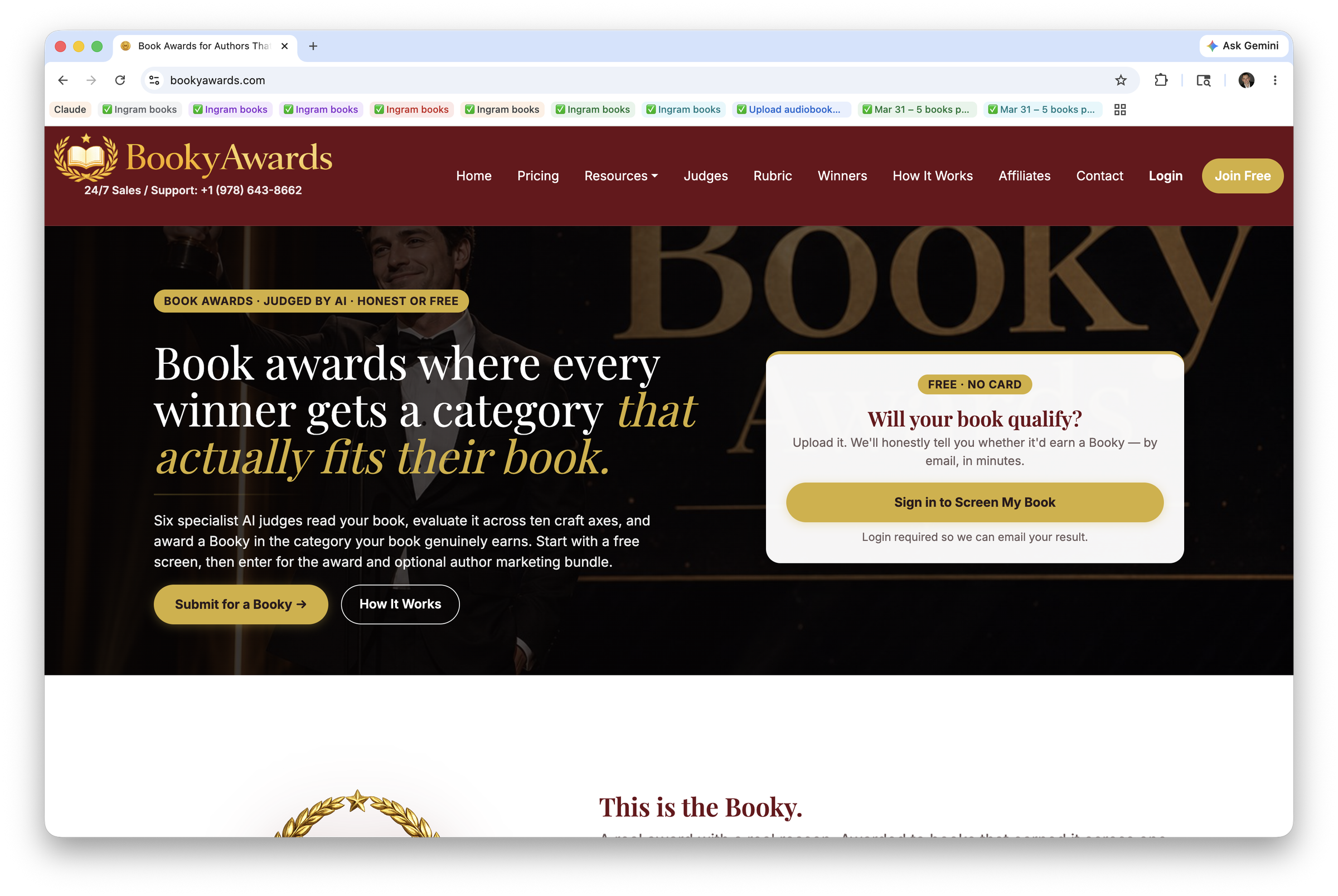
https://www.bookyawards.com has launched a book award platform built around a premise most award programs avoid: not every book qualifies. BookyAwards uses a panel of genre-specialist AI judges to evaluate submitted manuscripts across ten craft dimensions — dialogue, prose, characterization, plot, world-building, and others — and awards a category-specific Booky only to books that genuinely earn one. Roughly 25 percent of submissions are rejected, a threshold the platform's founder deliberately calibrates and considers a feature, not a flaw. The service is live now, with per-book entry starting at $39 and a free pre-submission screen available at no cost and with no credit card required.
The book award market has a credibility problem that authors and readers both recognize. Many existing award programs function more as vanity services than quality signals — accepting nearly every submission and issuing generic plaques that carry little weight with readers. For self-published and independently released authors, the absence of a trustworthy third-party credential creates a specific marketing gap: readers encountering an unfamiliar title have no reliable signal to move them from consideration to purchase. BookyAwards was built to fill that gap by making the rejection rate part of the value proposition. An award that turns away a quarter of its applicants carries more weight than one that doesn't. The platform targets authors who want a credibility marker early in their marketing funnel — before heavy ad spend, before a book launch push — placed on a book's web page or description where it can influence a buying decision at the moment of consideration.
The judging architecture is built around specialization rather than generality. Five named AI judges each cover a distinct domain: Eleanor Whitcombe handles literary fiction, prose, and style; Marcus Thorne covers thriller, mystery, and suspense; Dr. Aiyana Reyes evaluates science fiction, fantasy, and horror; Vivienne Park judges romance and women's fiction; and Arthur Beaumont assesses non-fiction, memoir, and business. A sixth generalist judge handles edge cases. When a manuscript is submitted, it is routed to the appropriate specialist. According to Bo Bennett, the platform's founder, smaller specialized agents produce more accurate evaluations than a single generalist model because they carry less memory overhead and are less prone to confusion across genre conventions. Each judge reads the manuscript end-to-end and produces a written rationale for the award or the rejection.
The evaluation is holistic rather than checklist-based. A book that excels in one dimension — say, dialogue — but is weak across prose, grammar, or overall construction will not earn a Booky on the strength of that single element. Conversely, a book that performs consistently across multiple axes earns a category-specific award reflecting its actual strongest dimension, not a generic "winner" designation. Every award page publishes the rubric scores used to reach the decision, making the process auditable. Authors and readers can disagree with the judges' taste; they cannot dispute that a scoring process was applied and documented. A permanent award page at a fixed URL is generated for each winner, displaying the judge's quoted reasoning alongside the author's name and book title.
The platform's competitive distinction is structural. Most book awards assign a single judge or a small panel to evaluate across all genres, introduce inconsistency across categories, and rarely publish their scoring criteria. BookyAwards publishes its rubric, names its judges, discloses that they are AI, and ties the award's long-term value explicitly to its rejection rate. Bennett has stated publicly that accepting low-quality books would destroy the award's value and that he views long-term credibility as more important than short-term submission revenue — a trade-off most award programs are not designed to make.
"If we accept low quality books, then the value of the award would be very low — and that's more important than some quick cash," said Bo Bennett, Owner and Founder, BookyAwards.
The primary audience is self-published and independently released authors who lack access to the gatekeeping infrastructure — major publisher imprints, established review outlets, traditional award bodies — that signals quality to retail readers. A Booky badge and permanent award page give those authors a documented, third-party credential they can place on a book's Amazon or retail description, author website, or promotional materials before committing to a paid marketing campaign. The free screen option allows authors to upload a manuscript and receive an honest qualification assessment by email within minutes, before any money changes hands. This makes the platform accessible to authors at any budget level for the initial evaluation step, with a paid entry required only if the author chooses to proceed to full judging and award issuance.
BookyAwards offers two paid tiers with per-book pricing and volume discounts up to 50 percent for purchases of up to 100 entries in a single transaction. The base Booky Award tier is priced at $39 per book and includes full ten-axis judging by the relevant specialist judge, a permanent award page, a PDF certificate, and an embeddable badge. The Author Bundle is priced at $129 per book and adds a custom press release written for the winning book, an eight-graphic social media bundle, a 30-second AI-narrated audio reel, a cover variant incorporating the award badge, and entry into an annual Book of the Year shortlist. Both tiers carry the platform's "honest or free" guarantee: if the judges cannot find a category the book genuinely earns, the entry fee is refunded. A real published book with a valid ASIN or ISBN is required for submission.
BookyAwards is part of a broader suite of author-facing tools developed under Archieboy Holdings, which has been serving authors since 2011 across more than 50 tool websites. The award platform is positioned as an early-funnel instrument — a credibility signal that precedes, rather than follows, marketing investment. Future calibration of the rejection threshold will be driven by observed pass rates; Bennett has indicated he would adjust the AI's evaluation parameters if the 25 percent rejection rate drifts significantly in either direction, preserving the signal value of the award over time. The platform's architecture — specialist agents, published rubrics, permanent award pages — is designed to scale across submission volume without degrading evaluation consistency, which positions it for expansion into additional genre categories and award dimensions as the catalog grows.
BookyAwards is an AI-powered book award platform at https://www.bookyawards.com, built to give authors a credible, category-specific quality signal they can use before and during book marketing. The platform is operated by Archieboy Holdings, founded by Bo Bennett, which has supported authors through more than 50 tool websites since 2011. BookyAwards judges manuscripts using genre-specialist AI judges across ten craft dimensions, publishes its scoring rubric for every award, and refunds entry fees when no award can be honestly issued. Authors can begin with a free manuscript screen at https://www.bookyawards.com with no payment information required.
