Boston, MA — 2026-10-28
Bo Bennett Releases 'The Household Chief,' a Family's Four-Month Test of an AI Agent Running Home
The 61-page book logs what the AI agent Duncan got right, where it failed, and the rules the family wrote after each mistake
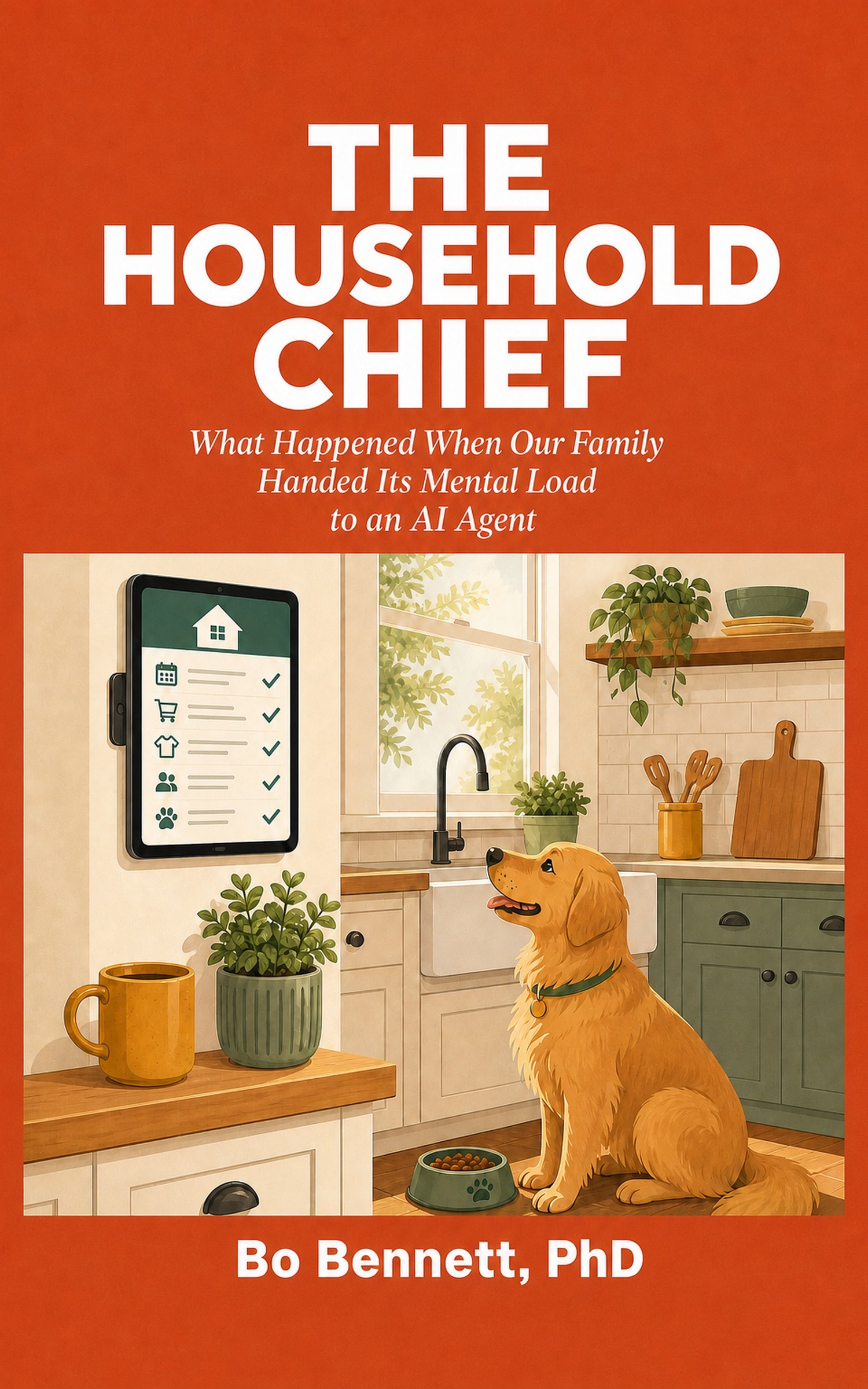
Bo Bennett, PhD, has released The Household Chief: What Happened When Our Family Handed Its Mental Load to an AI Agent, a 61-page account of four months in which his family gave the work of remembering to an AI agent named Duncan. The book is free to read and download at https://www.privatechief.com/book#household (ISBN 9781456689346) in the House & Home category. It reports what the agent handled, what it got wrong, and the rules the family adopted after each failure. Rather than a general argument about artificial intelligence, the book is a record of one real household's experience, written for readers who want to know what delegating domestic logistics to software involves in practice.
The premise is that every household carries a job that never appears on a chore list: remembering. Someone has to know that the tire appointment is due, that a warranty expires on the 30th, that the pool company has stopped answering, and whether anyone fed the dog. This invisible coordination work, often called the mental load, tends to fall on one or two people in a home and rarely gets named or measured. Bennett's book treats it as a delegable function and asks a practical question: how much of it can an AI agent take on, and what does the family have to do to make that arrangement safe and useful?
According to the book, Duncan booked the family's tires, chased down the warranty, and arranged for trees to be cut back from the power lines. It also watched the family's empty house from a thousand miles away and sent a one-minute briefing every morning. None of these tasks is exotic. Together they are the kind of follow-up that usually slips because no single item is urgent until it suddenly is. The book describes how each errand was handed off, how Duncan reported back, and what the family had to supply for the work to be finished rather than merely started.
The account does not stop at the successes. Duncan looked in the wrong place for information. It told the family a car was locked when it was not. In one case it filed one person's words in another person's memory, a privacy and accuracy failure that matters in any house with more than one occupant. Bennett writes that every one of those mistakes became a rule, and he calls the resulting rules the most useful part of the book. Readers get the failures alongside the fixes, which allows them to anticipate similar problems before relying on an agent for tasks with real consequences.
The book is organized around questions a household would face when setting up an agent of its own. It covers what an AI agent can genuinely take off a person's plate and identifies five household jobs that should stay with people. It explains how to hand off an errand so that it gets done, and when to tell the agent to stop. It makes the case that a button beats a clever sensor and advises readers to always ask how old an answer is. A section on privacy in a house full of people addresses whose words go where, drawing directly on the misfiled-memory incident.
Each chapter ends with a short "Try it now" step designed to work either with an AI agent or with a plain notebook. That choice reflects the book's stated position that the discipline of delegation matters more than any particular tool. The final section lays out three honest routes to a household chief of one's own, including doing it yourself. The book does not assume readers will buy a product or adopt a specific platform. It treats the setup as a set of decisions about scope, supervision, and trust that a family can make deliberately and revisit as it learns what the agent does well.
Much writing about household AI focuses on what assistants might do in the future or on demonstrations built for a single task. The Household Chief differs in being a retrospective on sustained use in an ordinary home over four months, with errors reported as plainly as wins. Its organizing idea is that failures are usable material: each one produced a specific rule that another household could adopt. The book also draws a line around what should not be handed over, naming five jobs that stay with people, rather than presenting delegation as an all-or-nothing proposition. That framing gives readers a boundary to test rather than a promise to accept.
"The hard part of running a home is remembering, not doing. Every mistake Duncan made became a rule, and the rules are what I'd hand any family," said Bo Bennett, PhD, author of The Household Chief.
The book is written for people who manage the logistics of a home and recognize the constant background task of keeping track. That includes parents coordinating appointments and maintenance, homeowners who travel and want to keep an eye on an empty house, and anyone who has missed a warranty deadline or lost a contractor's follow-up. The morning-briefing format described in the book is one concrete model: a single short summary of what needs attention, delivered at the same time each day. Readers who are skeptical of AI can still use the "Try it now" steps with a notebook to build the same habits of handoff, verification, and review.
The book describes how it was produced. It was drafted by an AI agent from the family's own records, then checked and rewritten by the author. That disclosure is consistent with its subject: the agent keeps a record, a human verifies it, and corrections feed back into the process. For readers evaluating how much to trust an agent's output, the production method offers a small example of the supervision model the book recommends. The family's records served as source material, and the author's review served as the control on accuracy, much as the household rules do for Duncan's daily work.
The Household Chief is available free at https://www.privatechief.com/book#household. The page carries the ISBN 9781456689346 and the book's description, and the ebook and audiobook can be downloaded there at no charge. The book runs 61 pages, so it is intended as a quick read that a household can finish and begin applying right away. Because each chapter closes with a self-contained action, readers can work through the steps one at a time without committing to a full system. Journalists seeking review access or an interview with the author can begin from the same page.
The book sits within Bennett's wider work on practical AI for households and small organizations. He is the founder of Archieboy Holdings, which runs dozens of publishing and AI services for authors, businesses, and families, including PrivateChief, an AI chief of staff for households and businesses. The Household Chief documents the household use case in narrative form, from the family's own experience, rather than as product documentation. Bennett's earlier books include Logically Fallacious. The new title extends his writing from critical thinking into the everyday question of how families can delegate administrative work without giving up oversight of it.
About Bo Bennett, PhD, and The Household Chief: Bo Bennett, PhD, is the founder of Archieboy Holdings, which runs dozens of publishing and AI services for authors, businesses, and families, including PrivateChief, an AI chief of staff for households and businesses. He is the author of Logically Fallacious and many other books. The Household Chief: What Happened When Our Family Handed Its Mental Load to an AI Agent is a 61-page House & Home title (ISBN 9781456689346). More information and free downloads are available at https://www.privatechief.com/book#household.
