Seattle, Washington — 2026-11-05
Linda Soules Releases Kids' Archaeology Guide 'So You Want To Be A Treasure Hunter (Archaeologist)'
The 38-page children's nonfiction title has won a Literary Titan Gold Award, a Purple Dragonfly Grand Prize and a CIPA EVVY Silver Award
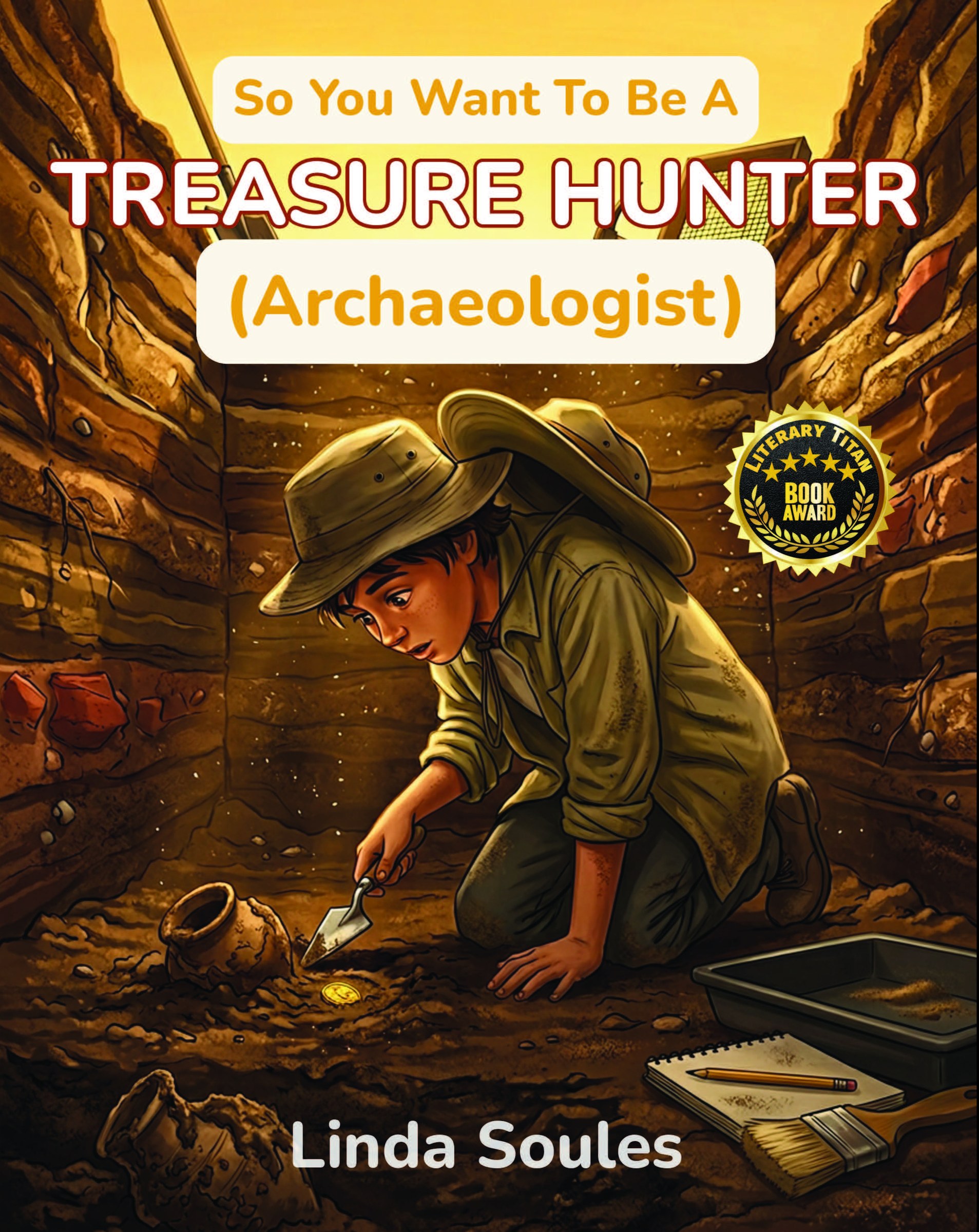
Author Linda Soules has released So You Want To Be A Treasure Hunter (Archaeologist), a 38-page children's nonfiction book that explains how working archaeologists find, study and preserve evidence of past civilizations. The book, listed at https://www.amazon.com/dp/1972766287, is subtitled A Kids' Guide to Archaeology, Ancient Civilizations, Lost Artifacts, and the Adventurous Scientists Who Uncover History Buried Beneath Our Feet. It carries the ISBN 978-1-972766-28-6. The title has already won the Literary Titan Gold Book Award, the Grand Prize at the 2026 Purple Dragonfly Book Awards and a Silver Award in Children's Nonfiction at the 2026 CIPA EVVY Book Awards. It belongs to Soules's So You Want To Be A... series of career-exploration books for readers ages 10 to 14.
Popular culture has long shaped how young people picture archaeology: hidden temples, booby traps, rolling boulders and a hero who grabs a golden idol and runs. The daily work of the profession looks very different. It involves years of study, methodical recording, laboratory analysis and a great deal of patience. Young readers who are curious about the field often have few age-appropriate sources that explain what archaeologists actually do, how they decide where to dig, or what training the career requires. Soules's book is built around that gap. It treats the film version as a starting point for curiosity and then replaces it with the real science. The book is written for the child who collects arrowheads, old coins and unidentified fragments and wants to know the story behind them.
The book walks readers through the tools and methods modern archaeologists use before and during excavation. It explains how ground-penetrating radar and remote sensing allow scientists to see beneath the surface before a single shovelful of soil is moved, which helps reduce unnecessary disturbance of a site. It also introduces stratigraphy, the study of layered soil and sediment, as the earth's own timeline. Readers learn how those layers let archaeologists read thousands of years of human activity recorded in the ground and understand why the position of an object can matter as much as the object itself. The explanations are paired with illustrations meant to make abstract ideas concrete, such as what it means for one layer to sit above another.
Later sections turn to what happens after something is found. The book addresses artifact conservation, including the question of how archaeologists keep a centuries-old object from crumbling once it is exposed to open air. It describes the physical demands of fieldwork and the intellectual detective work that turns a broken pottery shard into evidence about how a lost civilization lived. Soules frames each step as a series of real questions. What does an archaeologist do all day? How do they know where to dig? What happens in the first minutes after a discovery? The answers are written plainly and without simplification that would make older readers in the age range feel talked down to.
The book is also a career guide. It outlines what it takes to become an archaeologist, starting with the geology and history students encounter in school and continuing through fieldwork, laboratory analysis and scholarly research. It presents these as parts of a working scientist's life rather than a single dramatic moment of discovery. A section on the history of archaeology traces the field from its early days of treasure hunting to the rigorous discipline it has become, and it profiles the people who drove that change. For readers weighing future interests, the book shows how a childhood fascination with objects can connect to specific subjects, skills and professional paths.
Two features set the book apart from many children's titles on ancient history. First, it focuses on the people and methods behind discoveries rather than on a catalog of famous finds. Second, it makes the profession itself the subject, including the study, the physical labor and the lab work. The book also takes a deliberate position on tone. It does not rely on the myth of the lone adventurer, and it does not soften the fact that most of the work is slow and exacting. It still keeps a sense of wonder, using the premise that an object last touched by human hands a thousand years ago may be waiting beneath an ordinary field.
"Kids can tell when a book is simplifying the work. Real archaeology is slower and stranger than the movies, and that is exactly what makes it compelling," said Linda Soules, author of the So You Want To Be A... series.
The book is aimed first at readers ages 10 to 14 who are starting to ask what they might do with their interests. A student who already collects rocks, coins or pottery fragments can use it to see how that habit connects to a profession. A classroom teacher or school librarian can use it alongside units on ancient civilizations, geology or the scientific method, since it explains how evidence is gathered and interpreted. Parents looking for nonfiction that encourages independent reading may find it useful for the same reason. Because the series is written to be read by adults too, the book also works as a shared read-aloud, with the radar, stratigraphy and conservation sections offering natural points for discussion.
So You Want To Be A Treasure Hunter (Archaeologist) is available through its Amazon listing at https://www.amazon.com/dp/1972766287. The listing identifies the title by its ISBN, 978-1-972766-28-6, which readers, libraries and bookstores can use to locate the book. Current pricing, available formats and shipping details appear on the listing and may change, so interested buyers should check it directly for the latest information. No subscription, account or special access is required beyond a standard Amazon purchase. Educators and librarians who want to confirm the book's genre, page count or award history before ordering can find that information in the listing's description.
The archaeology title is one entry in a series that Soules envisions spanning more than 180 books in total. More than 60 have been published so far, and new releases continue on a steady cadence. The series covers a wide range of careers, from astronauts and marine biologists to magicians, stunt performers and roller coaster designers. Each book is written to pull back the curtain on a real occupation, including its rewards, its difficulties and the path to reach it. The awards recognizing this volume suggest that readers and judges respond to that format, and the series model allows a young reader who finishes one book to move directly to a related one.
Before turning to children's publishing, Soules spent 25 years in law and finance, advising hedge funds and sophisticated financial institutions on legal and regulatory matters. She says that career taught her precision and discipline, along with how to translate intricate subjects into language anyone can use. She applies that approach to the series, where technical topics such as remote sensing or artifact conservation are explained step by step. Her stated philosophy is that young readers are smarter, more curious and more capable than the publishing world often assumes, and that they deserve books that respect their intelligence while sparking real enthusiasm for the work adults do.
About Linda Soules and the So You Want To Be A... series: Linda Soules is the author and creator of the So You Want To Be A... series, a growing collection of career-exploration books for readers ages 10 to 14 and beyond. The series is envisioned to include more than 180 titles, with over 60 published to date. Each book examines a real career, including its joys, its challenges and the path to get there. Soules previously worked for 25 years in law and finance. Information on So You Want To Be A Treasure Hunter (Archaeologist) is available at https://www.amazon.com/dp/1972766287.
